|
About This Author
Come closer.
|
Complex Numbers
Complex Numbers
A complex number is expressed in the standard form a + bi, where a and b are real numbers and i is defined by i^2 = -1 (that is, i is the square root of -1). For example, 3 + 2i is a complex number.
The bi term is often referred to as an imaginary number (though this may be misleading, as it is no more "imaginary" than the symbolic abstractions we know as the "real" numbers). Thus, every complex number has a real part, a, and an imaginary part, bi.
Complex numbers are often represented on a graph known as the "complex plane," where the horizontal axis represents the infinity of real numbers, and the vertical axis represents the infinity of imaginary numbers. Thus, each complex number has a unique representation on the complex plane: some closer to real; others, more imaginary. If a = b, the number is equal parts real and imaginary.
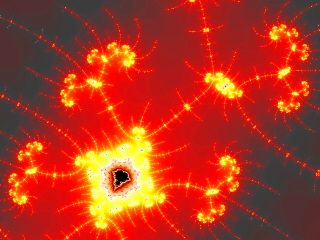
Very simple transformations applied to numbers in the complex plane can lead to fractal structures of enormous intricacy and astonishing beauty.
January 14, 2023 at 12:03am January 14, 2023 at 12:03am
| |
Periodically, as I've noted before, I find articles bloviating about things that science fiction authors have "predicted." This is misleading, because unless it was a sealed prediction opened some years later, it's more like they dreamed it up, or someone invented something based on an idea they saw in SF.
Today's article is a refreshing change from that because of how the headline is worded.
Ideas can come from all sorts of places, and inspiration can hit in a flash—think of Archimedes supposedly yelling “Eureka! Eureka!” in the bath when he realized that irregular items could be accurately measured through water displacement.
Probably apocryphal, but for whatever reason, we love our narratives about inspirational flashes. Like that one, or Newton's apple.
But sometimes, it’s fiction, not reality, that provides the spark of inspiration. There are sci-fi tales, for example, that have gone beyond predicting technological advancements to directly inspiring scientific progress, from robotics to rocketry and everything in between.
And they just lost my good will from the headline by using "predicting" here.
In any case, I'm not going to copy all of them here, just the ones I want to comment on.
1. The Taser // Victor Appleton’s Tom Swift and His Electric Rifle
Written under a pen name and published in 1911 by the Stratemeyer Syndicate (which also published the Nancy Drew and Hardy Boys novels), Tom Swift and His Electric Rifle sees the titular character invent a weapon that looks like an ordinary rifle but fires bolts of electricity. The book was a childhood favorite of Jack Cover and partly inspired the creation of his own electroshock weapon: The Taser.
That might have been the ultimate origin; I don't know of any stun devices in SF before that (the genre hadn't been around for even 100 years at that point, anyway). But the idea took off in a big way in SF and, especially, space operas; the ray gun, or zapper, or whatever, became a staple. Perhaps the most famous version was Star Trek's phaser. Now, this article goes on to note that "TASER" stands for "Thomas A. Swift’s Electric Rifle," and other sources back that up—but it was invented starting in 1969, three years after the first Star Trek episode featuring phasers. And phasers, of course, took their name inspiration from the laser.
My only point here being that many inventions have more than just one inspiration.
2. Helicopters // Jules Verne’s Robur the Conqueror
Leonardo came up with a helicopter concept first. In fairness, though, his wouldn't have flown.
3. The World Wide Web // Arthur C. Clarke’s “Dial F for Frankenstein”
Without Arthur C. Clarke’s 1960s-era short story “Dial F for Frankenstein,” there might be no World Wide Web as we know it. The sci-fi story is about a global, interconnected telephone network that gains sentience—and it served as one of Tim Berners-Lee’s inspirations when he created the Web while working at CERN in the 1980s.
I'm always amazed at the number of people who, after reading a science fiction story that warns "under no circumstances should we invent this thing," go on to invent that thing.
7. Investigating the Habitability of Mars // Ray Bradbury’s The Martian Chronicles and The Illustrated Man
Physicist Peter H. Smith, professor emeritus at the Lunar and Planetary Laboratory of the University of Arizona, attributes his initial interest in extraterrestrial worlds to Ray Bradbury’s sci-fi stories, including those in The Martian Chronicles (1950) and The Illustrated Man (1951).
Okay, fine, but let's remember that Bradbury himself was inspired by earlier Mars stories, which in turn were inspired by even earlier Mars stories, etc. Not all of them were science fiction. Hell, Bradbury is only marginally science fiction; he was more interested in poetic prose than in the science behind things. Nothing wrong with that—he was certainly awesome and inspiring; this isn't meant to rag on him at all.
11. Remote Manipulators // Robert Heinlein’s “Waldo”
Published under the pseudonym Anson MacDonald, Robert Heinlein’s short story “Waldo” is about a scientist named Waldo Farthingwaite-Jones who invents a device to help him manage his degenerative muscle disease. His machine can perfectly mimic his hand movements, but with greater strength and from a distance. This device is essentially a remote manipulator, also known as a telefactor. Because of Heinlein’s story, some call the mechanism—which, according to Fundamentals of Robot Mechanics, “usher[ed] in the era of teleoperators”—a “waldo.”
I'm mostly including this one because the term "waldo" is a legitimate word for this technology, and I get the impression many people don't know where it comes from. Heinlein didn't actually come up with the idea for the remote manipulator; he in turn was inspired by earlier writings. But the name is all Heinlein.
If I had to take a stab at which science fiction author was most influential in terms of real-life invention, Heinlein would be in the top 5. He's often credited with the ideas behind the waterbed (Stranger in a Strange Land), and computer-aided design (The Door into Summer), just to name two other examples.
It would be wrong to say that any of these writers "invented" the technology they inspired. Invention requires far more detailed design work than most SF writers need to go into, especially in their stories; that would get really boring really quickly, like Melville's detailed descriptions of whaling in Moby Dick. But this is the way things get invented in the first place: it always starts with an idea (or, some might say, a Platonic ideal) which only gradually makes its way through mind and sweat to consensus reality. Who gets the credit? Well, in my personal opinion, the inventor gets the bulk of the credit because they're the one who made it work. But there's good reason to acknowledge the source of one's inspiration. |
© Copyright 2025 Robert Waltz (UN: cathartes02 at Writing.Com). All rights reserved.
Robert Waltz has granted InkSpot.Com, its affiliates and its syndicates non-exclusive rights to display this work.
|



 I'm more than happy with Carrion Luggage, however.


 Comment • View 3 comments
![Merit Badge in Quill Award
[Click For More Info]
Congratulations on winning Best Blog in the 2021 edition of [Link To Item #quills] !](https://images.Writing.Com/imgs/writing.com/writers/badges/group-Quill_Award-1375927_6.gif)
![Merit Badge in Quill Award 2
[Click For More Info]
2022 Quill Award - Best Blog - [Link To Item #1196512] . Congratulations!!!](https://images.Writing.Com/imgs/writing.com/writers/badges/group-Quill_Award_2-1375927_6.gif)
![Merit Badge in 30DBC Winner
[Click For More Info]
Congratulations on winning the Jan. 2019 [Link To Item #30dbc] !!](https://images.Writing.Com/imgs/writing.com/writers/badges/group-30DBC_Winner-2064535_14.gif)
![Merit Badge in Blogging
[Click For More Info]
Congratulations on winning an honorable mention for Best Blog at the 2018 Quill Awards for [Link To Item #1196512] . *^*Smile*^* This award was sponsored by the blogging consortium including [Link To Item #30dbc] , [Link To Item #blogcity] , [Link To Item #bcof] and [Link To Item #1953629] . For more details, see [Link To Item #quills] .](https://images.Writing.Com/imgs/writing.com/writers/badges/type-Blogging-2180.gif)
![Merit Badge in Highly Recommended
[Click For More Info]
I highly recommend your blog.](https://images.Writing.Com/imgs/writing.com/writers/badges/Kudos-Highly_Recommended.gif)
![Merit Badge in Opinion
[Click For More Info]
For diving into the prompts for Journalistic Intentions- thanks for joining the fun!](https://images.Writing.Com/imgs/writing.com/writers/badges/genre-Opinion-1150.gif)
![Merit Badge in High Five
[Click For More Info]
For your inventive entries in [Link To Item #2213121] ! Thanks for the great read!](https://images.Writing.Com/imgs/writing.com/writers/badges/Kudos-High_Five.gif)
![Merit Badge in Enlightening
[Click For More Info]
For winning 3rd Place in [Link To Item #2213121] . Congratulations!](https://images.Writing.Com/imgs/writing.com/writers/badges/general-Enlightening.gif)
![Merit Badge in Quarks Bar
[Click For More Info]
For your awesome Klingon Bloodwine recipe from [Link to Book Entry #1016079] that deserves to be on the topmost shelf at Quark's.](https://images.Writing.Com/imgs/writing.com/writers/badges/group-Quarks_Bar-2046190_12.gif)