|
About This Author
Come closer.
|
Complex Numbers
Complex Numbers
A complex number is expressed in the standard form a + bi, where a and b are real numbers and i is defined by i^2 = -1 (that is, i is the square root of -1). For example, 3 + 2i is a complex number.
The bi term is often referred to as an imaginary number (though this may be misleading, as it is no more "imaginary" than the symbolic abstractions we know as the "real" numbers). Thus, every complex number has a real part, a, and an imaginary part, bi.
Complex numbers are often represented on a graph known as the "complex plane," where the horizontal axis represents the infinity of real numbers, and the vertical axis represents the infinity of imaginary numbers. Thus, each complex number has a unique representation on the complex plane: some closer to real; others, more imaginary. If a = b, the number is equal parts real and imaginary.
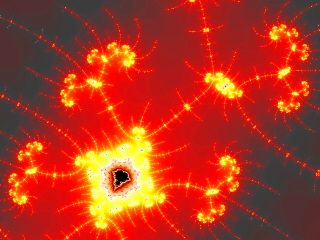
Very simple transformations applied to numbers in the complex plane can lead to fractal structures of enormous intricacy and astonishing beauty.
January 28, 2007 at 7:07pm January 28, 2007 at 7:07pm
| |
One of my great revelations in life was when it came to me that those things we call "creation" and "destruction" are not antonyms; that, in point of fact, they are one and the same thing. Certainly I'd heard this expressed before, but it's one thing to hear somebody say it in relation to some form of mysticism, and another to have its reality punch you in the gut. They're not just "two sides of the same coin," I realized; they ARE the coin, yin and yang, two heads, two tails.
So much of our worldview is dictated by language. Did what we call "intelligence" in humans predate the development of language, or was it the other way around? Or, alternatively, was it all part of the same evolutionary development? In any event, we insist on calling this event a "creation" and that other event a "destruction." But I can't imagine an instance of creation that does not also involve destruction. If I write on a piece of paper, creating a poem, I destroy the configuration of the paper and whatever I use to write it. If I got my hands on high explosives and blew something up, I would create a mess (and light, heat, noise, and legal trouble). Even if I only create something in my mind - an idea, or whatever - it destroys whatever neural configuration was there before (or however memory works).
Whether we call some event a creation or a destruction is a matter of the value we place on whatever is being created or destroyed.
Today has just been one of those days when my mind refuses to stop dwelling on the past, on all that I've lost along the way. But can I apply the semantic gymnastics above to the loss/gain relationship? Can we really lose or gain anything without gaining or losing something else? I suppose it's all in how you look at it. "Loss" has negative connotations - except, maybe, when it comes to losing weight. "Gain" has positive connotations, but certainly it's possible to gain something undesirable, like a tumor or, somewhat less malignantly, a traffic citation.
Can it really be all in how we look at things? Certainly there are absolutes, but so much of our experience is polarized through this half-empty vs. half-full filter. The optimists have been telling me this all along, but I don't listen to optimists; I don't trust anyone who smiles all the time. |
© Copyright 2025 Robert Waltz (UN: cathartes02 at Writing.Com). All rights reserved.
Robert Waltz has granted InkSpot.Com, its affiliates and its syndicates non-exclusive rights to display this work.
|



 I'm more than happy with Carrion Luggage, however.


 Comment • View 7 comments
![Merit Badge in Quill Award
[Click For More Info]
Congratulations on winning Best Blog in the 2021 edition of [Link To Item #quills] !](https://images.Writing.Com/imgs/writing.com/writers/badges/group-Quill_Award-1375927_6.gif)
![Merit Badge in Quill Award 2
[Click For More Info]
2022 Quill Award - Best Blog - [Link To Item #1196512] . Congratulations!!!](https://images.Writing.Com/imgs/writing.com/writers/badges/group-Quill_Award_2-1375927_6.gif)
![Merit Badge in 30DBC Winner
[Click For More Info]
Congratulations on winning the Jan. 2019 [Link To Item #30dbc] !!](https://images.Writing.Com/imgs/writing.com/writers/badges/group-30DBC_Winner-2064535_14.gif)
![Merit Badge in Blogging
[Click For More Info]
Congratulations on winning an honorable mention for Best Blog at the 2018 Quill Awards for [Link To Item #1196512] . *^*Smile*^* This award was sponsored by the blogging consortium including [Link To Item #30dbc] , [Link To Item #blogcity] , [Link To Item #bcof] and [Link To Item #1953629] . For more details, see [Link To Item #quills] .](https://images.Writing.Com/imgs/writing.com/writers/badges/type-Blogging-2180.gif)
![Merit Badge in Highly Recommended
[Click For More Info]
I highly recommend your blog.](https://images.Writing.Com/imgs/writing.com/writers/badges/Kudos-Highly_Recommended.gif)
![Merit Badge in Opinion
[Click For More Info]
For diving into the prompts for Journalistic Intentions- thanks for joining the fun!](https://images.Writing.Com/imgs/writing.com/writers/badges/genre-Opinion-1150.gif)
![Merit Badge in High Five
[Click For More Info]
For your inventive entries in [Link To Item #2213121] ! Thanks for the great read!](https://images.Writing.Com/imgs/writing.com/writers/badges/Kudos-High_Five.gif)
![Merit Badge in Enlightening
[Click For More Info]
For winning 3rd Place in [Link To Item #2213121] . Congratulations!](https://images.Writing.Com/imgs/writing.com/writers/badges/general-Enlightening.gif)
![Merit Badge in Quarks Bar
[Click For More Info]
For your awesome Klingon Bloodwine recipe from [Link to Book Entry #1016079] that deserves to be on the topmost shelf at Quark's.](https://images.Writing.Com/imgs/writing.com/writers/badges/group-Quarks_Bar-2046190_12.gif)