|
About This Author
Come closer.
|
Complex Numbers
Complex Numbers
A complex number is expressed in the standard form a + bi, where a and b are real numbers and i is defined by i^2 = -1 (that is, i is the square root of -1). For example, 3 + 2i is a complex number.
The bi term is often referred to as an imaginary number (though this may be misleading, as it is no more "imaginary" than the symbolic abstractions we know as the "real" numbers). Thus, every complex number has a real part, a, and an imaginary part, bi.
Complex numbers are often represented on a graph known as the "complex plane," where the horizontal axis represents the infinity of real numbers, and the vertical axis represents the infinity of imaginary numbers. Thus, each complex number has a unique representation on the complex plane: some closer to real; others, more imaginary. If a = b, the number is equal parts real and imaginary.
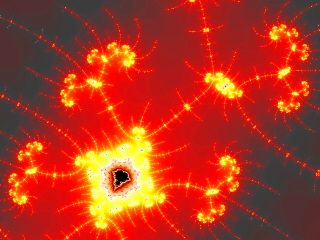
Very simple transformations applied to numbers in the complex plane can lead to fractal structures of enormous intricacy and astonishing beauty.
October 21, 2008 at 7:44pm October 21, 2008 at 7:44pm
| |
I went to a county Planning Commission meeting this evening. I have to do that sometimes for my work.
Before they got to my part of the agenda, though, they had to hear a report from this group who claims to be putting together a report about what a "sustainable" population number is for the city/county area. This report is partly funded by our local tax dollars, and presumably the localities (in Virginia, city and county are separate entities) will take it seriously as a public policy tool.
Leaving aside for the moment the definition of "sustainable" - I've been in this business nearly 20 years and nobody's been able to give me one I can understand - let's think about the BASIC PREMISE here.
The basic premise is that you can take an arbitrary unit of geography - in this case, a county containing a city - and determine whether it's biologically sustainable, given the natural resources, waste absorption capacity, and human population. And THEN that you can take the sustainability population number and make public policy to limit, restrict, and/or reverse growth based on that number.
Do you see the fallacy here?
Let's draw an arbitrary box around some geographical area. In fact, let's extend this to every region in the country, or the world, and draw a LOT of arbitrary boxes. Within each of those boxes, create public policy to say: X is the biological capacity, N is the current population, and we need to make N <= X.
If one of those arbitrary boxes contains the five boroughs of New York... is there anyone who thinks that N<=X there? Doubt it. How about the arbitrary box that contains 640 acres of farmland in Kansas somewhere - is N>X there? Um, no.
The whole POINT of our civilization - a word meaning "the art of living in cities" - is that x acres of farmland SOMEWHERE ELSE support n people in a CITY, people who then respond by sending the farmers money and heaps of scorn. Scorn for corn - hey, I like that.
So, MY tax dollars are going to fund a study whose premise is fundamentally flawed.
I love government.  |
© Copyright 2025 Robert Waltz (UN: cathartes02 at Writing.Com). All rights reserved.
Robert Waltz has granted InkSpot.Com, its affiliates and its syndicates non-exclusive rights to display this work.
|



 I'm more than happy with Carrion Luggage, however.


 Comment • View 6 comments

![Merit Badge in Quill Award
[Click For More Info]
Congratulations on winning Best Blog in the 2021 edition of [Link To Item #quills] !](https://images.Writing.Com/imgs/writing.com/writers/badges/group-Quill_Award-1375927_6.gif)
![Merit Badge in Quill Award 2
[Click For More Info]
2022 Quill Award - Best Blog - [Link To Item #1196512] . Congratulations!!!](https://images.Writing.Com/imgs/writing.com/writers/badges/group-Quill_Award_2-1375927_6.gif)
![Merit Badge in 30DBC Winner
[Click For More Info]
Congratulations on winning the Jan. 2019 [Link To Item #30dbc] !!](https://images.Writing.Com/imgs/writing.com/writers/badges/group-30DBC_Winner-2064535_14.gif)
![Merit Badge in Blogging
[Click For More Info]
Congratulations on winning an honorable mention for Best Blog at the 2018 Quill Awards for [Link To Item #1196512] . *^*Smile*^* This award was sponsored by the blogging consortium including [Link To Item #30dbc] , [Link To Item #blogcity] , [Link To Item #bcof] and [Link To Item #1953629] . For more details, see [Link To Item #quills] .](https://images.Writing.Com/imgs/writing.com/writers/badges/type-Blogging-2180.gif)
![Merit Badge in Highly Recommended
[Click For More Info]
I highly recommend your blog.](https://images.Writing.Com/imgs/writing.com/writers/badges/Kudos-Highly_Recommended.gif)
![Merit Badge in Opinion
[Click For More Info]
For diving into the prompts for Journalistic Intentions- thanks for joining the fun!](https://images.Writing.Com/imgs/writing.com/writers/badges/genre-Opinion-1150.gif)
![Merit Badge in High Five
[Click For More Info]
For your inventive entries in [Link To Item #2213121] ! Thanks for the great read!](https://images.Writing.Com/imgs/writing.com/writers/badges/Kudos-High_Five.gif)
![Merit Badge in Enlightening
[Click For More Info]
For winning 3rd Place in [Link To Item #2213121] . Congratulations!](https://images.Writing.Com/imgs/writing.com/writers/badges/general-Enlightening.gif)
![Merit Badge in Quarks Bar
[Click For More Info]
For your awesome Klingon Bloodwine recipe from [Link to Book Entry #1016079] that deserves to be on the topmost shelf at Quark's.](https://images.Writing.Com/imgs/writing.com/writers/badges/group-Quarks_Bar-2046190_12.gif)