|
About This Author
Come closer.
|
Complex Numbers
Complex Numbers
A complex number is expressed in the standard form a + bi, where a and b are real numbers and i is defined by i^2 = -1 (that is, i is the square root of -1). For example, 3 + 2i is a complex number.
The bi term is often referred to as an imaginary number (though this may be misleading, as it is no more "imaginary" than the symbolic abstractions we know as the "real" numbers). Thus, every complex number has a real part, a, and an imaginary part, bi.
Complex numbers are often represented on a graph known as the "complex plane," where the horizontal axis represents the infinity of real numbers, and the vertical axis represents the infinity of imaginary numbers. Thus, each complex number has a unique representation on the complex plane: some closer to real; others, more imaginary. If a = b, the number is equal parts real and imaginary.
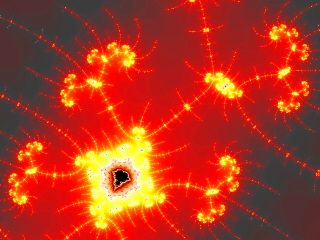
Very simple transformations applied to numbers in the complex plane can lead to fractal structures of enormous intricacy and astonishing beauty.
October 30, 2007 at 6:29pm October 30, 2007 at 6:29pm
| |
I had a meeting at an architect's office to finish off my work day. Consequently, I took a different way home than usual.
A few blocks from my street, I came upon a squirrel struggling in the middle of the other lane. It was sliding around, propelled by its front legs, leaving a trail of blood. I figured someone had hit it - squirrels around here are suicidal once the first frost hits; either they're frantically trying to score a last few nuts for their stash, or they've given it up as a lost cause and started playing chicken with cars just to end it all before they starve to death.
This one was still barely alive, obviously. A white Honda had stopped before it, in the oncoming lane. I slowed down on general principles but kept going.
I've encountered badly damaged squirrels before. One of them once dragged its ass (literally) into my front yard and collapsed there, still breathing but unable to move further. In that case, I'd grabbed a shovel and Kevorkianed the poor thing with a quick strike to the neck, then used the same shovel to give it a decent burial under my dogwood tree.
Once, when I was driving home along yet another route, I passed by a kitten struggling similarly in the street, its hindquarters immobile. It was a couple miles from my house. Someone was kneeling by it, her hand on its head. As I came closer, I saw that the someone was my wife. I turned around illegally and parked. By that time a cop had come by and was asking whose cat it was. Some of the neighbors had come out and were watching, concerned. No one admitted to belonging to the cat, though one of the neighbors, who was obviously mentally challenged in some way, said he'd seen the cat around.
My wife took matters into her own hands and scooped up the cat, who in its agony tried to bite her. She'd called the vet and they agreed to stay open until she got there - about a mile and a half from the incident. Depositing the injured kitty into a crate from her trunk, she slid it into her passenger seat and drove off, one hand on the cat's head, regardless of any further bites.
But the cat didn't bite her; nor would it bite anyone ever again. She died on the way to the vet, her last sensation a human hand caressing her head.
We've all passed dead animals in the road, I know - some more recent than others. Dogs, cats, rabbits, opossums, squirrels... once I saw a human I thought was dead, but upon summoning the appropriate authorities, it turned out he was merely dead drunk. Usually, I mutter something like, "Poor kitty," hoping that its end was swift, which is as close as I get to prayer, though I know it's very often not - as with my squirrel today.
The Honda backed up, I saw in my sideview mirror, and deliberately ran over the doomed squirrel's head, performing a crude, but presumably effective, euthanasia.
Halloween - Samhain - is traditionally a time to reflect on the end part of the cycle of life, that which binds all of us living things together whether we know it or not. Some living things, notably humans, are aware of this part of life. Morbidly aware. It permeates us. Without death or, more precisely, without the knowledge of our own and our loved ones' inescapable deaths, we wouldn't be what we are. We couldn't love as deeply as we do. We couldn't hate as passionately as we do. We couldn't laugh as heartily as we do, for laughter is essentially a way to ease the pain of mortality. And we are all aware that in order for us to live, something has to die - and this is as true for vegetarians as it is for us carnivores, for the life of a carrot is no less real than the life of a squirrel, or a kitten, or a baby.
There's a book by Samuel Delany called Dhalgren. I read it when I was entirely too young to read it. It's a massive allegory about life, death and what happens in between - and about a bunch of other stuff that I didn't comprehend then and barely comprehend now. The main character, who I don't remember being called anything but "The Kid," occasionally has the thought pop into his mind: "Someday, I will die."
Someday, I will die.
In the meantime, I'm damn well going to live. |
October 30, 2007 at 3:31pm October 30, 2007 at 3:31pm
| |
5 Scientific Reasons a Zombie Apocalypse Could Actually Happen
We found out recently that if you try to leave a little kid in a graveyard late at night, he'll freak out. Even if you offer to leave him a gun to protect himself. Why? It's because on some instinctual level, all humans know it's just a matter of time until the zombies show up.
http://www.cracked.com/article_15643_5-scientific-reasons-zombie-apocalypse-coul... |
© Copyright 2025 Robert Waltz (UN: cathartes02 at Writing.Com). All rights reserved.
Robert Waltz has granted InkSpot.Com, its affiliates and its syndicates non-exclusive rights to display this work.
|



 I'm more than happy with Carrion Luggage, however.


 Comment • View 3 comments
![Merit Badge in Quill Award
[Click For More Info]
Congratulations on winning Best Blog in the 2021 edition of [Link To Item #quills] !](https://images.Writing.Com/imgs/writing.com/writers/badges/group-Quill_Award-1375927_6.gif)
![Merit Badge in Quill Award 2
[Click For More Info]
2022 Quill Award - Best Blog - [Link To Item #1196512] . Congratulations!!!](https://images.Writing.Com/imgs/writing.com/writers/badges/group-Quill_Award_2-1375927_6.gif)
![Merit Badge in 30DBC Winner
[Click For More Info]
Congratulations on winning the Jan. 2019 [Link To Item #30dbc] !!](https://images.Writing.Com/imgs/writing.com/writers/badges/group-30DBC_Winner-2064535_14.gif)
![Merit Badge in Blogging
[Click For More Info]
Congratulations on winning an honorable mention for Best Blog at the 2018 Quill Awards for [Link To Item #1196512] . *^*Smile*^* This award was sponsored by the blogging consortium including [Link To Item #30dbc] , [Link To Item #blogcity] , [Link To Item #bcof] and [Link To Item #1953629] . For more details, see [Link To Item #quills] .](https://images.Writing.Com/imgs/writing.com/writers/badges/type-Blogging-2180.gif)
![Merit Badge in Highly Recommended
[Click For More Info]
I highly recommend your blog.](https://images.Writing.Com/imgs/writing.com/writers/badges/Kudos-Highly_Recommended.gif)
![Merit Badge in Opinion
[Click For More Info]
For diving into the prompts for Journalistic Intentions- thanks for joining the fun!](https://images.Writing.Com/imgs/writing.com/writers/badges/genre-Opinion-1150.gif)
![Merit Badge in High Five
[Click For More Info]
For your inventive entries in [Link To Item #2213121] ! Thanks for the great read!](https://images.Writing.Com/imgs/writing.com/writers/badges/Kudos-High_Five.gif)
![Merit Badge in Enlightening
[Click For More Info]
For winning 3rd Place in [Link To Item #2213121] . Congratulations!](https://images.Writing.Com/imgs/writing.com/writers/badges/general-Enlightening.gif)
![Merit Badge in Quarks Bar
[Click For More Info]
For your awesome Klingon Bloodwine recipe from [Link to Book Entry #1016079] that deserves to be on the topmost shelf at Quark's.](https://images.Writing.Com/imgs/writing.com/writers/badges/group-Quarks_Bar-2046190_12.gif)