|
About This Author
Come closer.
|
Complex Numbers
Complex Numbers
A complex number is expressed in the standard form a + bi, where a and b are real numbers and i is defined by i^2 = -1 (that is, i is the square root of -1). For example, 3 + 2i is a complex number.
The bi term is often referred to as an imaginary number (though this may be misleading, as it is no more "imaginary" than the symbolic abstractions we know as the "real" numbers). Thus, every complex number has a real part, a, and an imaginary part, bi.
Complex numbers are often represented on a graph known as the "complex plane," where the horizontal axis represents the infinity of real numbers, and the vertical axis represents the infinity of imaginary numbers. Thus, each complex number has a unique representation on the complex plane: some closer to real; others, more imaginary. If a = b, the number is equal parts real and imaginary.
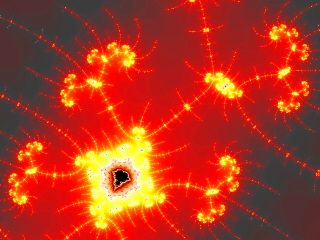
Very simple transformations applied to numbers in the complex plane can lead to fractal structures of enormous intricacy and astonishing beauty.
February 1, 2007 at 12:50pm February 1, 2007 at 12:50pm
| |
panthera: Would you agree that nothing is truly 'discovered', that it is just a question of a new awareness of this or that, which may have existed all along?... we live in a bigger world than what we are 'aware' of, proven by many 'discoveries' starting with the planet not being flat... being newly 'aware' of its real shape does not take away the fact that it always was round.
(for full text see comments to "The Father of Invention"  ) )
Thanks for the thoughtful comment, Chatty.
I like to think that my philosophy is pragmatic and realistic; that is, I don't concern myself much with the question of whether all y'all exist or not. Solipsism is an easy trap to get into, especially on the Internet, but it's also easy to get out of: I'm real, you're real; my computer is real. I'm also not "a butterfly dreaming I'm a man;" that observation strikes me as some straw-grasping from a guy who doesn't want to deal with reality. I'm willing to accept variant definitions of reality, but they all have to embrace the fact of me sitting here on my lunch break and typing in my blog; the idea that this is all illusion is simply preposterous, not worthy of consideration outside the walls of University philosophy departments and Buddhism.
Now, that doesn't mean that we don't all run around with illusions, or that these illusions don't affect our reality. That's the symbolism of all the math discussion in my blog header, if you haven't figured it out by now: the idea that there's a real part and an imaginary part, and that most of what we see isn't purely one or the other but some mixture of both.
So, yes, to me the definition of "discovery" is finding something that existed before you knew about it (as a species or an individual) AND incorporating that into your worldview. Like, for instance, I have a "Discover" card, so named because you have to run around and discover places that actually take it. They took it before I found them; I merely found what was already there, and others already knew about. Once I find them, they're on my mental list of "places that take Discover cards."
It's the "incorporating that into your worldview" that's tough for a lot of people. There are still people who think the world is flat, despite all evidence to the contrary, and despite this being known since at least as far back as Aristotle. Others deny that anyone ever walked on the Moon, or that the Holocaust happened. You can deny all you want; it doesn't change the facts - but it does change your worldview, your perception of the meaning of events (or even if events have meaning, which I'd dispute).
So I'd turn around what Chatty said: Being newly aware of the Earth's real shape doesn't take away from the fact that a lot of people have thought it was flat. And for some, even all the evidence to the contrary won't convince them.
We're just stubborn that way, we (mostly) hairless apes. |
© Copyright 2025 Robert Waltz (UN: cathartes02 at Writing.Com). All rights reserved.
Robert Waltz has granted InkSpot.Com, its affiliates and its syndicates non-exclusive rights to display this work.
|



 I'm more than happy with Carrion Luggage, however.


 Comment • View 1 comment
![Merit Badge in Quill Award
[Click For More Info]
Congratulations on winning Best Blog in the 2021 edition of [Link To Item #quills] !](https://images.Writing.Com/imgs/writing.com/writers/badges/group-Quill_Award-1375927_6.gif)
![Merit Badge in Quill Award 2
[Click For More Info]
2022 Quill Award - Best Blog - [Link To Item #1196512] . Congratulations!!!](https://images.Writing.Com/imgs/writing.com/writers/badges/group-Quill_Award_2-1375927_6.gif)
![Merit Badge in 30DBC Winner
[Click For More Info]
Congratulations on winning the Jan. 2019 [Link To Item #30dbc] !!](https://images.Writing.Com/imgs/writing.com/writers/badges/group-30DBC_Winner-2064535_14.gif)
![Merit Badge in Blogging
[Click For More Info]
Congratulations on winning an honorable mention for Best Blog at the 2018 Quill Awards for [Link To Item #1196512] . *^*Smile*^* This award was sponsored by the blogging consortium including [Link To Item #30dbc] , [Link To Item #blogcity] , [Link To Item #bcof] and [Link To Item #1953629] . For more details, see [Link To Item #quills] .](https://images.Writing.Com/imgs/writing.com/writers/badges/type-Blogging-2180.gif)
![Merit Badge in Highly Recommended
[Click For More Info]
I highly recommend your blog.](https://images.Writing.Com/imgs/writing.com/writers/badges/Kudos-Highly_Recommended.gif)
![Merit Badge in Opinion
[Click For More Info]
For diving into the prompts for Journalistic Intentions- thanks for joining the fun!](https://images.Writing.Com/imgs/writing.com/writers/badges/genre-Opinion-1150.gif)
![Merit Badge in High Five
[Click For More Info]
For your inventive entries in [Link To Item #2213121] ! Thanks for the great read!](https://images.Writing.Com/imgs/writing.com/writers/badges/Kudos-High_Five.gif)
![Merit Badge in Enlightening
[Click For More Info]
For winning 3rd Place in [Link To Item #2213121] . Congratulations!](https://images.Writing.Com/imgs/writing.com/writers/badges/general-Enlightening.gif)
![Merit Badge in Quarks Bar
[Click For More Info]
For your awesome Klingon Bloodwine recipe from [Link to Book Entry #1016079] that deserves to be on the topmost shelf at Quark's.](https://images.Writing.Com/imgs/writing.com/writers/badges/group-Quarks_Bar-2046190_12.gif)