|
About This Author
Come closer.
|
Complex Numbers
Complex Numbers
A complex number is expressed in the standard form a + bi, where a and b are real numbers and i is defined by i^2 = -1 (that is, i is the square root of -1). For example, 3 + 2i is a complex number.
The bi term is often referred to as an imaginary number (though this may be misleading, as it is no more "imaginary" than the symbolic abstractions we know as the "real" numbers). Thus, every complex number has a real part, a, and an imaginary part, bi.
Complex numbers are often represented on a graph known as the "complex plane," where the horizontal axis represents the infinity of real numbers, and the vertical axis represents the infinity of imaginary numbers. Thus, each complex number has a unique representation on the complex plane: some closer to real; others, more imaginary. If a = b, the number is equal parts real and imaginary.
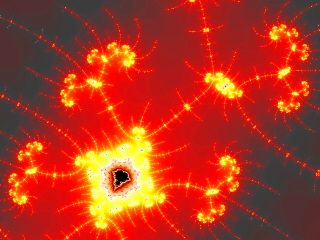
Very simple transformations applied to numbers in the complex plane can lead to fractal structures of enormous intricacy and astonishing beauty.
February 20, 2007 at 5:13pm February 20, 2007 at 5:13pm
| |
So I ran across this interesting little tidbit:
http://www.businessweek.com/ap/financialnews/D8NDHKEG0.htm
The Australian government on Tuesday announced plans to phase out incandescent light bulbs and replace them with more energy-efficient compact fluorescent bulbs across the country...
In incandescent light bulbs, perfected for mass use by Thomas A. Edison in the late 19th century, electricity flows through a filament to create light. Much of the energy, however, is wasted in the form of heat.
Australia is not the only place looking to replace them with fluorescent lighting, which is more efficient and longer lasting.
In incandescent light bulbs, perfected for mass use by Thomas A. Edison in the late 19th century, electricity flows through a filament to create light. Much of the energy, however, is wasted in the form of heat.
Note how Edison is mentioned by name as the "perfector" of incandescent light bulbs. Note also how the inventor (or perfector) of flourescent lights isn't even mentioned in passing in the story.
This isn't new. The two of them had a battle about electric current transmission, too. Edison was sure DC power was the answer. So what if there was no way, at the time, to send DC more than a few blocks without significant losses from resistance? It was the way things would be because, by damn, Edison said so! Meanwhile, the other guy found a way to send power over far vaster distances: AC transmission, enabling the power source to be significantly removed from the user. Hence, a power plant at Niagara Falls was able to supply power to New York City.
There's a statue of him on Goat Island, between Niagara's Falls. Goat Island is ephemeral; erosion will eventually push the falls upstream and make the island, and presumably the statue, disappear.
Same guy invented radio. Marconi got the popular credit, but the patent went to Nikola Tesla.
It's said that Tesla refused a Nobel prize when he found that he'd have to share it with Edison.
And now, if the trend is indeed to phase out (pun intended) incandescent bulbs in favor of flourescents... well, to me it represents the final triumph of Tesla over his blustering rival, Edison. Let there be light - cheap, clean, efficient light!
Now if they can only make them a bit less industrial-looking... |
© Copyright 2025 Robert Waltz (UN: cathartes02 at Writing.Com). All rights reserved.
Robert Waltz has granted InkSpot.Com, its affiliates and its syndicates non-exclusive rights to display this work.
|



 I'm more than happy with Carrion Luggage, however.


 Comment • View 2 comments
![Merit Badge in Quill Award
[Click For More Info]
Congratulations on winning Best Blog in the 2021 edition of [Link To Item #quills] !](https://images.Writing.Com/imgs/writing.com/writers/badges/group-Quill_Award-1375927_6.gif)
![Merit Badge in Quill Award 2
[Click For More Info]
2022 Quill Award - Best Blog - [Link To Item #1196512] . Congratulations!!!](https://images.Writing.Com/imgs/writing.com/writers/badges/group-Quill_Award_2-1375927_6.gif)
![Merit Badge in 30DBC Winner
[Click For More Info]
Congratulations on winning the Jan. 2019 [Link To Item #30dbc] !!](https://images.Writing.Com/imgs/writing.com/writers/badges/group-30DBC_Winner-2064535_14.gif)
![Merit Badge in Blogging
[Click For More Info]
Congratulations on winning an honorable mention for Best Blog at the 2018 Quill Awards for [Link To Item #1196512] . *^*Smile*^* This award was sponsored by the blogging consortium including [Link To Item #30dbc] , [Link To Item #blogcity] , [Link To Item #bcof] and [Link To Item #1953629] . For more details, see [Link To Item #quills] .](https://images.Writing.Com/imgs/writing.com/writers/badges/type-Blogging-2180.gif)
![Merit Badge in Highly Recommended
[Click For More Info]
I highly recommend your blog.](https://images.Writing.Com/imgs/writing.com/writers/badges/Kudos-Highly_Recommended.gif)
![Merit Badge in Opinion
[Click For More Info]
For diving into the prompts for Journalistic Intentions- thanks for joining the fun!](https://images.Writing.Com/imgs/writing.com/writers/badges/genre-Opinion-1150.gif)
![Merit Badge in High Five
[Click For More Info]
For your inventive entries in [Link To Item #2213121] ! Thanks for the great read!](https://images.Writing.Com/imgs/writing.com/writers/badges/Kudos-High_Five.gif)
![Merit Badge in Enlightening
[Click For More Info]
For winning 3rd Place in [Link To Item #2213121] . Congratulations!](https://images.Writing.Com/imgs/writing.com/writers/badges/general-Enlightening.gif)
![Merit Badge in Quarks Bar
[Click For More Info]
For your awesome Klingon Bloodwine recipe from [Link to Book Entry #1016079] that deserves to be on the topmost shelf at Quark's.](https://images.Writing.Com/imgs/writing.com/writers/badges/group-Quarks_Bar-2046190_12.gif)