|
About This Author
Come closer.
|
Complex Numbers
Complex Numbers
A complex number is expressed in the standard form a + bi, where a and b are real numbers and i is defined by i^2 = -1 (that is, i is the square root of -1). For example, 3 + 2i is a complex number.
The bi term is often referred to as an imaginary number (though this may be misleading, as it is no more "imaginary" than the symbolic abstractions we know as the "real" numbers). Thus, every complex number has a real part, a, and an imaginary part, bi.
Complex numbers are often represented on a graph known as the "complex plane," where the horizontal axis represents the infinity of real numbers, and the vertical axis represents the infinity of imaginary numbers. Thus, each complex number has a unique representation on the complex plane: some closer to real; others, more imaginary. If a = b, the number is equal parts real and imaginary.
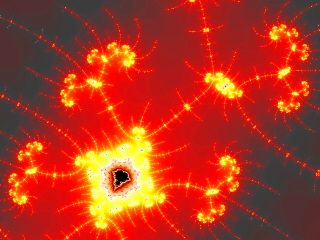
Very simple transformations applied to numbers in the complex plane can lead to fractal structures of enormous intricacy and astonishing beauty.
February 20, 2008 at 10:34pm February 20, 2008 at 10:34pm
| |
http://antwrp.gsfc.nasa.gov/apod/ap080220.html
I was concerned, today, that the cloud cover would preclude my viewing of the total eclipse of the moon this evening. As with much in life, I hoped for the best but prepared for the worst... but it's a wonderfully clear night, and the moon around 8:30 looked like it had a big chunk bitten out of it.
It's at the times of eclipse that I can best visualize how the solar system is put together. In this case, we're treated to a view of Saturn just a few moon-widths away (the moon subtends an arc of 0.5 degrees of sky; thus, two moon-widths is about one degree of arc. There are, of course, about 180 degrees of arc across the visible celestial equator, and a total of 360 degrees, corresponding to 360 degrees of longitude. Why 360? Largely because there are 365 days in a year, and 360 is the closest number with many factors.
They came up with that system in ancient Babylon, or perhaps inherited it from an even older culture. The ancients were pretty good with numbers, but fractions sometimes stumped them; hence, they looked for numbers that were easily divided. That's why there's 24 hours in a day instead of some multiple of 10; it's divisible by 1, 2, 3, 4, 6, 8, 12 and, of course, itself. 24 itself goes neatly into 360. And then there's the mystery of why there are seven days in a "week" and not six or eight; I think that calendar evolved separately from the solar calendar, as weeks of seven days work relatively well in marking off lunar cycles. Perhaps, long ago, weeks alternated between seven and eight days, before some bright caveperson noticed: seven days in a week; seven moving celestial bodies. Coincidence? He or she didn't think so. And so the days of the week took on the attributes of the Sun, Moon, Mars, Mercury, Jupiter, Venus and Saturn (in that order), disengaging the week from its relationship to the moon. Just a thought I had; I don't know if there's any reality to it.
On a more personal note, things are starting to turn around a bit, for me. My back continues to improve. We're starting to get some jobs dribbling in at the office. My dad's going to be released from the hospital soon, perhaps even tomorrow, to go back to his assisted-living place - though he'll require more nursing care.
Well, time to go check on the moon again - it should be at its darkest right about now. It can only get brighter from here. |
February 20, 2008 at 7:03pm February 20, 2008 at 7:03pm © Copyright 2025 Robert Waltz (UN: cathartes02 at Writing.Com). All rights reserved.
Robert Waltz has granted InkSpot.Com, its affiliates and its syndicates non-exclusive rights to display this work.
|



 I'm more than happy with Carrion Luggage, however.


 Comment • View 4 comments
![Merit Badge in Quill Award
[Click For More Info]
Congratulations on winning Best Blog in the 2021 edition of [Link To Item #quills] !](https://images.Writing.Com/imgs/writing.com/writers/badges/group-Quill_Award-1375927_6.gif)
![Merit Badge in Quill Award 2
[Click For More Info]
2022 Quill Award - Best Blog - [Link To Item #1196512] . Congratulations!!!](https://images.Writing.Com/imgs/writing.com/writers/badges/group-Quill_Award_2-1375927_6.gif)
![Merit Badge in 30DBC Winner
[Click For More Info]
Congratulations on winning the Jan. 2019 [Link To Item #30dbc] !!](https://images.Writing.Com/imgs/writing.com/writers/badges/group-30DBC_Winner-2064535_14.gif)
![Merit Badge in Blogging
[Click For More Info]
Congratulations on winning an honorable mention for Best Blog at the 2018 Quill Awards for [Link To Item #1196512] . *^*Smile*^* This award was sponsored by the blogging consortium including [Link To Item #30dbc] , [Link To Item #blogcity] , [Link To Item #bcof] and [Link To Item #1953629] . For more details, see [Link To Item #quills] .](https://images.Writing.Com/imgs/writing.com/writers/badges/type-Blogging-2180.gif)
![Merit Badge in Highly Recommended
[Click For More Info]
I highly recommend your blog.](https://images.Writing.Com/imgs/writing.com/writers/badges/Kudos-Highly_Recommended.gif)
![Merit Badge in Opinion
[Click For More Info]
For diving into the prompts for Journalistic Intentions- thanks for joining the fun!](https://images.Writing.Com/imgs/writing.com/writers/badges/genre-Opinion-1150.gif)
![Merit Badge in High Five
[Click For More Info]
For your inventive entries in [Link To Item #2213121] ! Thanks for the great read!](https://images.Writing.Com/imgs/writing.com/writers/badges/Kudos-High_Five.gif)
![Merit Badge in Enlightening
[Click For More Info]
For winning 3rd Place in [Link To Item #2213121] . Congratulations!](https://images.Writing.Com/imgs/writing.com/writers/badges/general-Enlightening.gif)
![Merit Badge in Quarks Bar
[Click For More Info]
For your awesome Klingon Bloodwine recipe from [Link to Book Entry #1016079] that deserves to be on the topmost shelf at Quark's.](https://images.Writing.Com/imgs/writing.com/writers/badges/group-Quarks_Bar-2046190_12.gif)