|
About This Author
Come closer.
|
Complex Numbers
Complex Numbers
A complex number is expressed in the standard form a + bi, where a and b are real numbers and i is defined by i^2 = -1 (that is, i is the square root of -1). For example, 3 + 2i is a complex number.
The bi term is often referred to as an imaginary number (though this may be misleading, as it is no more "imaginary" than the symbolic abstractions we know as the "real" numbers). Thus, every complex number has a real part, a, and an imaginary part, bi.
Complex numbers are often represented on a graph known as the "complex plane," where the horizontal axis represents the infinity of real numbers, and the vertical axis represents the infinity of imaginary numbers. Thus, each complex number has a unique representation on the complex plane: some closer to real; others, more imaginary. If a = b, the number is equal parts real and imaginary.
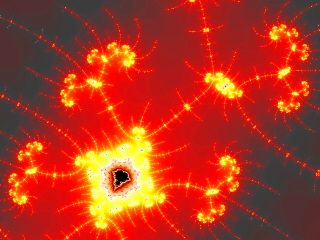
Very simple transformations applied to numbers in the complex plane can lead to fractal structures of enormous intricacy and astonishing beauty.
February 6, 2007 at 6:57pm February 6, 2007 at 6:57pm
| |
Sometimes when I get reviews, I get entreated to rid my prose of adverbs and stop it with the long synopses. "Show, don't tell," they say - and they're right, and I've often used this same advice in my own reviews. It's easier to spot it in other writers, which is one reason we review.
I've had two classes of my Fiction Writing Workshop now, and it's been useful. Last night, we discussed two "classic" short stories: Chekov's Lady with a Lapdog and Hemingway's Hills Like White Elephants. Now, keep in mind that I do not come from a literary background; mostly I just read science fiction, though occasionally I'll branch out. I've read some Hemingway, mostly for school, but I don't recall ever reading Chekov. Watching Chekov - Pavel, not Anton - yes.
I've got nothing bad to say about the Hemingway story; it's tight, focused, and doesn't waste a word. Sometimes you have to look hard to see the subtext, especially if you're used to more accessible stories like I am.
Chekov, now...
Oh, right, what gives me the right to say ANYthing bad about the man who pretty much defined the modern short story form? After all, I haven't even been published.
Well, if I wrote prose like Chekov wrote Lapdog, I'd never be published. Long paragraphs of synopsizing history that barely helps at all with character definition. An entire sentence where every other word is an adverb. Willy-nilly point of view shifts. Never mind the ending; that particular story is as happily-ever-after as a Russian ever gets, and I can live with it. Not only that, but one of the title characters (the lapdog) disappears halfway through the story, and is never so much as mentioned again!
Well. I guess it's a good thing Chekov is long gone - I'd probably have to driveby rate his story with two stars.  |
© Copyright 2025 Robert Waltz (UN: cathartes02 at Writing.Com). All rights reserved.
Robert Waltz has granted InkSpot.Com, its affiliates and its syndicates non-exclusive rights to display this work.
|



 I'm more than happy with Carrion Luggage, however.


 Comment • View 8 comments
![Merit Badge in Quill Award
[Click For More Info]
Congratulations on winning Best Blog in the 2021 edition of [Link To Item #quills] !](https://images.Writing.Com/imgs/writing.com/writers/badges/group-Quill_Award-1375927_6.gif)
![Merit Badge in Quill Award 2
[Click For More Info]
2022 Quill Award - Best Blog - [Link To Item #1196512] . Congratulations!!!](https://images.Writing.Com/imgs/writing.com/writers/badges/group-Quill_Award_2-1375927_6.gif)
![Merit Badge in 30DBC Winner
[Click For More Info]
Congratulations on winning the Jan. 2019 [Link To Item #30dbc] !!](https://images.Writing.Com/imgs/writing.com/writers/badges/group-30DBC_Winner-2064535_14.gif)
![Merit Badge in Blogging
[Click For More Info]
Congratulations on winning an honorable mention for Best Blog at the 2018 Quill Awards for [Link To Item #1196512] . *^*Smile*^* This award was sponsored by the blogging consortium including [Link To Item #30dbc] , [Link To Item #blogcity] , [Link To Item #bcof] and [Link To Item #1953629] . For more details, see [Link To Item #quills] .](https://images.Writing.Com/imgs/writing.com/writers/badges/type-Blogging-2180.gif)
![Merit Badge in Highly Recommended
[Click For More Info]
I highly recommend your blog.](https://images.Writing.Com/imgs/writing.com/writers/badges/Kudos-Highly_Recommended.gif)
![Merit Badge in Opinion
[Click For More Info]
For diving into the prompts for Journalistic Intentions- thanks for joining the fun!](https://images.Writing.Com/imgs/writing.com/writers/badges/genre-Opinion-1150.gif)
![Merit Badge in High Five
[Click For More Info]
For your inventive entries in [Link To Item #2213121] ! Thanks for the great read!](https://images.Writing.Com/imgs/writing.com/writers/badges/Kudos-High_Five.gif)
![Merit Badge in Enlightening
[Click For More Info]
For winning 3rd Place in [Link To Item #2213121] . Congratulations!](https://images.Writing.Com/imgs/writing.com/writers/badges/general-Enlightening.gif)
![Merit Badge in Quarks Bar
[Click For More Info]
For your awesome Klingon Bloodwine recipe from [Link to Book Entry #1016079] that deserves to be on the topmost shelf at Quark's.](https://images.Writing.Com/imgs/writing.com/writers/badges/group-Quarks_Bar-2046190_12.gif)