|
About This Author
Come closer.
|
Complex Numbers
Complex Numbers
A complex number is expressed in the standard form a + bi, where a and b are real numbers and i is defined by i^2 = -1 (that is, i is the square root of -1). For example, 3 + 2i is a complex number.
The bi term is often referred to as an imaginary number (though this may be misleading, as it is no more "imaginary" than the symbolic abstractions we know as the "real" numbers). Thus, every complex number has a real part, a, and an imaginary part, bi.
Complex numbers are often represented on a graph known as the "complex plane," where the horizontal axis represents the infinity of real numbers, and the vertical axis represents the infinity of imaginary numbers. Thus, each complex number has a unique representation on the complex plane: some closer to real; others, more imaginary. If a = b, the number is equal parts real and imaginary.
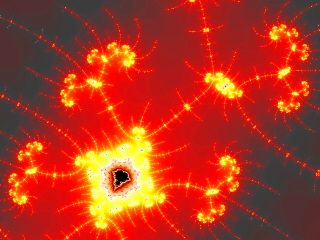
Very simple transformations applied to numbers in the complex plane can lead to fractal structures of enormous intricacy and astonishing beauty.
February 7, 2007 at 7:40pm February 7, 2007 at 7:40pm
| |
I appreciated yesterday's insightful comments about my Chekov entry. What I might have failed to make clear is that I actually did enjoy the story - it's just that as a person on this site who's gotten (and given!) many reviews warning against long expositions and adverbitis, it struck me as odd that an acknowledged master could get away with such things - successfully.
Sheherazade  mentioned translation and, yes, it did occur to me that some of my issues could be put down to translation. mentioned translation and, yes, it did occur to me that some of my issues could be put down to translation.
Mavis Moog brings up a good point about style police.
Here's the thing for me: I do not have classical literature training. By that, I mean I was exposed to Shakespeare, Faulkner and Hawthorne same as anyone, but never pursued much beyond AP English class. In college I placed out of English requirements, and concentrated on engineering (though I did have a fiction writing class, even then). So I don't KNOW what those techniques are that Mavis talks about; I only know when reading something whether I liked it or not - and very rarely exactly why.
I have, however, been reading science fiction since I was eight, and my writing - even that which is not SF - probably reflects it. While SF has been attaining greater literary heights lately, it's very aware of its roots as lowbrow pulp fiction.
Which brings me to esprit 's link to Twain on Cooper.
http://users.telerama.com/~joseph/cooper/cooper.html
I've always loved Clemens' writing. When I was a kid, I kept re-reading Tom Sawyer because it alternately made me laugh and be scared. His literary style alone does that. I laughed my damn head off reading the article.
Twain / Clemens wasn't writing highbrow fiction; he was, for the most part, writing for the masses - and the masses are notoriously lowbrow (come on; we're talking about people who watch Springer and American Idol here). But he wasn't lowbrow himself. He knew what he was doing, what effect every word he put down would have. I don't think Twain would have given two shits what a professor thought of his work - at least, that's the impression one gets from his writing.
Impression, of course, is key.
I'm not writing for professors; I'm writing for your average person. I don't write for kids; I write for adults, even when I'm not writing erotica. If I am ever successful, it will be because my works are popular, not because some professor is entranced by my cleverness.
But to do that, I have to be clever - in a subtle way.
I'll let you know if I ever figure that out. |
© Copyright 2025 Robert Waltz (UN: cathartes02 at Writing.Com). All rights reserved.
Robert Waltz has granted InkSpot.Com, its affiliates and its syndicates non-exclusive rights to display this work.
|



 I'm more than happy with Carrion Luggage, however.


 Comment • View 2 comments
![Merit Badge in Quill Award
[Click For More Info]
Congratulations on winning Best Blog in the 2021 edition of [Link To Item #quills] !](https://images.Writing.Com/imgs/writing.com/writers/badges/group-Quill_Award-1375927_6.gif)
![Merit Badge in Quill Award 2
[Click For More Info]
2022 Quill Award - Best Blog - [Link To Item #1196512] . Congratulations!!!](https://images.Writing.Com/imgs/writing.com/writers/badges/group-Quill_Award_2-1375927_6.gif)
![Merit Badge in 30DBC Winner
[Click For More Info]
Congratulations on winning the Jan. 2019 [Link To Item #30dbc] !!](https://images.Writing.Com/imgs/writing.com/writers/badges/group-30DBC_Winner-2064535_14.gif)
![Merit Badge in Blogging
[Click For More Info]
Congratulations on winning an honorable mention for Best Blog at the 2018 Quill Awards for [Link To Item #1196512] . *^*Smile*^* This award was sponsored by the blogging consortium including [Link To Item #30dbc] , [Link To Item #blogcity] , [Link To Item #bcof] and [Link To Item #1953629] . For more details, see [Link To Item #quills] .](https://images.Writing.Com/imgs/writing.com/writers/badges/type-Blogging-2180.gif)
![Merit Badge in Highly Recommended
[Click For More Info]
I highly recommend your blog.](https://images.Writing.Com/imgs/writing.com/writers/badges/Kudos-Highly_Recommended.gif)
![Merit Badge in Opinion
[Click For More Info]
For diving into the prompts for Journalistic Intentions- thanks for joining the fun!](https://images.Writing.Com/imgs/writing.com/writers/badges/genre-Opinion-1150.gif)
![Merit Badge in High Five
[Click For More Info]
For your inventive entries in [Link To Item #2213121] ! Thanks for the great read!](https://images.Writing.Com/imgs/writing.com/writers/badges/Kudos-High_Five.gif)
![Merit Badge in Enlightening
[Click For More Info]
For winning 3rd Place in [Link To Item #2213121] . Congratulations!](https://images.Writing.Com/imgs/writing.com/writers/badges/general-Enlightening.gif)
![Merit Badge in Quarks Bar
[Click For More Info]
For your awesome Klingon Bloodwine recipe from [Link to Book Entry #1016079] that deserves to be on the topmost shelf at Quark's.](https://images.Writing.Com/imgs/writing.com/writers/badges/group-Quarks_Bar-2046190_12.gif)