|
About This Author
Come closer.
|
Complex Numbers
Complex Numbers
A complex number is expressed in the standard form a + bi, where a and b are real numbers and i is defined by i^2 = -1 (that is, i is the square root of -1). For example, 3 + 2i is a complex number.
The bi term is often referred to as an imaginary number (though this may be misleading, as it is no more "imaginary" than the symbolic abstractions we know as the "real" numbers). Thus, every complex number has a real part, a, and an imaginary part, bi.
Complex numbers are often represented on a graph known as the "complex plane," where the horizontal axis represents the infinity of real numbers, and the vertical axis represents the infinity of imaginary numbers. Thus, each complex number has a unique representation on the complex plane: some closer to real; others, more imaginary. If a = b, the number is equal parts real and imaginary.
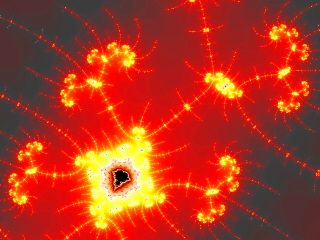
Very simple transformations applied to numbers in the complex plane can lead to fractal structures of enormous intricacy and astonishing beauty.
| |
Now that I'm doing two newsletters a month, it's becoming harder for me to find suitable material to feature. Usually I pick the genres I'm featuring, set the listing to random, and look for stories, poems or whatever that seem suitable for the newsletter's topic.
Folks, if you want to get featured in a newsletter - or, at least, in mine (Comedy and Fantasy) as I can't speak for the other editors:
DO NOT:
 Leave the item unfinished - there's nothing I hate more than getting into a story only to find the author broke it off in mid-paragraph. In these situations, I appreciate a warning in the brief description such as "Unfinished." Leave the item unfinished - there's nothing I hate more than getting into a story only to find the author broke it off in mid-paragraph. In these situations, I appreciate a warning in the brief description such as "Unfinished."
Put your opinion of the piece in the description or, worse, the title. If you're going to title your work "Rising Suns," for example, give it a brief description like, "Two children evoke the wrath of the Sun God and change their society forever." DO NOT make your description say, "Comments needed," "Unedited," "Not my best work," or anything of that sort. I will not click on items with these comments. If people are going to comment, they will, and if not, they won't; if it needs edits, then pay attention to your comments; and if it's not your best work why in the HELL is it out in public?
Pick the wrong genres - if I find one more teen angst melodrama with a "Fantasy" label, I'm going to puke. Hint: Teen angst goes under "Teen" or "Melodrama" or sometimes "Satire." Fantasy is for magical realism, fairies, gods, magic, elves, and that sort of thing; not about how much your parents must hate you for making you do chores.
DO:
Check your spelling and grammar. Even if do a formal review of my Editor's Picks, you won't have time to fix typos before the issue comes out, and you'll get a lot of reviews after it publishes that tell you that "friend" is spelled with the i before the e and that sort of thing. Chances are, if there's a significant problem with spelling, grammar, punctuation or other technical issues, your item won't make it into my newsletter.
Take advantage of the "keyword" section when creating and/or editing an item. Put in relevant keywords, like if you're writing a novel about gay sex with aliens on Saturn's moons, make your keywords like, "homosexual, alien, Saturn, Titan, Rhea, Enceladus, Tethys, Dione, Mimas, Iapetus, sex, space" (The sad thing is I didn't have to look up the moons' names.)
Pick the right genres. I know I said the same thing under "do not" above, but it bears repeating.
And that's enough ranting for today. Where's the goddamn Advil? |
© Copyright 2025 Robert Waltz (UN: cathartes02 at Writing.Com). All rights reserved.
Robert Waltz has granted InkSpot.Com, its affiliates and its syndicates non-exclusive rights to display this work.
|



 I'm more than happy with Carrion Luggage, however.


 Comment • View 4 comments
![Merit Badge in Quill Award
[Click For More Info]
Congratulations on winning Best Blog in the 2021 edition of [Link To Item #quills] !](https://images.Writing.Com/imgs/writing.com/writers/badges/group-Quill_Award-1375927_6.gif)
![Merit Badge in Quill Award 2
[Click For More Info]
2022 Quill Award - Best Blog - [Link To Item #1196512] . Congratulations!!!](https://images.Writing.Com/imgs/writing.com/writers/badges/group-Quill_Award_2-1375927_6.gif)
![Merit Badge in 30DBC Winner
[Click For More Info]
Congratulations on winning the Jan. 2019 [Link To Item #30dbc] !!](https://images.Writing.Com/imgs/writing.com/writers/badges/group-30DBC_Winner-2064535_14.gif)
![Merit Badge in Blogging
[Click For More Info]
Congratulations on winning an honorable mention for Best Blog at the 2018 Quill Awards for [Link To Item #1196512] . *^*Smile*^* This award was sponsored by the blogging consortium including [Link To Item #30dbc] , [Link To Item #blogcity] , [Link To Item #bcof] and [Link To Item #1953629] . For more details, see [Link To Item #quills] .](https://images.Writing.Com/imgs/writing.com/writers/badges/type-Blogging-2180.gif)
![Merit Badge in Highly Recommended
[Click For More Info]
I highly recommend your blog.](https://images.Writing.Com/imgs/writing.com/writers/badges/Kudos-Highly_Recommended.gif)
![Merit Badge in Opinion
[Click For More Info]
For diving into the prompts for Journalistic Intentions- thanks for joining the fun!](https://images.Writing.Com/imgs/writing.com/writers/badges/genre-Opinion-1150.gif)
![Merit Badge in High Five
[Click For More Info]
For your inventive entries in [Link To Item #2213121] ! Thanks for the great read!](https://images.Writing.Com/imgs/writing.com/writers/badges/Kudos-High_Five.gif)
![Merit Badge in Enlightening
[Click For More Info]
For winning 3rd Place in [Link To Item #2213121] . Congratulations!](https://images.Writing.Com/imgs/writing.com/writers/badges/general-Enlightening.gif)
![Merit Badge in Quarks Bar
[Click For More Info]
For your awesome Klingon Bloodwine recipe from [Link to Book Entry #1016079] that deserves to be on the topmost shelf at Quark's.](https://images.Writing.Com/imgs/writing.com/writers/badges/group-Quarks_Bar-2046190_12.gif)