|
About This Author
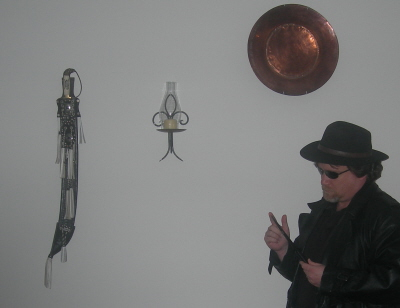
Come closer.
|
Complex Numbers
Complex Numbers
A complex number is expressed in the standard form a + bi, where a and b are real numbers and i is defined by i^2 = -1 (that is, i is the square root of -1). For example, 3 + 2i is a complex number.
The bi term is often referred to as an imaginary number (though this may be misleading, as it is no more "imaginary" than the symbolic abstractions we know as the "real" numbers). Thus, every complex number has a real part, a, and an imaginary part, bi.
Complex numbers are often represented on a graph known as the "complex plane," where the horizontal axis represents the infinity of real numbers, and the vertical axis represents the infinity of imaginary numbers. Thus, each complex number has a unique representation on the complex plane: some closer to real; others, more imaginary. If a = b, the number is equal parts real and imaginary.
Very simple transformations applied to numbers in the complex plane can lead to fractal structures of enormous intricacy and astonishing beauty.
| |
Because of its inclusion on a list for a reviewing group, my story "Dreams and Secrets"  has been getting a lot of feedback, lately. has been getting a lot of feedback, lately.
I wrote it nearly two years ago, now. Since then, I've written... well, very little, apart from blogging. I keep getting story ideas, and sometimes writing them down, but that part of me, the part that got me onto this site, has been - not exactly shut down, but spinning gears.
I've long felt that a writer is someone who has to write, like de Sade in Quills. And I just haven't had that push, lately.
That story I referenced above - it's pretty obviously my attempt to write in the style of Neil Gaiman, one of my favorite authors. From the feedback I've been getting, I think the attempt was largely successful, in that it seems to elicit the feelings I was going for, and leaves many readers wanting more.
The thing I have to wonder is: Is there more? It's the prologue, not to a novel or story, but to an idea of a story, and not one that I've fleshed out even in my own mind. I get caught up in symbolism and metaphor, and I can't find a plot that works.
I'm sure you've read stories, or poems, that try to capture the feeling of dreams. I have, of course, by Neil Gaiman and by others, but to me, none of them come close. I've come close, now, with two stories: that one and another, older story. But can another author capture, for an individual, what that individual's dreams feel like?
Am I so different that the feel of my dreams is different, or is it just monumentally difficult to capture that feeling, to put it into words? It's not the same feeling as you get with movies with excellent special effects, even Neil Gaiman's Mirrormask.
Why would you want to? Because dreaming is a common human experience, like love and death, and to relate to other humans you have to invoke your common experiences; to use common languages like dreams and love and death to convey something that is, perhaps, outside a reader's experience. A translation, of sorts.
Besides, I see my job as a writer to affect a reader's emotions, to make him or her laugh, or cry, or be outraged - and sometimes I almost feel as if I can.
Almost. |
© Copyright 2025 Robert Waltz (UN: cathartes02 at Writing.Com). All rights reserved.
Robert Waltz has granted InkSpot.Com, its affiliates and its syndicates non-exclusive rights to display this work.
|




 I'm more than happy with Carrion Luggage, however.


 Comment • View 2 comments
![Merit Badge in Quill Award
[Click For More Info]
Congratulations on winning Best Blog in the 2021 edition of [Link To Item #quills] !](https://images.Writing.Com/imgs/writing.com/writers/badges/group-Quill_Award-1375927_6.gif)
![Merit Badge in Quill Award 2
[Click For More Info]
2022 Quill Award - Best Blog - [Link To Item #1196512] . Congratulations!!!](https://images.Writing.Com/imgs/writing.com/writers/badges/group-Quill_Award_2-1375927_6.gif)
![Merit Badge in 30DBC Winner
[Click For More Info]
Congratulations on winning the Jan. 2019 [Link To Item #30dbc] !!](https://images.Writing.Com/imgs/writing.com/writers/badges/group-30DBC_Winner-2064535_14.gif)
![Merit Badge in Blogging
[Click For More Info]
Congratulations on winning an honorable mention for Best Blog at the 2018 Quill Awards for [Link To Item #1196512] . *^*Smile*^* This award was sponsored by the blogging consortium including [Link To Item #30dbc] , [Link To Item #blogcity] , [Link To Item #bcof] and [Link To Item #1953629] . For more details, see [Link To Item #quills] .](https://images.Writing.Com/imgs/writing.com/writers/badges/type-Blogging-2180.gif)
![Merit Badge in Highly Recommended
[Click For More Info]
I highly recommend your blog.](https://images.Writing.Com/imgs/writing.com/writers/badges/Kudos-Highly_Recommended.gif)
![Merit Badge in Opinion
[Click For More Info]
For diving into the prompts for Journalistic Intentions- thanks for joining the fun!](https://images.Writing.Com/imgs/writing.com/writers/badges/genre-Opinion-1150.gif)
![Merit Badge in High Five
[Click For More Info]
For your inventive entries in [Link To Item #2213121] ! Thanks for the great read!](https://images.Writing.Com/imgs/writing.com/writers/badges/Kudos-High_Five.gif)
![Merit Badge in Enlightening
[Click For More Info]
For winning 3rd Place in [Link To Item #2213121] . Congratulations!](https://images.Writing.Com/imgs/writing.com/writers/badges/general-Enlightening.gif)
![Merit Badge in Quarks Bar
[Click For More Info]
For your awesome Klingon Bloodwine recipe from [Link to Book Entry #1016079] that deserves to be on the topmost shelf at Quark's.](https://images.Writing.Com/imgs/writing.com/writers/badges/group-Quarks_Bar-2046190_12.gif)