|
About This Author
Come closer.
|
Complex Numbers
Complex Numbers
A complex number is expressed in the standard form a + bi, where a and b are real numbers and i is defined by i^2 = -1 (that is, i is the square root of -1). For example, 3 + 2i is a complex number.
The bi term is often referred to as an imaginary number (though this may be misleading, as it is no more "imaginary" than the symbolic abstractions we know as the "real" numbers). Thus, every complex number has a real part, a, and an imaginary part, bi.
Complex numbers are often represented on a graph known as the "complex plane," where the horizontal axis represents the infinity of real numbers, and the vertical axis represents the infinity of imaginary numbers. Thus, each complex number has a unique representation on the complex plane: some closer to real; others, more imaginary. If a = b, the number is equal parts real and imaginary.
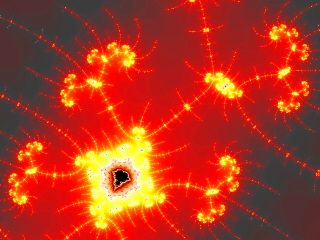
Very simple transformations applied to numbers in the complex plane can lead to fractal structures of enormous intricacy and astonishing beauty.
| |
When I think back
On all the crap I learned in high school
It's a wonder
I can think at all
And though my lack of education
Hasn't hurt me none
I can read the writing on the wall
Kodachrome
They give us those nice bright colors
They give us the greens of summers
Makes you think all the world's a sunny day, Oh yeah
I got a Nikon camera
I love to take a photograph
So mama don't take my Kodachrome away...
Back in 1983, my mother bought me a Nikon SLR for a graduation present. I took that camera and ran with it, dabbling into amateur and professional photography.
I was never much good, and I wasn't about to get a job with National Geographic or Playboy (I'd have jumped at either one, though I read them both for the articles), but I did a stint with a newspaper and a bunch of gigs as a wedding / party photographer. Kept me in beer money in college, you know.
My attempts at "art" photography were hit or miss, but they focused (heh) on two styles: black and white, and Kodachrome.
The thing about Kodachrome was that it was slow. But the tradeoff for its slowness was rich, deep colors and no grain. I mean, NO grain. You could blow a Kodachrome slide up thousands of times, and it might show some blur, but no grain. No other film behaved like that, and even the most dense digital cameras of today can't claim the same thing.
Now, those days are over.
http://www.democratandchronicle.com/article/20090622/BUSINESS/90622004/Kodak+to+...
The color film line that helped build Rochester-based Eastman Kodak Co. into an industrial powerhouse will be retired this year, Kodak announced today.
I like digital cameras. I'm probably going to get one soon - a Nikon digital SLR. It may even be able to take my old lenses; I don't know yet.
But I can't help but feel that something big is gone.
If you took all the girls I knew
When I was single
And brought them all together for one night
I know they'd never match
my sweet imagination
everything looks WORSE in black and white
Kodachrome
They give us those nice bright colors
They give us the greens of summers
Makes you think all the world's a sunny day, Oh yeah
I got a Nikon camera
I love to take a photograph
So mama don't take my Kodachrome away
Mama don't take my Kodachrome away
Mama don't take my Kodachrome away
Mama don't take my Kodachrome away... |
© Copyright 2025 Robert Waltz (UN: cathartes02 at Writing.Com). All rights reserved.
Robert Waltz has granted InkSpot.Com, its affiliates and its syndicates non-exclusive rights to display this work.
|



 I'm more than happy with Carrion Luggage, however.


 Comment • View 3 comments
![Merit Badge in Quill Award
[Click For More Info]
Congratulations on winning Best Blog in the 2021 edition of [Link To Item #quills] !](https://images.Writing.Com/imgs/writing.com/writers/badges/group-Quill_Award-1375927_6.gif)
![Merit Badge in Quill Award 2
[Click For More Info]
2022 Quill Award - Best Blog - [Link To Item #1196512] . Congratulations!!!](https://images.Writing.Com/imgs/writing.com/writers/badges/group-Quill_Award_2-1375927_6.gif)
![Merit Badge in 30DBC Winner
[Click For More Info]
Congratulations on winning the Jan. 2019 [Link To Item #30dbc] !!](https://images.Writing.Com/imgs/writing.com/writers/badges/group-30DBC_Winner-2064535_14.gif)
![Merit Badge in Blogging
[Click For More Info]
Congratulations on winning an honorable mention for Best Blog at the 2018 Quill Awards for [Link To Item #1196512] . *^*Smile*^* This award was sponsored by the blogging consortium including [Link To Item #30dbc] , [Link To Item #blogcity] , [Link To Item #bcof] and [Link To Item #1953629] . For more details, see [Link To Item #quills] .](https://images.Writing.Com/imgs/writing.com/writers/badges/type-Blogging-2180.gif)
![Merit Badge in Highly Recommended
[Click For More Info]
I highly recommend your blog.](https://images.Writing.Com/imgs/writing.com/writers/badges/Kudos-Highly_Recommended.gif)
![Merit Badge in Opinion
[Click For More Info]
For diving into the prompts for Journalistic Intentions- thanks for joining the fun!](https://images.Writing.Com/imgs/writing.com/writers/badges/genre-Opinion-1150.gif)
![Merit Badge in High Five
[Click For More Info]
For your inventive entries in [Link To Item #2213121] ! Thanks for the great read!](https://images.Writing.Com/imgs/writing.com/writers/badges/Kudos-High_Five.gif)
![Merit Badge in Enlightening
[Click For More Info]
For winning 3rd Place in [Link To Item #2213121] . Congratulations!](https://images.Writing.Com/imgs/writing.com/writers/badges/general-Enlightening.gif)
![Merit Badge in Quarks Bar
[Click For More Info]
For your awesome Klingon Bloodwine recipe from [Link to Book Entry #1016079] that deserves to be on the topmost shelf at Quark's.](https://images.Writing.Com/imgs/writing.com/writers/badges/group-Quarks_Bar-2046190_12.gif)