|
About This Author
Come closer.
|
Complex Numbers
Complex Numbers
A complex number is expressed in the standard form a + bi, where a and b are real numbers and i is defined by i^2 = -1 (that is, i is the square root of -1). For example, 3 + 2i is a complex number.
The bi term is often referred to as an imaginary number (though this may be misleading, as it is no more "imaginary" than the symbolic abstractions we know as the "real" numbers). Thus, every complex number has a real part, a, and an imaginary part, bi.
Complex numbers are often represented on a graph known as the "complex plane," where the horizontal axis represents the infinity of real numbers, and the vertical axis represents the infinity of imaginary numbers. Thus, each complex number has a unique representation on the complex plane: some closer to real; others, more imaginary. If a = b, the number is equal parts real and imaginary.
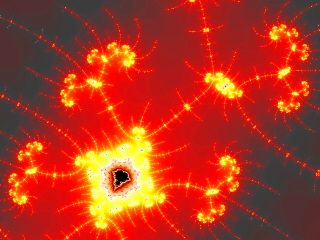
Very simple transformations applied to numbers in the complex plane can lead to fractal structures of enormous intricacy and astonishing beauty.
| |
Or does it just smell that way?
Since it's been a while since I directly addressed the topic of "writing" on this site, and I found this article, I'll take a break from the comedy to tackle something serious.
http://www.wired.com/beyond_the_beyond/2009/05/eighteen-challenges-in-contempora...
Eighteen Challenges in Contemporary Literature
This list appears to exist without any sort of context.
Though I write, I'm not trained in liberal arts, so some of these items I just don't grok:
7. Media conglomerates have poor business model; economically rationalized “culture industry” is actively hostile to vital aspects of humane culture.
What exactly does this mean?
8. Long tail balkanizes audiences, disrupts means of canon-building and fragments literary reputation.
I understand the definition of every single word in that sentence, and yet, taken as a whole... huh?
10. Contemporary literature not confronting issues of general urgency; dominant best-sellers are in former niche genres such as fantasies, romances and teen books.
While this is a point I do understand, as a science fiction writer, I consider this to be not a bad thing.
11. Barriers to publication entry have crashed, enabling huge torrent of subliterary and/or nonliterary textual expression.
*whistles innocently*
14. Unstable computer and cellphone interfaces becoming world’s primary means of cultural access. Compositor systems remake media in their own hybrid creole image.
English, please.
16. Academic education system suffering severe bubble-inflation.
In what way?
17. Polarizing civil cold war is harmful to intellectual honesty.
I assume this means the ongoing battle between conservatives and liberals, which has gotten worse since the advent of the internet, which treats polarizing and extreme opinions with the same weight as moderate, rational ones. What happens is conservatives don't bother reading anything once they determine it has a "liberal bias" - and vice versa.
So. Am I pursuing a hobby in a dead field? |
© Copyright 2025 Robert Waltz (UN: cathartes02 at Writing.Com). All rights reserved.
Robert Waltz has granted InkSpot.Com, its affiliates and its syndicates non-exclusive rights to display this work.
|



 I'm more than happy with Carrion Luggage, however.


 Comment • View 4 comments
![Merit Badge in Quill Award
[Click For More Info]
Congratulations on winning Best Blog in the 2021 edition of [Link To Item #quills] !](https://images.Writing.Com/imgs/writing.com/writers/badges/group-Quill_Award-1375927_6.gif)
![Merit Badge in Quill Award 2
[Click For More Info]
2022 Quill Award - Best Blog - [Link To Item #1196512] . Congratulations!!!](https://images.Writing.Com/imgs/writing.com/writers/badges/group-Quill_Award_2-1375927_6.gif)
![Merit Badge in 30DBC Winner
[Click For More Info]
Congratulations on winning the Jan. 2019 [Link To Item #30dbc] !!](https://images.Writing.Com/imgs/writing.com/writers/badges/group-30DBC_Winner-2064535_14.gif)
![Merit Badge in Blogging
[Click For More Info]
Congratulations on winning an honorable mention for Best Blog at the 2018 Quill Awards for [Link To Item #1196512] . *^*Smile*^* This award was sponsored by the blogging consortium including [Link To Item #30dbc] , [Link To Item #blogcity] , [Link To Item #bcof] and [Link To Item #1953629] . For more details, see [Link To Item #quills] .](https://images.Writing.Com/imgs/writing.com/writers/badges/type-Blogging-2180.gif)
![Merit Badge in Highly Recommended
[Click For More Info]
I highly recommend your blog.](https://images.Writing.Com/imgs/writing.com/writers/badges/Kudos-Highly_Recommended.gif)
![Merit Badge in Opinion
[Click For More Info]
For diving into the prompts for Journalistic Intentions- thanks for joining the fun!](https://images.Writing.Com/imgs/writing.com/writers/badges/genre-Opinion-1150.gif)
![Merit Badge in High Five
[Click For More Info]
For your inventive entries in [Link To Item #2213121] ! Thanks for the great read!](https://images.Writing.Com/imgs/writing.com/writers/badges/Kudos-High_Five.gif)
![Merit Badge in Enlightening
[Click For More Info]
For winning 3rd Place in [Link To Item #2213121] . Congratulations!](https://images.Writing.Com/imgs/writing.com/writers/badges/general-Enlightening.gif)
![Merit Badge in Quarks Bar
[Click For More Info]
For your awesome Klingon Bloodwine recipe from [Link to Book Entry #1016079] that deserves to be on the topmost shelf at Quark's.](https://images.Writing.Com/imgs/writing.com/writers/badges/group-Quarks_Bar-2046190_12.gif)