|
About This Author
Come closer.
|
Complex Numbers
Complex Numbers
A complex number is expressed in the standard form a + bi, where a and b are real numbers and i is defined by i^2 = -1 (that is, i is the square root of -1). For example, 3 + 2i is a complex number.
The bi term is often referred to as an imaginary number (though this may be misleading, as it is no more "imaginary" than the symbolic abstractions we know as the "real" numbers). Thus, every complex number has a real part, a, and an imaginary part, bi.
Complex numbers are often represented on a graph known as the "complex plane," where the horizontal axis represents the infinity of real numbers, and the vertical axis represents the infinity of imaginary numbers. Thus, each complex number has a unique representation on the complex plane: some closer to real; others, more imaginary. If a = b, the number is equal parts real and imaginary.
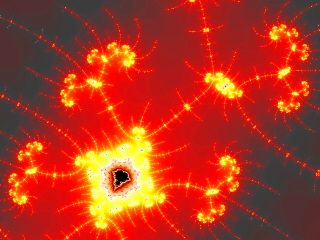
Very simple transformations applied to numbers in the complex plane can lead to fractal structures of enormous intricacy and astonishing beauty.
| |
There can be no clearer evidence of the world-shattering power of rock & roll in general - and Bruce Springsteen in particular - than the following article.
Did the Boss help bring down the Berlin Wall?
BERLIN - When Bruce Springsteen spoke out against the Berlin Wall at the biggest concert in East German history in 1988, no one in the crowd of 160,000 had the faintest idea that the symbol of the Cold War would soon be history.
http://www.msnbc.msn.com/id/25696021/>1=43001
“Springsteen’s concert and speech certainly contributed in a larger sense to the events leading up to the fall of the Wall,” said Gerd Dietrich, a historian at Berlin’s Humboldt University.
Okay, giving credit where credit is due, I have to give Pink Floyd partial credit. Still:
Springsteen stopped halfway through the three-hour show for a short speech — in heavily accented German:
“I want to tell you I’m not here for or against any government,” Springsteen said, as he pointedly introduced his rendition of the Bob Dylan ballad “Chimes of Freedom.”
“I came to play rock ’n’ roll for you East Berliners in the hope that one day all the barriers will be torn down.”
Well, of course we can't point the finger of responsibility at any one person. Like any action in a Communist country, the fall of the Wall was a group effort. Still, sometimes these things take a catalyst, or at least a Last Straw.
I had a friend in the Army at the time stationed in Germany, and he was there when the Wall came down. Got me a piece of it, too. I haven't the slightest idea where it is now - most likely at some point, some well-meaning cohabitant thought it was trash. Women - you gotta watch 'em every second (hmm, that's not such a bad thing).
“People didn’t want to leave when it was over,” [Cherno Zobatey] said [of the concert]. “The police gave up after a while. I walked back across town for about two hours and everywhere everyone was happy and on a real high. But it didn’t feel like a revolution, just yet anyhow.”
I forget who said it, but I've heard that it's not poverty that causes revolutions - it's the knowledge of poverty.
Twenty years later, Bruce is still working for social justice. And East Berlin? It's history.
Thanks to Deelyte- Chillin'  for sending me the link! for sending me the link! |
© Copyright 2025 Robert Waltz (UN: cathartes02 at Writing.Com). All rights reserved.
Robert Waltz has granted InkSpot.Com, its affiliates and its syndicates non-exclusive rights to display this work.
|



 I'm more than happy with Carrion Luggage, however.


 Comment • View 1 comment
![Merit Badge in Quill Award
[Click For More Info]
Congratulations on winning Best Blog in the 2021 edition of [Link To Item #quills] !](https://images.Writing.Com/imgs/writing.com/writers/badges/group-Quill_Award-1375927_6.gif)
![Merit Badge in Quill Award 2
[Click For More Info]
2022 Quill Award - Best Blog - [Link To Item #1196512] . Congratulations!!!](https://images.Writing.Com/imgs/writing.com/writers/badges/group-Quill_Award_2-1375927_6.gif)
![Merit Badge in 30DBC Winner
[Click For More Info]
Congratulations on winning the Jan. 2019 [Link To Item #30dbc] !!](https://images.Writing.Com/imgs/writing.com/writers/badges/group-30DBC_Winner-2064535_14.gif)
![Merit Badge in Blogging
[Click For More Info]
Congratulations on winning an honorable mention for Best Blog at the 2018 Quill Awards for [Link To Item #1196512] . *^*Smile*^* This award was sponsored by the blogging consortium including [Link To Item #30dbc] , [Link To Item #blogcity] , [Link To Item #bcof] and [Link To Item #1953629] . For more details, see [Link To Item #quills] .](https://images.Writing.Com/imgs/writing.com/writers/badges/type-Blogging-2180.gif)
![Merit Badge in Highly Recommended
[Click For More Info]
I highly recommend your blog.](https://images.Writing.Com/imgs/writing.com/writers/badges/Kudos-Highly_Recommended.gif)
![Merit Badge in Opinion
[Click For More Info]
For diving into the prompts for Journalistic Intentions- thanks for joining the fun!](https://images.Writing.Com/imgs/writing.com/writers/badges/genre-Opinion-1150.gif)
![Merit Badge in High Five
[Click For More Info]
For your inventive entries in [Link To Item #2213121] ! Thanks for the great read!](https://images.Writing.Com/imgs/writing.com/writers/badges/Kudos-High_Five.gif)
![Merit Badge in Enlightening
[Click For More Info]
For winning 3rd Place in [Link To Item #2213121] . Congratulations!](https://images.Writing.Com/imgs/writing.com/writers/badges/general-Enlightening.gif)
![Merit Badge in Quarks Bar
[Click For More Info]
For your awesome Klingon Bloodwine recipe from [Link to Book Entry #1016079] that deserves to be on the topmost shelf at Quark's.](https://images.Writing.Com/imgs/writing.com/writers/badges/group-Quarks_Bar-2046190_12.gif)