|
About This Author
Come closer.
|
Complex Numbers
Complex Numbers
A complex number is expressed in the standard form a + bi, where a and b are real numbers and i is defined by i^2 = -1 (that is, i is the square root of -1). For example, 3 + 2i is a complex number.
The bi term is often referred to as an imaginary number (though this may be misleading, as it is no more "imaginary" than the symbolic abstractions we know as the "real" numbers). Thus, every complex number has a real part, a, and an imaginary part, bi.
Complex numbers are often represented on a graph known as the "complex plane," where the horizontal axis represents the infinity of real numbers, and the vertical axis represents the infinity of imaginary numbers. Thus, each complex number has a unique representation on the complex plane: some closer to real; others, more imaginary. If a = b, the number is equal parts real and imaginary.
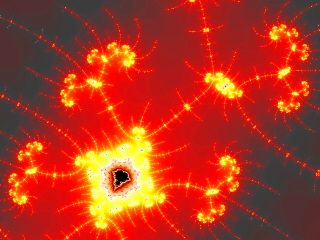
Very simple transformations applied to numbers in the complex plane can lead to fractal structures of enormous intricacy and astonishing beauty.
| |
Lorien  , commenting on us finding something else to obsess upon now that the last HP book is out: "Preferably something with literary merit." , commenting on us finding something else to obsess upon now that the last HP book is out: "Preferably something with literary merit."
While I agree with the sentiment to some extent - as good as Rowling is at capturing and engaging the reader, she's not the world's greatest writer (Richest, maybe, but the two are not synonyms) - I have issues with literary writing. Now, I'm not sure exactly how Lorien meant it, but to me,"literary merit" is code for "a dense, impenetrable force field of twisted allegory, obscure allusions, and other ways an author can demonstrate how clever she is without resorting to plot or characterization"
Ann Beattie is a great example of this. So is pretty much anything in The New Yorker (at least, it used to be that way - I haven't even tried to read that in a while). When I was younger and I picked up mags like that, and tried to read the stories, I found them dense, impenetrable and impossible to understand. I figured, "I'm a smart guy. One day, perhaps after college has warped my mind to a sufficient degree, I'll understand and appreciate the rarefied subtleties of literary fiction."
Well, here it is a quarter-century later. I'm still a smart guy, and I still find that sort of thing dense, impenetrable and impossible to understand. Granted, I took very few liberal arts courses in college - being an engineer and all - but I don't think I'm ignorant about writing.
As with a lot of modern art - an exhibit showing an overflowing trash can and a canvas painted red with a purple stripe down the middle come to mind - a lot of it is, as I mentioned above, artists (painters, sculptors, writers, whatever) having stopped trying to be accessible to ordinary people and merely trying to outdo each other using rules created BY the field FOR the field.
I shouldn't need a degree in art history to appreciate fine art. I shouldn't need a degree in literature to appreciate reading. And writers (I'll leave artists alone from now on, because this is writing.com and not deviantart.com) need to decide whether they're writing for other writers - or for general consumption.
If you're writing for other writers, hey, that's great. Don't expect to become rich, but then, that would be "selling out," wouldn't it? If you're writing for the general population, of course, don't expect to get rich doing that, either. I don't. I expect to get rich (well, at least earn enough to retire) doing engineering. You've as good a chance at winning the lottery, the only difference being that with writing there is some element of skill involved.
If you can string a sentence together, turn a few phrases, stand some clichés on their heads, create interesting characters, put them in interesting situations, and bribe a few publishers, you can get readers. Who cares if it's a rehashed plot? At least it's a plot. The romance industry makes a living cloning plots - or at least I've heard they do.
So... essence of rant: the same people who would rather find out what's going on in Paris Hilton than in Paris aren't going to read "literary" writings. They're going to read Stephen King and Patricia Cornwell - and J.K. Rowling, if they read at all. I'm not writing to impress professors and black-wearing, clove-smoking elitists*; I'm writing to (try to) impress guys in Ford pickup trucks and single mothers.
Not ragging on you, Lorien - I agree with you to a point. It just ain't going to happen.
*Incidentally, I wear black and I used to smoke cloves. |
| |
So the postman knocks on the door and hands me my copy of Deathly Hallows, which Amazon had oh-so-kindly labeled as such right there on the packaging. "People have been stealing these from mailboxes," he explains. "Thought I'd see if you were home."
Someone's getting a tip this year.
I spent the next eight hours straight reading the thing. Right now some of you are going, "Eight hours?! That's slow! It took me four and a half!" Shut the fuck up, okay?
All I can say is, there were a few things that surprised me, and at least two major plot points that I had nailed on the head. Plus, the ending was pretty much exactly what I expected - before I saw the god-be-damned Internet spoiler brigade. Did this disappoint me? Far from it. Just as with the ending to The Dark Tower, the prediction coming to fruition increased my enjoyment.
Sadly, however, Snape does not take McGonnagal to the dungeons.
And boy, am I glad that series is over. Move along, folks - let's all find something else to obsess upon. |
© Copyright 2025 Robert Waltz (UN: cathartes02 at Writing.Com). All rights reserved.
Robert Waltz has granted InkSpot.Com, its affiliates and its syndicates non-exclusive rights to display this work.
|



 I'm more than happy with Carrion Luggage, however.


 Comment • View 7 comments
![Merit Badge in Quill Award
[Click For More Info]
Congratulations on winning Best Blog in the 2021 edition of [Link To Item #quills] !](https://images.Writing.Com/imgs/writing.com/writers/badges/group-Quill_Award-1375927_6.gif)
![Merit Badge in Quill Award 2
[Click For More Info]
2022 Quill Award - Best Blog - [Link To Item #1196512] . Congratulations!!!](https://images.Writing.Com/imgs/writing.com/writers/badges/group-Quill_Award_2-1375927_6.gif)
![Merit Badge in 30DBC Winner
[Click For More Info]
Congratulations on winning the Jan. 2019 [Link To Item #30dbc] !!](https://images.Writing.Com/imgs/writing.com/writers/badges/group-30DBC_Winner-2064535_14.gif)
![Merit Badge in Blogging
[Click For More Info]
Congratulations on winning an honorable mention for Best Blog at the 2018 Quill Awards for [Link To Item #1196512] . *^*Smile*^* This award was sponsored by the blogging consortium including [Link To Item #30dbc] , [Link To Item #blogcity] , [Link To Item #bcof] and [Link To Item #1953629] . For more details, see [Link To Item #quills] .](https://images.Writing.Com/imgs/writing.com/writers/badges/type-Blogging-2180.gif)
![Merit Badge in Highly Recommended
[Click For More Info]
I highly recommend your blog.](https://images.Writing.Com/imgs/writing.com/writers/badges/Kudos-Highly_Recommended.gif)
![Merit Badge in Opinion
[Click For More Info]
For diving into the prompts for Journalistic Intentions- thanks for joining the fun!](https://images.Writing.Com/imgs/writing.com/writers/badges/genre-Opinion-1150.gif)
![Merit Badge in High Five
[Click For More Info]
For your inventive entries in [Link To Item #2213121] ! Thanks for the great read!](https://images.Writing.Com/imgs/writing.com/writers/badges/Kudos-High_Five.gif)
![Merit Badge in Enlightening
[Click For More Info]
For winning 3rd Place in [Link To Item #2213121] . Congratulations!](https://images.Writing.Com/imgs/writing.com/writers/badges/general-Enlightening.gif)
![Merit Badge in Quarks Bar
[Click For More Info]
For your awesome Klingon Bloodwine recipe from [Link to Book Entry #1016079] that deserves to be on the topmost shelf at Quark's.](https://images.Writing.Com/imgs/writing.com/writers/badges/group-Quarks_Bar-2046190_12.gif)