|
About This Author
Come closer.
|
Complex Numbers
Complex Numbers
A complex number is expressed in the standard form a + bi, where a and b are real numbers and i is defined by i^2 = -1 (that is, i is the square root of -1). For example, 3 + 2i is a complex number.
The bi term is often referred to as an imaginary number (though this may be misleading, as it is no more "imaginary" than the symbolic abstractions we know as the "real" numbers). Thus, every complex number has a real part, a, and an imaginary part, bi.
Complex numbers are often represented on a graph known as the "complex plane," where the horizontal axis represents the infinity of real numbers, and the vertical axis represents the infinity of imaginary numbers. Thus, each complex number has a unique representation on the complex plane: some closer to real; others, more imaginary. If a = b, the number is equal parts real and imaginary.
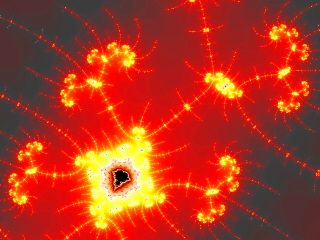
Very simple transformations applied to numbers in the complex plane can lead to fractal structures of enormous intricacy and astonishing beauty.
| |
My Hobby: Strolling through a full, busy parking lot with a key in my hand.
Yes, one day I'll get run over by a karma for my little joke. Meanwhile, it's fun to laugh at the expressions on the faces of the people trying to vulture a spot as I step out of the parking lot. |
| |
As most of you know, I'm fond of predicting the End of It All here. What can I say; it's fun. Recently, someone posted a poll on Failbook: "Should there be a national holiday in honor of Michael Jackson?"
The very existence of that poll means it's all over, I tell you.
But of course, apocalyptic fantasies are just that: fantasies. Harmless. The world's not going to REALLY end; it's just going to change, like it always does...
Or is it going to end, after all? I mean, it's happened before:
http://www.cracked.com/article_17562_5-horrifying-apocalyptic-scenarios-that-hav...
It's impossible to turn on the news or go the movies without hearing about some disease or cataclysm that's about to end the world. There's a movie coming (2012) that as far as we can tell is about every apocalypse happening at once, and in the news the flavor of the week is swine flu--though so far the fatality rate has fallen rather short of, say, Popsicles.
"After killing 50-60 percent of Europe's population, the Justinian Plague laid low for a couple centuries, repackaged itself as the Black Death and killed a third of Europe from 1348-1350. Like your mom's cooking, the bubonic plague wouldn't stay down--it hung around until the 1600s, when improved medicine and sanitation stanched its spread. And like your mom's cooking, the Black Death gave people fatal, necrotic tumors. "
At least we'll go out laughing, right? |
| |
You know you want it.
At some point in this setup, the Starship Enterprise stops and your sad little apartment begins. And while that chair looks awesome in the middle of a space-age bridge and blinking computers, sandwich it between the charcoal grill up there and your cat's litter box, and you have a recipe for instant clinical depression.
http://www.cracked.com/article_17550_10-geekiest-pieces-furniture-in-universe.ht...
I'm sorry, but the H.R. Giger Coffee Table and Chairs? REALLY REALLY WANT |
| |
Really, there's not much I can say about this that hasn't already been said. It's one of my earliest memories, so it's personal to me. It is what inspired me to go into a technical profession (though my work is right here on Earth.) It is what caused me to read and write science fiction. The motivations may have been suspect, but the dream was pure and the positive results were undeniable (we didn't "waste" money. It stayed, for the most part, right here on Earth, creating jobs and advancing technology across the board).
So I'll let my characters, Peter Sorrelle and Delphine Lovell, speak for me. From my novel in progress, Prototype:
On the screen, hanging against a background of stars, was a spacecraft unlike any Del had seen. Lacking the utilitarian frame of a cargo transport or the retro-futuristic look of a passenger liner, it was something else altogether, looking like a pair of spheres connected by a thick shaft – though one of the spheres was truncated, as if a quarter of it had been sliced off. The other sphere sported a duraglass dome, protruding from the sphere’s pole.
“I’ve never seen anything like him,” Del said. “I didn’t even know he was under development.” She struggled with scale; against the background of space, there was no way to tell whether it was a small, one-person craft or a larger transport. She put a hand on the back of the chair she’d just vacated, leaning on it.
“I remember when all ships were called ‘her,’” Sorrelle mused. “It still sounds odd to me.”
Del glanced at him; he was watching the screen. “Isn’t Neil a man’s name? It’d be weird calling him ‘her.’”
“Yes, I suppose it would. Do you recognize the name?”
Del turned back to the display. It wasn’t a still picture; as she watched, a maintenance pod detached from the ship and blasted toward the left of the screen. Since maintenance pods were standardized, Del finally got a feel for the scale: the new craft was large, bigger even than the Olympic. “No, not really. Some scientist?”
Sorrelle chuckled. “No, no. He was… I guess you could say he was a pilot, like you. They called them ‘astronauts’ back then.”
“I know what an astronaut was. They were also called ‘cosmonauts.’”
“Not by the same people. At the time, there was a big race between astronauts – from America – and cosmonauts from Russia to see who would be the first to land a human being on the moon.”
“Oh, yeah, I remember something about that from school,” Del said, continuing to watch the ship even though nothing else happened. “The space race. The Americans won, I think.”
“That’s right. Here, let me show you something.” He tapped buttons on his wrist and, after a moment, the view of the Neil Armstrong blinked out, to be replaced by a grainy picture.
It took Del a moment to figure out what she was looking at. A red tower attached at several points to a long series of cylinders, each cylinder smaller than the one below it. Behind the rocket was blue sky with a few clouds. “A rocket,” said Del.
“Not just a rocket,” Sorrelle corrected her. “The Saturn V, one of the biggest rockets ever built, and the biggest one ever launched successfully. Back then, over a century ago, no one had ever been to the moon, and there were no facilities in orbit, so one ship had to make the journey by itself. No transfer stations in LEO.”
“I guess you have to start somewhere,” Del said. “I can’t really tell how big the rocket is, though.”
“Just over a hundred and ten meters from nose to nozzle,” Sorrelle said. “But it was about 90% fuel. You see the little cone near the top? Just below the skinny framework.”
“Sure.” Delphine took a step closer to the screen, ignoring twinges in her leg.
“The crew was in that cone. Most of the rest of the rocket was fuel.”
“Damn.”
“By the way, if things had gone a bit differently, there would have been a Lovell in there. Jim Lovell was part of the backup crew.”
Del turned back to him. “Yeah? Ancestor of mine?”
“Not directly. At least, your father never mentioned it, and I’d think he would have. In any case, one of the three astronauts who did go was Neil Alden Armstrong.” Sorrelle tapped his CuffLink again, and the view changed. This time, it was from the top of the gantry, the rocket foreshortened, red arms from the gantry with their tenuous hold on the Saturn V. The picture moved, tendrils of white steam coming from near the bottom of the enormous craft. Sound came on, low quality but clear: a male voice, counting down from five.
At “zero” the steam turned to fire blossoming at the base of the rocket. At first, it seemed as if nothing would happen, and then… movement. The gantry arms swung wide. The flames brightened, and the rocket picked up speed.
The video switched to a view of the rocket blasting through the atmosphere. Sorrelle cut the sound. “Other missions had already swung around the moon and back, without landing. This one, called Apollo 11, would fulfill a promise made less than a decade earlier: to put a man on the moon.”
Del stepped back and grabbed the plush chair she’d been sitting in, turned it around, and settled back into it, finishing the rest of her water but still holding the empty glass. “And that man was Neil Armstrong?”
“That’s right.”
“Who were the others?”
“Buzz Aldrin, who was the second person on the moon, and Michael Collins, who had the unenviable job of staying in lunar orbit while the other two got to go sightseeing.”
Del watched as the rocket’s trail disappeared into blackness. The video switched to a view from the craft itself; in a burst of flame, the enormous first stage separated and fell away, discarded forever.
The scene cut again, this time to a metallic craft detaching from the orbital module, a craft with spidery legs and wide footpads. “That must have been exciting,” Del said, after a time. “To know, beyond doubt, that you’re going where no one’s ever been.” The familiar lunar surface scrolled by on the screen, framed between struts of the landing module. After a time, it stopped moving; the craft had touched down. Sorrelle turned the sound back on. “-the Eagle has landed…”
“That was quick,” said Del.
“It actually took four days. Most of it was boring, as you well know. Here it comes,” Sorrelle told her. “Probably the most famous single moment in history.”
The video’s quality diminished further, but Del could still make out the shapes: a ladder hanging from the landing craft’s hatch, and a human figure descending, trapped in a bulky spacesuit. “That’s one small step for a man; one giant leap for mankind.” Del shook off a chill.
“Yes, I do remember this,” she said. “I never paid much attention in history class, I’m afraid.”
Sorrelle stopped the blurry video with a touch to his CuffLink. “I’ve got that site preserved,” he told her. “It wasn’t a part of the moon that people visited much. Most of the mining operations started down south. But I had them build Tranquility Base where it is specifically because of that site, even though it’s not real convenient to the olivine deposits. The tourists love it.”
Del shrugged. “I guess that’s good. I haven’t been there.”
“Del, with what you did on the Olympic, you’ve more than proven yourself as a pilot. You can write your own ticket from here on out. The Sorrelle Corporation owes you a great deal. I owe you a great deal. But what I’d like you to do is pilot the Neil Armstrong.”
So maybe this 40-year anniversary will get me off my butt - actually, ON my butt - and editing that novel. |
| |
http://www.cracked.com/article_17510_5-ways-people-are-taking-harry-potter-waaay...
5 Ways People Are Taking Harry Potter Waaay Too Seriously
Readers everywhere have fallen in love with the tale of a magical boy who escapes a decade of child abuse only to wind up in a facility with a worse child-safety record than the Industrial Revolution. Unfortunately, humanity's ability to simply enjoy the Harry Potter books and get on with their lives ended the very second two computers were connected together.
Once again, Cracked outdoes itself.
A 200-woman conference room--which we imagine must have smelt strongly of cats--got together for a talk on "Out of Bounds: Transgressive Fiction," which meant Snape and Hermione fiction. And if you believe any words in the stories discussed even rhymed with "consensual," then can we come live in your world? It seems nicer there.
Gosh, I hope none of my readers write Harry Potter fanfiction.
Wait... yes I do  |
| |
Right here. Look: "Summer" 
I said, Just watch - they'll be advertising for Christmas next month. Guaranteed.
Well. Do I win something?
http://www.chicagotribune.com/business/chi-thu-sears-christmas-0709-jul09,0,7213...
On Sunday, while most of America was recovering from Fourth of July fireworks and cookouts, the Hoffman Estates-based retailer launched an online boutique called Christmas Lane at Sears.com and Kmart.com. It also set up Christmas decor shops at 372 Sears stores, including one at Woodfield mall in Schaumburg.
I hereby vow that I will not buy anything from Sears or K-mart until AT LEAST January, 2010. Who's with me?
The phenomenon, known as Christmas creep, is expected to kick into overdrive this year as retailers fight for their share of shoppers' shrinking pocketbooks.
And here I thought Christmas creep was that one Santa who put his hands where they didn't belong. |
| |
Ever listened to The Star-Spangled Banner? I mean, really listened to the words? The thing about our national anthem is that after a while, repetition robs it of its poetic force. And the thing was pretty damn poetic, at least until Roseanne Barr fucked it up at a baseball game.
Well, it turns out that as far as anthems go, ours is pretty tame. The British attacked; we kicked Tory ass; they went home with their union jacks between their legs. Now, they're practically the 51st state. Hell, we have more in common with England than we do with Hawaii. Still, if I had to choose which island to vacation on, it'd be the one with the volcano and hula skirts.
Anyway, here, Cracked presents national anthems that make ours look wimpy:
http://www.cracked.com/article_16735_6-national-anthems-that-will-make-you-tremb...
On Independence Day, Americans are probably feeling something approaching national pride. So we thought we'd take a closer look at the national anthem, that creepy ritual of bland patriotism.
We all know that the American national anthem tells the inspiring story of a brave flag that survives a scary night by believing in itself. But not all national anthems steal their plots from children's books. In fact, some countries aren't satisfied until their national anthem makes any child within earshot weep in terror. Here are six that take pride in their land to a whole new and insanely violent level.
Enjoy, and may the Fourth be with you today! (Unless you're from England, in which case... go eat a spotted dick or something.) |
© Copyright 2025 Robert Waltz (UN: cathartes02 at Writing.Com). All rights reserved.
Robert Waltz has granted InkSpot.Com, its affiliates and its syndicates non-exclusive rights to display this work.
|



 I'm more than happy with Carrion Luggage, however.


 Comment
![Merit Badge in Quill Award
[Click For More Info]
Congratulations on winning Best Blog in the 2021 edition of [Link To Item #quills] !](https://images.Writing.Com/imgs/writing.com/writers/badges/group-Quill_Award-1375927_6.gif)
![Merit Badge in Quill Award 2
[Click For More Info]
2022 Quill Award - Best Blog - [Link To Item #1196512] . Congratulations!!!](https://images.Writing.Com/imgs/writing.com/writers/badges/group-Quill_Award_2-1375927_6.gif)
![Merit Badge in 30DBC Winner
[Click For More Info]
Congratulations on winning the Jan. 2019 [Link To Item #30dbc] !!](https://images.Writing.Com/imgs/writing.com/writers/badges/group-30DBC_Winner-2064535_14.gif)
![Merit Badge in Blogging
[Click For More Info]
Congratulations on winning an honorable mention for Best Blog at the 2018 Quill Awards for [Link To Item #1196512] . *^*Smile*^* This award was sponsored by the blogging consortium including [Link To Item #30dbc] , [Link To Item #blogcity] , [Link To Item #bcof] and [Link To Item #1953629] . For more details, see [Link To Item #quills] .](https://images.Writing.Com/imgs/writing.com/writers/badges/type-Blogging-2180.gif)
![Merit Badge in Highly Recommended
[Click For More Info]
I highly recommend your blog.](https://images.Writing.Com/imgs/writing.com/writers/badges/Kudos-Highly_Recommended.gif)
![Merit Badge in Opinion
[Click For More Info]
For diving into the prompts for Journalistic Intentions- thanks for joining the fun!](https://images.Writing.Com/imgs/writing.com/writers/badges/genre-Opinion-1150.gif)
![Merit Badge in High Five
[Click For More Info]
For your inventive entries in [Link To Item #2213121] ! Thanks for the great read!](https://images.Writing.Com/imgs/writing.com/writers/badges/Kudos-High_Five.gif)
![Merit Badge in Enlightening
[Click For More Info]
For winning 3rd Place in [Link To Item #2213121] . Congratulations!](https://images.Writing.Com/imgs/writing.com/writers/badges/general-Enlightening.gif)
![Merit Badge in Quarks Bar
[Click For More Info]
For your awesome Klingon Bloodwine recipe from [Link to Book Entry #1016079] that deserves to be on the topmost shelf at Quark's.](https://images.Writing.Com/imgs/writing.com/writers/badges/group-Quarks_Bar-2046190_12.gif)