|
About This Author
Come closer.
|
Carrion Luggage
Carrion Luggage
 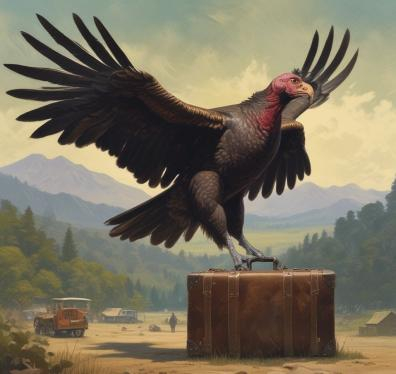
Native to the Americas, the turkey vulture (Cathartes aura) travels widely in search of sustenance. While usually foraging alone, it relies on other individuals of its species for companionship and mutual protection. Sometimes misunderstood, sometimes feared, sometimes shunned, it nevertheless performs an important role in the ecosystem.
This scavenger bird is a marvel of efficiency. Rather than expend energy flapping its wings, it instead locates uplifting columns of air, and spirals within them in order to glide to greater heights. This behavior has been mistaken for opportunism, interpreted as if it is circling doomed terrestrial animals destined to be its next meal. In truth, the vulture takes advantage of these thermals to gain the altitude needed glide longer distances, flying not out of necessity, but for the joy of it.
It also avoids the exertion necessary to capture live prey, preferring instead to feast upon that which is already dead. In this behavior, it resembles many humans.
It is not what most of us would consider to be a pretty bird. While its habits are often off-putting, or even disgusting, to members of more fastidious species, the turkey vulture helps to keep the environment from being clogged with detritus. Hence its Latin binomial, which translates to English as "golden purifier."
I rarely know where the winds will take me next, or what I might find there. The journey is the destination.
January 1, 2026 at 10:51am January 1, 2026 at 10:51am
| |
Yay. The odometer clicked over. Here's a somewhat appropriate article from Big Think:
Before we can build the future, we have to imagine it.
Progress in steel and silicon has long been preceded by progress in imagination. Jules Verne’s novels prepared readers for submarines and space travel. Star Trek’s communicator device inspired engineers to create the mobile phone.
This is not an argument for "culture." This is an argument in favor of science fiction (which is certainly part of culture, but not all of it), and one that I've made some versions of in the past.
And interesting that the author focuses on the communicator. Because when I think of "progress," I don't just think of technological progress, but also social, and that's what Trek has set the ideal for: a future where there's a blueprint for getting along with each other. If one can ignore or embrace the frequent absurdity in that franchise.
We usually think of infrastructure as bridges, satellites, and fiber-optic cables. But beneath steel and concrete lies something less tangible but just as powerful: culture — the stories and symbols that make some futures seem absurd, others inevitable, and a few worth building.
This is almost trivial, I think. But it probably helps to say it aloud (or type it): that before we can bring something new into existence, first we have to imagine it. That concept goes back to at least Plato.
What's not talked about as much, though, is the far more common occurrence: where we imagine something that will never happen, maybe can never happen, like (if we're sticking with Star Trek) transporter technology.
The Enlightenment was not an engineering project but a cultural shift. In coffee houses and pamphlets, curiosity and reason became public virtues. That shift created the conditions for modern science and the Industrial Revolution.
You're not promoting your case of positive progress.
Scientist Michael Nielsen has given us a useful term for understanding how culture shapes progress: the hyper-entity. He defines it as an “imagined hypothetical future object or class of objects” — something that exists in the collective consciousness before (maybe) becoming reality. Today’s hyper-entities include AGI, space elevators, Martian settlements, the Singularity, and universal quantum computers.
I'm not on board with "hyper-entity" for that. That would make a damn good supervillain name, though: Spider-Man vs.... the Hyper-Entity!
But again, let's be clear, here: all those things the author is calling hyper-entities made their debut in science fiction.
SF can also imagine entities we'd rather not have: xenomorphs, uppity androids, deadly lab-produced plagues. So yes, sometimes it's a warning about what not to do, but it can also be a blueprint for what might actually work.
National projects can start as hyper-entities as well. The Apollo program didn’t begin with rockets. It began with a story. President Kennedy’s line, “We choose to go to the Moon,” transformed space exploration into a cultural commitment.
No. It began with fantasy, and then science fiction. The basic idea that we can visit the moon is as old as stories. Only relatively recently did science fiction authors imagine how it might actually happen, and they inspired rocket scientists as well as politicians.
Yet hyper-entities are not always benign. Once they move from the imagination to the real world, they can take on unforeseen characteristics or become rigid and incapable of evolving with the times. The modern education system, once a breakthrough in spreading knowledge, is now often criticized for lagging behind the needs of a changing world. Bureaucracies, once cultural advances in coordination, can calcify into obstacles. Hyper-entities can magnify human potential, but they can just as easily magnify inertia.
Well, yeah. Nothing comes without a price. Probably the most obvious invention with clear upsides and downsides is nuclear energy.
If hyper-entities are the heavyweights of culture, then memes are its quick strikes.
In this section, the author, I think, falsely conflates Dawkins' original idea of a "meme" with the bumper-sticker philosophy added to cute cat pictures and all manner of other images floating around the internet, which are called "memes," but don't usually rise to the level required to be a true means of cultural idea transmission.
That the word "meme" itself has changed meaning, or at least connotation, over time, is a source of amusement to me. The word was coined as a cultural equivalent to "gene," the unit of trait transmission in biological entities. So, just as genes sometimes mutate and change the course of entire species, so too did the connotation of "meme."
Most memes burn out quickly, but some prove powerful. A few compress complicated ideas into such simple, contagious forms that they shape how people think and act at scale.
Just as genetic mutation usually produces something neutral or maladaptive, while occasionally creating something useful, like, I don't know, opposable thumbs or really sharp teeth. And damn, but there are a lot of maladaptive memes (modern connotation) out there.
“Move fast and break things” began as an internal motto at Facebook. Within a few years, it had spread across Silicon Valley, becoming shorthand for the entire startup ethos: experiment quickly, worry less about rules, and treat disruption as a virtue. Five words shifted an industry’s attitude.
This, too, has very obvious downsides.
To her credit, the author does address this:
Sparks don’t always start the fires you want, though. The same speed that makes memes powerful also makes them volatile. And what’s true for memes is true for culture more broadly: It doesn’t always drive society forward.
The idea that progress (of any kind) is some kind of bar that always goes up is a myth, and not the good kind of myth. It's more of a "three steps forward, two steps back" kind of thing. Sometimes, three steps forward, five steps back.
Sometimes culture stalls innovation. Genetically modified crops promised higher yields and reduced pesticide use, but public fear — shaped by stories of “Frankenfoods” — slowed adoption in many parts of the world, including places where GMOs might have reduced hunger and improved health.
This is, to me, the Platonic ideal of an example of that.
The Enlightenment, the Apollo program, and even today’s debates over AI all show that progress depends not only on technology and institutions, but also on our feelings about the future. Are we complacent, fearful, or hopeful?
Depending on my mood, I could be any one of those things. Well, not so much "fearful." I'm entirely too cynical and fatalistic for that. But somewhere on that spectrum, sure. Today, though, is traditionally a day to express hopefulness, so I'll leave that discussion for another time.
Optimism assumes things will work out no matter what. It’s a sunny outlook, but a passive one. If progress is guaranteed, there’s little reason to struggle for it.
The argument I think the author is making here is that hope is a better worldview than optimism, for that reason.
Hope is active where optimism is passive. Hope assumes risk and uncertainty. It isn’t blind to challenges, but it believes they can be navigated. Hope doesn’t wait for good outcomes to arrive on their own. It frames progress as something worth fighting for.
And, all too often, it's kicked right in the balls.
In my own work, I’ve noticed how often people look puzzled when asked to imagine positive futures. They can easily list disasters — pandemics, climate collapse, runaway AI — but when pressed for hopeful scenarios, they hesitate. That hesitation is telling. It shows how little scaffolding mainstream culture gives us for constructive imagination.
Takeaway: people need to pay more attention to Star Trek.
There is, of course, quite a bit more at the article. I think she makes some good points. I'm still not making any New Year's resolutions. But it's very likely I'll read and watch more science fiction. |
© Copyright 2026 Robert Waltz (UN: cathartes02 at Writing.Com). All rights reserved.
Robert Waltz has granted InkSpot.Com, its affiliates and its syndicates non-exclusive rights to display this work.
|


 Comment • View 4 comments