|
About This Author
Come closer.
|
Carrion Luggage
Carrion Luggage
 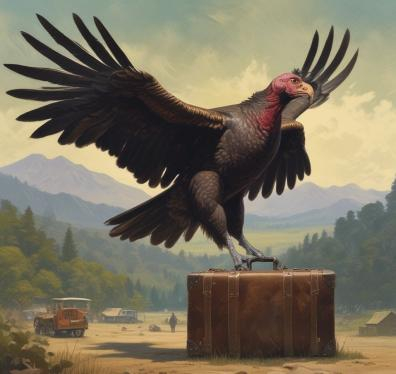
Native to the Americas, the turkey vulture (Cathartes aura) travels widely in search of sustenance. While usually foraging alone, it relies on other individuals of its species for companionship and mutual protection. Sometimes misunderstood, sometimes feared, sometimes shunned, it nevertheless performs an important role in the ecosystem.
This scavenger bird is a marvel of efficiency. Rather than expend energy flapping its wings, it instead locates uplifting columns of air, and spirals within them in order to glide to greater heights. This behavior has been mistaken for opportunism, interpreted as if it is circling doomed terrestrial animals destined to be its next meal. In truth, the vulture takes advantage of these thermals to gain the altitude needed glide longer distances, flying not out of necessity, but for the joy of it.
It also avoids the exertion necessary to capture live prey, preferring instead to feast upon that which is already dead. In this behavior, it resembles many humans.
It is not what most of us would consider to be a pretty bird. While its habits are often off-putting, or even disgusting, to members of more fastidious species, the turkey vulture helps to keep the environment from being clogged with detritus. Hence its Latin binomial, which translates to English as "golden purifier."
I rarely know where the winds will take me next, or what I might find there. The journey is the destination.
January 10, 2026 at 11:18am January 10, 2026 at 11:18am
| |
From Nautilus, one of those questions whose answers we're never going to agree on.
What Is Intelligence? 
At a church in Italy, we sought to shed an old definition for one that could save us
"Save us?" Okay, clickbait. Tell me how it's going to "save us" to define a word.
We were in the Tuscan countryside on an impossibly green hilltop, nothing but sheep bleating in the distance, and the creak of iron gates, flanked by carved stone lions, at the end of a gravel drive lined with Italian cypress trees.
Okay, now you're just bragging.
Gleiser fixed up the 500-year-old chapel with a dream of turning it into a think tank and named it the Island of Knowledge.
There is something immensely satisfying about turning a church into a place where knowledge is sought, not repressed.
We were here to come up with a new definition of intelligence. The old one, according to Gleiser, won’t do. “We have an ideology of infinite growth on a finite planet,” he said.
And? I've been saying this for years, and so have others, and yet no one with the power to do anything about it has ever done anything about it. I guess except maybe once, when China had a one-child policy, but they abandoned that because people are gonna people no matter what.
“That’s obviously not sustainable. What kind of intelligence are we using to create this scenario? That keeps me up at night.”
Maybe if you were intelligent, you'd know it was out of your hands and get some better sleep.
To expand the definition of intelligence, Gleiser brought together cognitive neuroscientist Peter Tse; astrophysicist Adam Frank; evolutionary ecologist Monica Gagliano; philosopher Evan Thompson; technology critic and essayist Meghan O’Gieblyn; and Indigenous scholar Yuria Celidwen.
Kind of like one of those carefully diverse superhero teams, I guess.
Celidwen handed us each a dried leaf, which she produced from a small pouch, then told us to taste it. “Let it explore your palate,” she said. I pretended to comply but palmed mine, wondering what it would be like to be the kind of person who puts a strange thing in their mouth just because someone tells them to.
I think I'm beginning to better understand "intelligence."
And, you know, so much for turning a church into a place to explore knowledge.
This was not going to be a typical scientific conference. Which I suppose made sense when you’re trying to overhaul typical scientific ideas. Poems would be recited. Tears would be shed. We weren’t allowed to wear shoes.
There's a big part of my psyche that is forever salty that I was born too late to experience the sixties in all their glory. But then I see something like this and go, "Nah."
Intelligence is usually understood as the ability to use reason to solve problems, skillfully wielding knowledge to achieve particular ends.
Crucial point here: Intelligence is not the same thing as knowledge.
In 1949, at Manchester University, a computer scientist, a chemist, a philosopher, a zoologist, a neurophysiologist, and a mathematician got together to debate whether intelligence could ever be instantiated in machines.
In a bar? Please tell me it was in a bar. Or, wait. Manchester: Pub. Whatever.
One of the participants, Alan Turing, inspired by the discussion, went home and wrote up his “imitation game,” now known as the Turing test, where a machine is dubbed intelligent if, through text conversation alone, it can fool us into thinking it’s human.
It is funny how no one talks about the Turing test anymore. Thing is, I have met scadoodles of humans who could not pass the Turing test. I figure it's likely that the concept inspired PKD to come up with the fictional Voight-Kampff test to tell replicants from humans in the story that became Blade Runner.
Thing is, from what little we know about the VK test, Dick seems to have been more focused on emotion than on intelligence, which, again, I suspect many humans (e.g. sociopaths and some of the neurodiverse) wouldn't pass, either.
Seventy-five years later, we’ve got chatbots acing the Turing test, and science conceiving of brains as Turing machines. Is it possible we’re missing something?
Of course we're missing something. I'm just not sure that "something" is hippie crap.
Inside the church, I could feel Gleiser’s urgency as he launched the discussion. Could the world agree on a new definition of intelligence before our collective stupidity destroys us?
It's not our stupidity that will destroy us. Lots of animals are stupid, by at least some definition, and most of them don't show any signs of wanting to destroy the world. And intelligence can be used for positive or negative things, and anything in between. No, if we destroy ourselves, it won't be a matter of intelligence, by any plausible definition, but shortsightedness. And maybe a little game theory: the first person or group who deliberately puts themselves at a disadvantage will be overrun by the groups that don't.
When nothing matters, nothing is a problem. Nothing means anything. “People call large language models ‘stochastic parrots,’ ” Thompson said. “But I think it’s insulting to parrots.”
Congratulations; you have reinvented nihilism.
There's quite a bit more at the link, though I wonder at the intelligence of trying to redefine an old word instead of coming up with and defining a new concept that might do a better job convincing the general public as well as those who might actually be able to do something about the problems. Despite my snark above, and a lingering doubt about their methods, I gotta give them props for trying to do something. And, if nothing else, at least they got to go to a retreat in fucking Tuscany. |
© Copyright 2026 Robert Waltz (UN: cathartes02 at Writing.Com). All rights reserved.
Robert Waltz has granted InkSpot.Com, its affiliates and its syndicates non-exclusive rights to display this work.
|


 Comment • View 3 comments