|
About This Author
Come closer.
|
Carrion Luggage
Carrion Luggage
 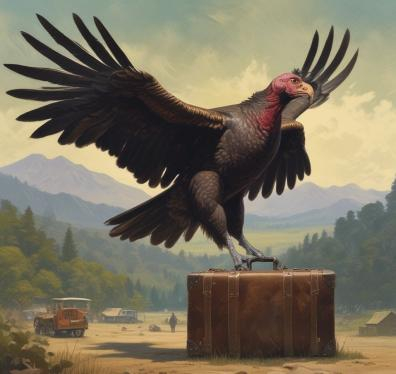
Native to the Americas, the turkey vulture (Cathartes aura) travels widely in search of sustenance. While usually foraging alone, it relies on other individuals of its species for companionship and mutual protection. Sometimes misunderstood, sometimes feared, sometimes shunned, it nevertheless performs an important role in the ecosystem.
This scavenger bird is a marvel of efficiency. Rather than expend energy flapping its wings, it instead locates uplifting columns of air, and spirals within them in order to glide to greater heights. This behavior has been mistaken for opportunism, interpreted as if it is circling doomed terrestrial animals destined to be its next meal. In truth, the vulture takes advantage of these thermals to gain the altitude needed glide longer distances, flying not out of necessity, but for the joy of it.
It also avoids the exertion necessary to capture live prey, preferring instead to feast upon that which is already dead. In this behavior, it resembles many humans.
It is not what most of us would consider to be a pretty bird. While its habits are often off-putting, or even disgusting, to members of more fastidious species, the turkey vulture helps to keep the environment from being clogged with detritus. Hence its Latin binomial, which translates to English as "golden purifier."
I rarely know where the winds will take me next, or what I might find there. The journey is the destination.
January 11, 2026 at 10:10am January 11, 2026 at 10:10am
| |
Continuing a theme, by chance, there's this recent anti-doom article from The Conversation.
What's a US philosopher? One who thinks before pulling the trigger?
Can one individual truly change the world?
I've had my doubts about this for a while.
US philosophers Michael Brownstein, Alex Madva and Daniel Kelly believe individuals can make a difference.
And all you have to do is buy our book!
No, seriously, they want you to buy their book. The article says so.
The authors aim to show readers how certain personal choices can alter the “structures” and “systems” that govern the myriad decisions we make, usually quite passively.
Um, that sounds like just another inspirational "self-help" book.
Written for a general audience, the gist of their argument is captured by the words of US environmental activist Bill McKibben. “The most important thing an individual can do,” he once said, “is become somewhat less of an individual.”
Pithy and all, but I think it undermines the idea that one person can change the world, at least not by themselves. You might have a good idea or a brilliant invention, but it doesn't do any good if other people don't adopt it.
As for changing the world for the worse, well, I think it's trivial to say that yes, for the worse, one individual can make a difference.
This book is timely. In the Anglosphere, and further afield, many people are unhappy.
Ah, yes, the essence of advertising: You're missing a piece. You're unhappy. I can help, for a price.
One response has been a widespread loss of belief that joining an established political party or even voting in an election can achieve change.
As they say, if voting could actually change things, it would be illegal. (Yes, I do it anyway.)
The authors are strong critics of the “self-responsibilisation” that big fossil fuel, tobacco, betting and other companies have foisted on people to head off real systemic change.
Now, on that, I can tentatively agree. I've been saying for years that it shouldn't all be on us.
They advocate an approach in which individuals focus on those activities most likely to trigger other people into changing entrenched structures.
That, at least, has potential.
In many respects, the book is inspiring. The examples show how some ordinary people can become change agents without, metaphorically, having to climb Mount Everest.
And that's cool and all, but, first of all, that sounds like those business success stories you always hear: Ordinary people, hard work, grit, determination, getting up at 4am, blah, blah... sure, but what about the vastly larger number of people who did all that and still failed?
Second of all, one of my favorite memes is the one that goes "Every corpse on Mount Everest was once a highly motivated person."
Anyway, there's a lot more at the article which, despite being a blatant book ad, is an interesting read. |
© Copyright 2026 Robert Waltz (UN: cathartes02 at Writing.Com). All rights reserved.
Robert Waltz has granted InkSpot.Com, its affiliates and its syndicates non-exclusive rights to display this work.
|


 Comment • View 5 comments