|
About This Author
Come closer.
|
Carrion Luggage
Carrion Luggage
 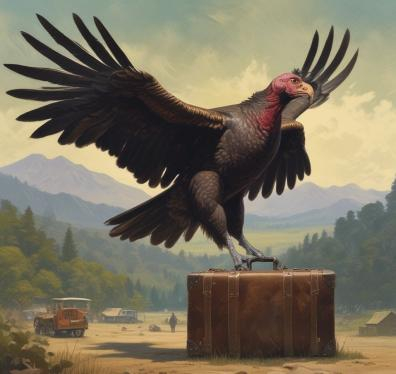
Native to the Americas, the turkey vulture (Cathartes aura) travels widely in search of sustenance. While usually foraging alone, it relies on other individuals of its species for companionship and mutual protection. Sometimes misunderstood, sometimes feared, sometimes shunned, it nevertheless performs an important role in the ecosystem.
This scavenger bird is a marvel of efficiency. Rather than expend energy flapping its wings, it instead locates uplifting columns of air, and spirals within them in order to glide to greater heights. This behavior has been mistaken for opportunism, interpreted as if it is circling doomed terrestrial animals destined to be its next meal. In truth, the vulture takes advantage of these thermals to gain the altitude needed glide longer distances, flying not out of necessity, but for the joy of it.
It also avoids the exertion necessary to capture live prey, preferring instead to feast upon that which is already dead. In this behavior, it resembles many humans.
It is not what most of us would consider to be a pretty bird. While its habits are often off-putting, or even disgusting, to members of more fastidious species, the turkey vulture helps to keep the environment from being clogged with detritus. Hence its Latin binomial, which translates to English as "golden purifier."
I rarely know where the winds will take me next, or what I might find there. The journey is the destination.
January 20, 2026 at 9:41am January 20, 2026 at 9:41am
| |
This is one of those times when I don't remember the original reason I saved something. But whatever; I'll find something to yap about. From NPR:
I guess I might have kept it because it's a word origin thing, and I do like knowing origins. But I've known this word's origin for decades, so I don't know.
Since the word was coined in the 18th century, "serendipity" has been used to describe all kinds of scientific and technological breakthroughs, including penicillin, the microwave oven and Velcro.
I'll take their word for it. For now.
And let's not forget that it was the name of the charming 2001 romantic comedy...
I'd already forgotten, thanks.
"Serendipity" — as the Merriam-Webster dictionary defines it — is "the ability to find valuable or agreeable things not sought for" or "luck that takes the form of such finding."
A dictionary, being descriptive and not prescriptive, is the beginning of understanding, not the end.
While the word has often been associated with good fortune or happy accidents, its origin suggests that serendipity goes beyond just happenstance. Some researchers argue that serendipity can be acquired through skill and that opportunities for serendipitous moments occur more frequently than we realize.
Okay, but wouldn't that give it a different definition?
The term was introduced by English politician and writer Horace Walpole in a letter dated Jan. 28, 1754. Walpole is widely credited with writing the first gothic novel, The Castle of Otranto, but he was also the inventor of dozens of words in the English language, including "souvenir" and "nuance,"...
Well, I thought "souvenir" was French, but I suppose someone had to port it to English. "Nuance" is definitely from French.
Walpole said he drew inspiration from a Persian fairy tale, "The Three Princes of Serendip." (Serendip is a historical name for Sri Lanka.)
No idea why I remembered that word origin over lo these many years, when I've forgotten so much else.
Over the years, the definition of "serendipity" has broadened slightly.
"I think often now people will use it in a bit more of a generic sense to mean a positive thing that happened by chance," Gorrie said. " It's the same basic meaning, but it's less to do with finding and more just to do with happening."
Yeah, words have a tendency to do that.
Personally, I don't know if I've ever used the word in other writing (besides today). I don't particularly like it. It's too close to "serenity," for one thing; and, for another, I suppose I was never quite sure of its nuance (see what I did there?) For a third thing, I can't say or even think the word without thinking "Dippity Do."
However, to Sanda Erdelez, a professor at the School of Library and Information Science at Simmons University, serendipity involves more than just being at the right place at the right time.
" What matters is not just chance, but how people recognize this opportunity and then how they act on that opportunity," she said. "There is actually an element of human agency in it."
I could argue that the ability to recognize and act on an opportunity is itself a form of luck: either you start out with that character trait, or you find an article like this one, by chance, and decide to work on that aspect of yourself. (Whether such efforts can be successful, I leave up to the reader.)
In her research, Erdelez focused on how people come across information important to them either unexpectedly or when they are not actively looking for it. She called them "super-encounterers."
"These are people who have a high level of curiosity," Erdelez said. "[They] have either a number of hobbies or interest areas so they can see connections between various things."
Oh. Yeah. That's why I saved this article: I consider myself a curious person with many areas of interest, and for as long as I can remember, I've tried to see connections between disparate things. It is, I think, a good trait for a writer to have.
So, for those on the hunt for serendipitous moments, Erdelez suggests carving out time from a busy schedule to give chance a good chance to happen.
Yeah, that borders on mysticism, but I'm not going to quibble about that; serendipity or not, I can't help but feel it's important to do that anyway. |
© Copyright 2026 Robert Waltz (UN: cathartes02 at Writing.Com). All rights reserved.
Robert Waltz has granted InkSpot.Com, its affiliates and its syndicates non-exclusive rights to display this work.
|


 Comment • View 5 comments