|
About This Author
Come closer.
|
Carrion Luggage
Carrion Luggage
 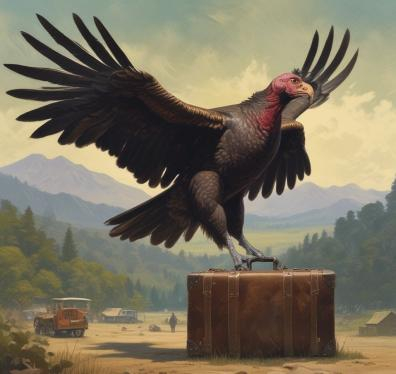
Native to the Americas, the turkey vulture (Cathartes aura) travels widely in search of sustenance. While usually foraging alone, it relies on other individuals of its species for companionship and mutual protection. Sometimes misunderstood, sometimes feared, sometimes shunned, it nevertheless performs an important role in the ecosystem.
This scavenger bird is a marvel of efficiency. Rather than expend energy flapping its wings, it instead locates uplifting columns of air, and spirals within them in order to glide to greater heights. This behavior has been mistaken for opportunism, interpreted as if it is circling doomed terrestrial animals destined to be its next meal. In truth, the vulture takes advantage of these thermals to gain the altitude needed glide longer distances, flying not out of necessity, but for the joy of it.
It also avoids the exertion necessary to capture live prey, preferring instead to feast upon that which is already dead. In this behavior, it resembles many humans.
It is not what most of us would consider to be a pretty bird. While its habits are often off-putting, or even disgusting, to members of more fastidious species, the turkey vulture helps to keep the environment from being clogged with detritus. Hence its Latin binomial, which translates to English as "golden purifier."
I rarely know where the winds will take me next, or what I might find there. The journey is the destination.
January 29, 2026 at 8:57am January 29, 2026 at 8:57am
| |
This article from The Independent seems to have been reissued from The Conversation, a source I've linked before. Why didn't I go look for it at Conversation? Because I'm lazy.
Okay, well, first of all-
No. Honestly, I don't even know where to begin with that headline. I'll try to just follow the article.
Medieval alchemists dreamed of transmuting lead into gold.
It is certain that some did. However, it is possible that the original idea was metaphorical: to turn something common and ordinary into something rare and precious.
Today, we know that lead and gold are different elements, and no amount of chemistry can turn one into the other.
I won't quibble about this except to say that what we call "elements," a category based on the number of protons in an atomic nucleus, isn't what alchemists called "elements." And actually, it seems to me that this quoted sentence is a bit tautological: an element is a substance that can't be turned into another substance through chemistry. Dictionary definition: "each of more than one hundred substances that cannot be chemically interconverted or broken down into simpler substances and are primary constituents of matter."
Note the definition doesn't say they can't be transmuted. Only that it can't be done via chemistry.
Perhaps I digress.
But our modern knowledge tells us the basic difference between an atom of lead and an atom of gold: the lead atom contains exactly three more protons.
First thing I've seen here that's unambiguously true.
So can we create a gold atom by simply pulling three protons out of a lead atom?
As it turns out, we can. But it’s not easy.
In other words, the resources needed to do so exceed, by many orders of magnitude, the value of the substance transmuted.
It would be like... I don't know, let's try this analogy. Somehow, you get knowledge that there's a gold nugget buried three miles beneath you. Is it worth the expense of excavation, drilling, time, etc., to get that nugget? Not in terms of the value of the gold, it's not. Or astronomers find an asteroid made of platinum: what's the cost of retrieving the asteroid, vs. the price of platinum?
Nevertheless, from a purely scientific perspective, it's cool. However, we already knew transmutation was possible. The Sun does it all the time, converting hydrogen to helium. Other elements are easier to transmute. Some even do it spontaneously, like with radioactive decay.
Scientifically, it's kind of like exoplanets. Until the 1990s, no one had imaged, or even inferred the existence of, a planet around a star other than our Sun. We were certain they had to be there; it made no sense whatsoever from a scientific perspective that our star, out of all the trillions and trillions of stars in the universe, was the only one with planets. Every space opera, every science fiction book or series, simply assumed that other stars had planets. But it's one thing to believe something, and another thing entirely to have experimental verification.
While smashing lead atoms into each other at extremely high speeds in an effort to mimic the state of the universe just after the Big Bang...
The "mimic the Big Bang" thing is hype for the public, and it led (pun intended) to all kinds of misunderstandings about what they were actually doing. To be fair, what they were actually doing is way above my pay grade, so of course they had to find a way to explain it to the general public.
But this created its own set of problems like people thinking it meant they were trying to create a whole nother universe. The funniest thing to come out of this misunderstanding was this web page: https://hasthelargehadroncolliderdestroyedtheworldyet.com/
Anyway, here's CERN itself  explaining the LHC. explaining the LHC.
So, getting back to the article:
Despite my misgivings about its sensationalism, it actually goes on to do a pretty good explanation of what's actually happening, without getting too technical. So it's there if you care; the article itself is pretty short, unlike the LHC.
One final thing: it would be a mistake to scoff at those alchemists, based on our current knowledge of science and the universe. Just as astrology preceded astronomy, alchemy was an essential step on the road to chemistry. I know I've said it before, but even Isaac Newton had alchemical beliefs. What marks a scientist, though, isn't the beliefs they start out with; it's the conclusions they end up with based on observation and experiment.
And that, folks, is the true alchemy: turning the lead of guesswork and wishful thinking into the gold of knowledge and understanding. |
© Copyright 2026 Robert Waltz (UN: cathartes02 at Writing.Com). All rights reserved.
Robert Waltz has granted InkSpot.Com, its affiliates and its syndicates non-exclusive rights to display this work.
|


 Comment • View 3 comments