Blog Calendar
    January     ►
SMTWTFS
    
9
10
11
12
13
14
15
16
17
18
19
20
21
22
23
24
25
26
27
28
29
30
31
Archive RSS
About This Author
Come closer.
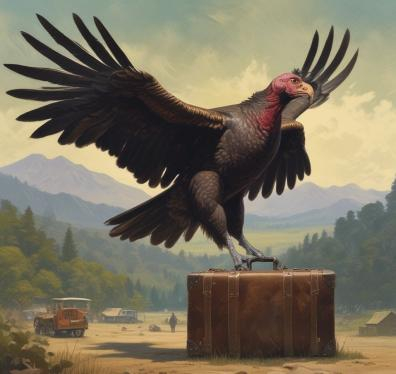
Carrion Luggage

Carrion Luggage

Blog header image

Native to the Americas, the turkey vulture (Cathartes aura) travels widely in search of sustenance. While usually foraging alone, it relies on other individuals of its species for companionship and mutual protection. Sometimes misunderstood, sometimes feared, sometimes shunned, it nevertheless performs an important role in the ecosystem.

This scavenger bird is a marvel of efficiency. Rather than expend energy flapping its wings, it instead locates uplifting columns of air, and spirals within them in order to glide to greater heights. This behavior has been mistaken for opportunism, interpreted as if it is circling doomed terrestrial animals destined to be its next meal. In truth, the vulture takes advantage of these thermals to gain the altitude needed glide longer distances, flying not out of necessity, but for the joy of it.

It also avoids the exertion necessary to capture live prey, preferring instead to feast upon that which is already dead. In this behavior, it resembles many humans.

It is not what most of us would consider to be a pretty bird. While its habits are often off-putting, or even disgusting, to members of more fastidious species, the turkey vulture helps to keep the environment from being clogged with detritus. Hence its Latin binomial, which translates to English as "golden purifier."

I rarely know where the winds will take me next, or what I might find there. The journey is the destination.


January 8, 2026 at 8:20am
#1105435
Today, we're back to food, but with an article of limited use to those who don't live in pawpaw country. From Atlas Obscura:
Kitchen Dispatch: A Quest to Create the Perfect Pawpaw Ice Cream  Open in new Window.
The wild-growing fruit is best found through foraging, and custard turned out to be the key ingredient.

And I do live in pawpaw country. Or I did. They grew wild in the woods where I spent my childhood.

As the weather got colder last week, I decided it was the perfect time to make pawpaw ice cream.

I was wondering why there's a December article about ice cream in the northern hemisphere, but really, ice cream is a forever treat.

I tested several recipes I thought would work well with the fruit’s flavor—a mix of banana, mango, and durian.

None of which, I must emphasize, are native to Virginia. Not by a long shot. Hell, durian grows on damn near the opposite side of the planet. (I'll refrain from making durian jokes this time after a faux pas in the newsfeed yesterday.)

Flavor is flavor, though. My dad always called them "Virginia bananas."

I chose a simple ice cream recipe, a mixture of pawpaw puree, sugar, cream, and milk.

Unfortunately, Dad never figured out how to prepare pawpaw, and my mother refused to. Just as well, considering her other attempts at cooking. She tried, she really did, but just never got the hang of it.

Since pawpaws are notoriously difficult to cultivate, foraging is the best way to obtain a large amount.

But that's
work.

On the other hand, it's probably cheap, or even, in my case, free.

The author apparently lives in New York, and honestly, I didn't know pawpaws ranged all the way up there. Nice to learn new things.

Making ice cream is, of course, also work, so I won't be doing it. Still, it's nice to know that this relatively obscure wild fruit, connected to my personal history in some small way, is getting the respect it deserves.


© Copyright 2026 Robert Waltz (UN: cathartes02 at Writing.Com). All rights reserved.
Robert Waltz has granted InkSpot.Com, its affiliates and its syndicates non-exclusive rights to display this work.

... powered by: Writing.Com
Online Writing Portfolio * Creative Writing Online