|
About This Author
Come closer.
|
Carrion Luggage
Carrion Luggage
 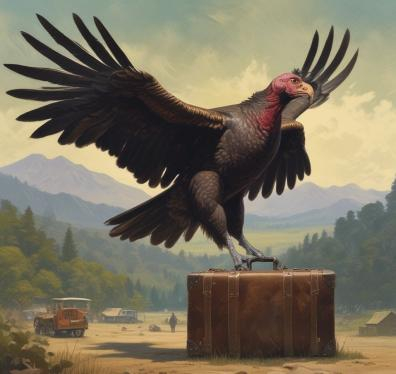
Native to the Americas, the turkey vulture (Cathartes aura) travels widely in search of sustenance. While usually foraging alone, it relies on other individuals of its species for companionship and mutual protection. Sometimes misunderstood, sometimes feared, sometimes shunned, it nevertheless performs an important role in the ecosystem.
This scavenger bird is a marvel of efficiency. Rather than expend energy flapping its wings, it instead locates uplifting columns of air, and spirals within them in order to glide to greater heights. This behavior has been mistaken for opportunism, interpreted as if it is circling doomed terrestrial animals destined to be its next meal. In truth, the vulture takes advantage of these thermals to gain the altitude needed glide longer distances, flying not out of necessity, but for the joy of it.
It also avoids the exertion necessary to capture live prey, preferring instead to feast upon that which is already dead. In this behavior, it resembles many humans.
It is not what most of us would consider to be a pretty bird. While its habits are often off-putting, or even disgusting, to members of more fastidious species, the turkey vulture helps to keep the environment from being clogged with detritus. Hence its Latin binomial, which translates to English as "golden purifier."
I rarely know where the winds will take me next, or what I might find there. The journey is the destination.
January 9, 2026 at 10:33am January 9, 2026 at 10:33am
| |
Words about words, from Mental Floss:
It’s easy to forget that new words, just like everything else that comes in and out of fashion, are being coined all the time.
One of the things I'm most salty about in life, and no I will not get over it, is that no one recognizes that I coined the word "rad."
Well, not the word, but the meaning, as in "that shit's totally rad, bro."
Now, it's entirely possible that someone else came up with it independently. Still, it stings to never get the credit I deserved.
...as best as their research can tell us, all the words and phrases in this list were coined precisely 50 years ago, in 1976.
I have my doubts. Still, it's probably a decent look at what words/phrases hit the mainstream in '76, which, for context, is the year Jimmy Carter was elected President.
As usual, I'm only going to cover a few of these.
Athleisure
The likes of tracksuits, spandex, and sneakers began to step out of the gym and into everyday fashion in the 1970s, leading to an athleisure trend that has continued to grow ever since.
I haven't heard or seen that word, outside of this article, in some time, so I don't know if it's still relevant. What is relevant is that it started, or perhaps elevated, a trend of stupid fucking portmanteaux that all need to die.
Butterfly Effect
The popular metaphor of the tiny flap of a butterfly’s wings sparking an eventually large-scale chain reaction has been discussed since the early 1970s at least. But both Merriam-Webster and the Oxford English Dictionary have traced the very earliest written record of the butterfly effect to an article published in the scientific journal Nature in 1976.
Okay, maybe. That one's related to chaos theory: that a butterfly flapping in the Amazon can, due to the way chaos works, lead to a typhoon in the Pacific. Not that such a thing can be predicted or controlled; that's why it's called chaos. But I'm pretty sure chaos theory was introduced in the early 60s, and even before that, there was Bradbury's "A Sound of Thunder," which speculated on large-scale changes in time thanks to some idiot stepping on a butterfly after time-traveling to the distant past.
That's not an obscure SF short story, either; it's one of the acknowledged all-time greats.
Couch Potato
TV played such a big part in 1970s homelife that this was the era when the couch potato was born. Defined by Merriam-Webster as “a lazy and inactive person, especially one who spends a great deal of time watching television,” etymologically, the term might just allude to the dormancy of potatoes below ground.
In the late 70s / early 80s, I proposed alternatives to this one: Bench Fry, and Sofa Spud. Neither of those caught on.
French Press
The very first kettle—or pitcher-like devices for brewing loose coffee, which can then be pushed to the bottom of the vessel using a metal plunger—were supposedly developed in France in the mid-1800s.
You know, with the exception of "fries," I can't think offhand of any phrases that start with "French" that aren't inherently sexual. Okay, maybe fries, too.
Meme
Richard Dawkins coined the word meme as “a unit of cultural transmission” in his groundbreaking book exploring gene-centered evolution, The Selfish Gene, in 1976.
Lest we forget what that word is supposed to mean. That its popular definition has changed since then is one of the finest examples of irony that I know.
Radical
Derived from the Latin word for a plant’s root, radical first emerged in medieval English in its original and literal sense, to refer to anything growing or deriving from a root, and therefore vital or essential to life or survival.
And I'm the one who shortened it, dammit!
Wuss
No one is entirely sure where the word wuss comes from...
Oh come on. As the article suggests, it's a combination of "wimp" and "pussy." My guess is someone started to say "wimp" but his (it was almost certainly "his") tiny brain tried to change it to "pussy" halfway, and behold, a new insult was born.
I don't know why "pussy" got associated with wimpiness in the first place, anyway. Those things evolved to be tough. Their male counterparts are far more fragile. |
© Copyright 2026 Robert Waltz (UN: cathartes02 at Writing.Com). All rights reserved.
Robert Waltz has granted InkSpot.Com, its affiliates and its syndicates non-exclusive rights to display this work.
|


 Comment • View 7 comments