|
About This Author
Come closer.
|
Carrion Luggage
Carrion Luggage
 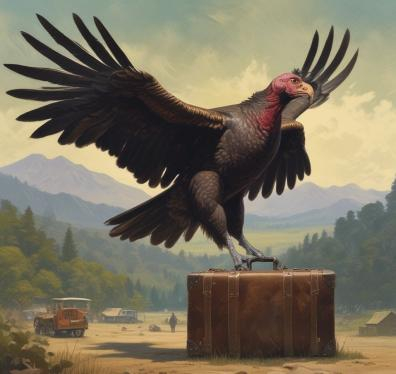
Native to the Americas, the turkey vulture (Cathartes aura) travels widely in search of sustenance. While usually foraging alone, it relies on other individuals of its species for companionship and mutual protection. Sometimes misunderstood, sometimes feared, sometimes shunned, it nevertheless performs an important role in the ecosystem.
This scavenger bird is a marvel of efficiency. Rather than expend energy flapping its wings, it instead locates uplifting columns of air, and spirals within them in order to glide to greater heights. This behavior has been mistaken for opportunism, interpreted as if it is circling doomed terrestrial animals destined to be its next meal. In truth, the vulture takes advantage of these thermals to gain the altitude needed glide longer distances, flying not out of necessity, but for the joy of it.
It also avoids the exertion necessary to capture live prey, preferring instead to feast upon that which is already dead. In this behavior, it resembles many humans.
It is not what most of us would consider to be a pretty bird. While its habits are often off-putting, or even disgusting, to members of more fastidious species, the turkey vulture helps to keep the environment from being clogged with detritus. Hence its Latin binomial, which translates to English as "golden purifier."
I rarely know where the winds will take me next, or what I might find there. The journey is the destination.
October 19, 2025 at 11:01am October 19, 2025 at 11:01am
| |
I thought I might have addressed this at some point, and it turns out I did, in the previous blog, back in 2021. That entry can be found here: "My Baloney Has a First Name..."  . This time, though, it's a relatively recent article from a different source, Open Culture. . This time, though, it's a relatively recent article from a different source, Open Culture.
Part of the reason I'm doing this is that I found an inconsistency. I wouldn't call it "baloney" or fake news or bullshit, but it illustrates exactly why we shouldn't take words on the internet to be absolute truth without some backup.
Though he died too young, Carl Sagan left behind an impressively large body of work, including more than 600 scientific papers and more than 20 books.
And yet, he was best known for his Mister Rogers-like TV personality.
Sagan’s other popular books... are also well worth reading, but we perhaps ignore at our greatest peril The Demon-Haunted World: Science as a Candle in the Dark. Published in 1995, the year before Sagan’s death, it stands as his testament to the importance of critical, scientific thinking for all of us.
It has been too long since I read that. If I can't even remember what I posted here four years ago, it would do me well to revisit it, since I try to promote real science in here.
The article lays out the "Baloney Detection Kit." Or does it? Both this article and the one I linked in 2021 claim nine principles, starting with
Wherever possible there must be independent confirmation of the “facts.”
But today's link ends with "Occam's Razor," while the previously linked article had a lengthy bit about hypotheses needing to be, in principle, falsifiable, after that one.
This doesn't sink to the level of fake news, in my opinion. It's, at worst, a different way to look at the source material (which, I reiterate, I haven't seen in decades). The article isn't a scientific paper. If you make a transcription error in a scientific paper, bad things happen. I had one in here a while back about the ooga-booga scare over black plastic cooking utensils; turns out they'd misplaced a decimal, and black plastic is about as safe as anything in your kitchen, and safer than most.
I suppose even that is better than if the mistake went in the other direction, calling something safe when it's not, but still. The particular team involved in that, as I recall, had some sort of bias against the utensils (perhaps they were being paid by a manufacturer of different kinds of utensils, perhaps not), and it's that kind of bias that science is supposed to mitigate, as noted in the article:
As McCoy points out, these techniques of mind have to do with canceling out the manifold biases present in our thinking, those natural human tendencies that incline us to accept ideas that may or may not coincide with reality as it is. If we take no trouble to correct for these biases, Sagan came to believe, we’ll become easy marks for all the tricksters and charlatans who happen to come our way.
And there are more tricksters and charlatans than ever before. Or, at least, they have a broader range with the internet and all.
Now, other sources break the principles up slightly differently, too. I suppose it's a bit like the Ten Commandments, which vary depending on which version and translation of the Old Testament you look at.
“Like all tools, the baloney detection kit can be misused, applied out of context, or even employed as a rote alternative to thinking,” Sagan cautions. “But applied judiciously, it can make all the difference in the world — not least in evaluating our own arguments before we present them to others.”
Sagan was, apparently, a far nicer person than I am, because I call it bullshit. Baloney is at least edible. Though "bullshit" holds the implication that it's deliberate, but it's not always so.
Whichever version you see, though, I think the principles are sound. I may not have memorized them, but I still find myself applying them and, often, find articles that come up short. This isn't always a science problem; most of the time, it's a writing problem. And that's what we're really here for, isn't it? |
© Copyright 2026 Robert Waltz (UN: cathartes02 at Writing.Com). All rights reserved.
Robert Waltz has granted InkSpot.Com, its affiliates and its syndicates non-exclusive rights to display this work.
|


 Comment • View 4 comments