|
About This Author
Come closer.
|
Carrion Luggage
Carrion Luggage
 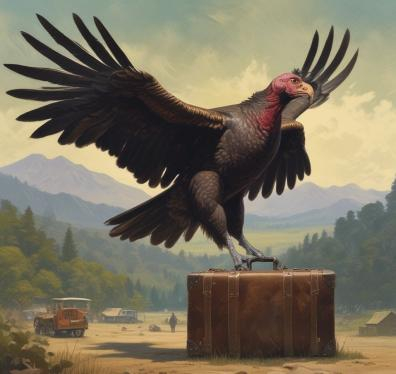
Native to the Americas, the turkey vulture (Cathartes aura) travels widely in search of sustenance. While usually foraging alone, it relies on other individuals of its species for companionship and mutual protection. Sometimes misunderstood, sometimes feared, sometimes shunned, it nevertheless performs an important role in the ecosystem.
This scavenger bird is a marvel of efficiency. Rather than expend energy flapping its wings, it instead locates uplifting columns of air, and spirals within them in order to glide to greater heights. This behavior has been mistaken for opportunism, interpreted as if it is circling doomed terrestrial animals destined to be its next meal. In truth, the vulture takes advantage of these thermals to gain the altitude needed glide longer distances, flying not out of necessity, but for the joy of it.
It also avoids the exertion necessary to capture live prey, preferring instead to feast upon that which is already dead. In this behavior, it resembles many humans.
It is not what most of us would consider to be a pretty bird. While its habits are often off-putting, or even disgusting, to members of more fastidious species, the turkey vulture helps to keep the environment from being clogged with detritus. Hence its Latin binomial, which translates to English as "golden purifier."
I rarely know where the winds will take me next, or what I might find there. The journey is the destination.
November 25, 2025 at 8:28am November 25, 2025 at 8:28am
| |
Unless you've been living under the proverbial rock, you've probably heard of this phenomenon. I know I have, even though I have no offspring. From Atlas Obscura, though this time it's not about a physical place:
Admittedly, I'm skeptical. How is repeating what other people are doing "creativity?" Seems like the polar opposite of that.
Have you heard about 2025’s word of the year? It’s causing a bit of controversy because it’s actually not a word. “67” (pronounced six-seven) is all the rage with Gen Alpha, a phrase often accompanied by an up and down hand movement.
If not, you've heard about it now.
...it has become inescapable in 2025, causing outright bans on the phrase in classrooms as well as extensive head scratching by parents.
Because everyone knows that the way to keep kids from doing something is to ban it.
Oh, wait, sorry, that's the way to ensure they keep doing it.
But other than its initial spread via TikTok, there’s not much that separates “67” from centuries of absurd, nonsensical kid culture.
The internet, and is associated social media, spreads these things faster, and to audiences that might not otherwise have been exposed. But yeah, when I first heard about it, I was like "Hmpf. Kids these days." Then my second thought was "What about non-Anglophone kids? Are they aping this meme too?"
The Opies were a British couple who dedicated their lives to the study of children’s folklore, games, traditions, and beliefs.
Kids are gonna kid, and people gonna people. Our tech has changed drastically since their research, but, like the Ship of Theseus, humanity keeps the same general shape. So yeah, even stuff from the middle of last century can still have relevance.
Part of their obsession with documenting children’s traditions had to do with refuting an idea, common at the time, that television and mass media was “ruining” childhood. (Sound familiar?)
As the article notes, they were amateurs, albeit very effective ones. The practice of doing science, or science-adjacent research, shouldn't start with the conclusion you want. It taints the science. It would be like if someone did a study on childhood cannabis use with the express purpose of showing that it's a good thing.
Still, they were challenging others' unfounded assumptions, so I can forgive them.
The Opies didn’t use the word “meme” because that term wasn’t coined until the 1980s, with Richard Dawkins’ work on “the selfish gene,” but they were essentially demonstrating that these rhymes were memes, being passed along from child to child in a long unbroken chain, being modified somewhat from generation to generation as they mutated to survive.
This also has relevance to folklore in general. No doubt, when writing was invented, some old folks would have been like "Damn, this newfangled 'writing' crap is going to rot the kids' minds, you mark my words!"
So is “67” a sign that screens and algorithms are “ruining childhood” with “brainrot?” Far from it—this trend actually shows that despite a screen-mediated culture kids are actually managing to generate new entries in the playground canon.
And if you want them to just fucking stop already, the answer isn't to ban it. It's to adopt it yourself, and use it unironically around children. Then it stops being relevant to them.
Problem is, they'll just come up with some other way to annoy and baffle adults. And the cycle continues. The only saving grace is that, barring global catastrophe, most of them will grow up eventually, and some of them will have kids, and those kids will find ways to annoy and baffle them in turn. |
© Copyright 2026 Robert Waltz (UN: cathartes02 at Writing.Com). All rights reserved.
Robert Waltz has granted InkSpot.Com, its affiliates and its syndicates non-exclusive rights to display this work.
|


 Comment • View 7 comments