|
About This Author
Come closer.
|
Carrion Luggage
Carrion Luggage
 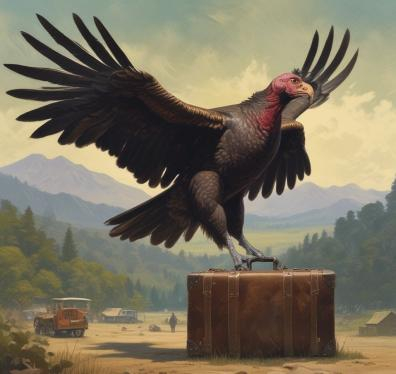
Native to the Americas, the turkey vulture (Cathartes aura) travels widely in search of sustenance. While usually foraging alone, it relies on other individuals of its species for companionship and mutual protection. Sometimes misunderstood, sometimes feared, sometimes shunned, it nevertheless performs an important role in the ecosystem.
This scavenger bird is a marvel of efficiency. Rather than expend energy flapping its wings, it instead locates uplifting columns of air, and spirals within them in order to glide to greater heights. This behavior has been mistaken for opportunism, interpreted as if it is circling doomed terrestrial animals destined to be its next meal. In truth, the vulture takes advantage of these thermals to gain the altitude needed glide longer distances, flying not out of necessity, but for the joy of it.
It also avoids the exertion necessary to capture live prey, preferring instead to feast upon that which is already dead. In this behavior, it resembles many humans.
It is not what most of us would consider to be a pretty bird. While its habits are often off-putting, or even disgusting, to members of more fastidious species, the turkey vulture helps to keep the environment from being clogged with detritus. Hence its Latin binomial, which translates to English as "golden purifier."
I rarely know where the winds will take me next, or what I might find there. The journey is the destination.
December 10, 2025 at 9:48am December 10, 2025 at 9:48am
| |
I don't expect this BBC article to be of interest to everyone. But, as someone who was adopted, I have Opinions.
I will note, for those not wanting to click on the link (but come on, it's the BBC, not some malware site), that the article opens with a big pic of Tom Hiddleston as Loki from the MCU.
Hollywood blockbusters and horror films frequently using adopted children as psychopaths and villains causes harm in real life, adoptees have said.
Okay. I'm not going to argue that such a thing can't cause, or hasn't caused, harm. I don't know. What I do know is that the same can be said for any minority: villain-casting has the potential to reinforce stereotypes if the writers are careless. Though the same can be said for hero-casting them.
James Evans, 23, was two-and-a-half months old when he was removed from his birth family due to their inability to parent and harmful behaviour.
Now with a masters degree in scriptwriting, James said films such as Thor, Annabelle and The Conjuring: The Devil Made Me Do It, among many others, made him "frustratingly uncomfortable" at how adoptees are depicted.
I didn't see those last two, but they sound like horror movies. No one in a horror movie, generally, is portrayed in a great light.
He was fostered by two families before Ruth and Andrew Evans adopted him when he was two and said no film or TV series had ever made him feel "properly seen".
Well... if he feels that way, he feels that way. I suppose there might be unresolved trauma, given his unfortunate first two years. My situation was different (adopted as an infant and kept in a stable, if not perfect, home). (What family is perfect?)
One of the most high-profile adoptees in cinema is the Norse god of mischief Loki in the Marvel films.
This bit, though, I can say something about.
First of all, in that movie, Thor himself starts out as a massive, throbbing cock, and he's the one who's the biological (or however it works in Asgard) offspring. The whole movie is his redemption arc. Loki is... complicated, I'd say more a foil than a villain, and really shows up as a major villain in The Avengers.
But what the article doesn't talk about, and may not know, is that Loki gets his own redemption arc, in the form of the series that bears his name. I'm not going to spoil it, but damn, I can't think of a more powerful redemption arc in all of literature.
Yes, I said literature. Shut up.
These stories reinforce damaging stereotypes of adopted people as imposters or "devil children" where trauma is used as a "lazy" plot device for evil, he said.
Okay, like I said, stereotyping is bad. But writers use trauma as a background for villainy with bio children, as well.
The other end of the spectrum is the "grateful adoptee", when a child's adoption is seen as a fairy tale ending, such as Miss Honey taking in Matilda in the Roald Dahl book and subsequent films.
Another one I'm not familiar with, but having read other Dahl, I find it difficult to believe it's truly a fairy tale ending.
This ignores "the loss and grief" of children being taken away from their birth parents, James said.
Sheesh, talk about stereotypes.
I've no doubt there are Issues involved there. But, again, Issues can stem from a lot of childhood trauma, not just having been adopted.
While James has been "loved and cared for" and has "the best support system" in parents Ruth and Andrew, he said just because his trauma was invisible, does not mean he did not need help.
To be clear, I am not trying to minimize or mock his lived experience. Again, though, lots of people need help.
James said the portrayal of adoptees through the fairy tale lens was as damaging as being presented as villains as it tells society they were ungrateful if they behave outside this stereotype.
You think that's bad? Try being a fairy-tale stepmother.
"If an adopted child's parents are parenting them, they are their real parents.
"They are the ones who are there every day fighting for their child and that is real parenting. Biology isn't fundamentally what defines parenting, it's what you do."
On that, I am completely in agreement. My real parents are the ones who changed my diapers, kissed skinned knees, and put up with my teenage bullshit. Not the ones who happened to share five minutes of fun.
Despite all this, James and Susie highlighted some good portrayals.
And yet, the ones they highlighted don't paint the whole picture.
See, there's another adoptee in literature. Probably the most famous one. The one that is the most canonically not a villain, but the absolute polar opposite thereof, despite his trauma.
I'm talking about the guy in the blue suit and red cape.
Now, I'm not saying they can't do better. That we can't do better, as writers. But I object to the idea that adopted people should never be villains. Just like with anyone else, they have agency. We're not angels; we're not monsters. We're just people. It would be like saying "We can't show this Black dude as a gangster, because that would make people think that all Black dudes are criminals."
As for me, if I want to see a positive role model for my own experience, all I have to do is look. Up in the sky. |
© Copyright 2026 Robert Waltz (UN: cathartes02 at Writing.Com). All rights reserved.
Robert Waltz has granted InkSpot.Com, its affiliates and its syndicates non-exclusive rights to display this work.
|


 Comment • View 5 comments