|
About This Author
Come closer.
|
Carrion Luggage
Carrion Luggage
 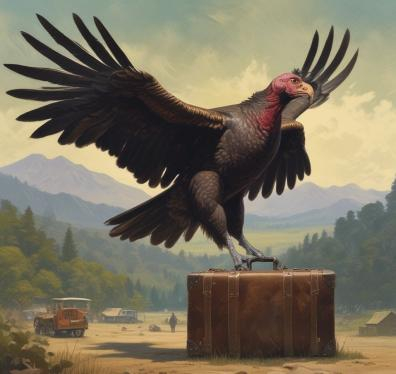
Native to the Americas, the turkey vulture (Cathartes aura) travels widely in search of sustenance. While usually foraging alone, it relies on other individuals of its species for companionship and mutual protection. Sometimes misunderstood, sometimes feared, sometimes shunned, it nevertheless performs an important role in the ecosystem.
This scavenger bird is a marvel of efficiency. Rather than expend energy flapping its wings, it instead locates uplifting columns of air, and spirals within them in order to glide to greater heights. This behavior has been mistaken for opportunism, interpreted as if it is circling doomed terrestrial animals destined to be its next meal. In truth, the vulture takes advantage of these thermals to gain the altitude needed glide longer distances, flying not out of necessity, but for the joy of it.
It also avoids the exertion necessary to capture live prey, preferring instead to feast upon that which is already dead. In this behavior, it resembles many humans.
It is not what most of us would consider to be a pretty bird. While its habits are often off-putting, or even disgusting, to members of more fastidious species, the turkey vulture helps to keep the environment from being clogged with detritus. Hence its Latin binomial, which translates to English as "golden purifier."
I rarely know where the winds will take me next, or what I might find there. The journey is the destination.
December 11, 2025 at 9:46am December 11, 2025 at 9:46am
| |
What am I doing on a site called VegOut? Glad you asked. Just questioning the validity of this article.
*taps cane*
I'm telling you. Kids these days.
...shall we start with the obvious? If this really applied to everyone, or even to the majority, in my cohort, then that's the polar opposite of "set you apart."
So even with the headline, my inner cynic is poking out of my pants, looking around, and going, "Yeah, right."
Growing up in the 1960s or 70s wasn’t just a different era — it was a different psychological environment entirely. No smartphones. No constant supervision. No algorithm telling you what to think. You were shaped by freedoms, challenges, and cultural norms that simply don’t exist for today’s kids.
And spankings. Lots and lots of spankings.
(I'm not saying that was right, mind you. It's just the way most parents did it back then, because they, too, were shaped by their pasts.)
And psychologists agree: the way your brain developed during those formative years left you with cognitive patterns, emotional habits, and mental strengths that set you apart — for better and for worse.
I can't disagree that experience during one's formative years is a big factor in one's personalty. Without getting into the age-old debate of nature vs. nurture, both have some role to play. What makes my skepticism rise is the idea that we all, or most of us anyway, had experiences similar enough to make sweeping generalizations.
My own upbringing was unique. Others were even more rural. Many were suburban, or urban. I feel like those environments mold people differently. And I'm not even going to get into how the article is US-centric; let's just acknowledge that it is, and run with it.
About the only thing I can think of was what we all, indeed, had in common: TV was three commercial channels, plus PBS, broadcast over airwaves and received by antennas. Radio was our only source of music, and, for me at least, they had both kinds: country AND western. Worst of all, no video games, at least not until the late 70s, which also featured disco, so kind of a mixed blessing there.
I'm not reminiscing about this out of some nostalgia, mind you. There was a lot to dislike about the situation. Let's not forget how the military action in Vietnam affected all of us at the time.
Point is, I feel like a lot of these things do, in fact, apply to me. But that doesn't make my skepticism go limp.
As someone who writes about psychology, mindfulness...
Normally, I'd Stop Reading Right There.
...and the changing dynamics between generations, I’ve noticed something fascinating: people who grew up in the 60s or 70s often share certain traits that younger generations don’t naturally develop.
Okay, but a statement that general, couldn't it apply to every "generation," however you want to define that?
The article gets into the specifics of the "certain traits," but swap those out, and you're back to making sweeping generalizations about any generation.
1. You developed resilience through boredom, not stimulation
Kids today are never bored — they have a screen in their pocket that delivers instant entertainment on demand. But in the 60s and 70s, boredom was your constant companion.
I remember being bored on occasion. I always found something to do, though (living on a farm'll do that). If nothing else, I loved reading books. And there weren't a lot of other kids around; the ones that were, were delinquents (one of them is in prison for murder one right now).
I'm not saying I was an angel, but I was an only child in a rural area and I had to get creative. But I'm certain boredom wasn't a "constant companion."
This is why so many older adults are naturally more grounded and less dependent on external stimulation. Your childhood literally trained your brain to be comfortable sitting with your own thoughts.
It couldn't be just because older adults of any generation generally become more grounded and less thrill-seeking. Could it?
2. You learned independence because no one was tracking your every move
On this point, I provisionally agree. I'm not sure how that's better, though. There's something to be said for training your kids to grow up in a surveillance environment. Makes 'em more paranoid and less likely to do some of the shit I got away with. This is what Elf on a Shelf is for, by the way: letting kids internalize that someone, somewhere, is always watching.
3. You became socially adaptable long before the internet existed
Growing up in a pre-digital world meant you had to socialize the old-fashioned way:
Face to face.
At school.
On the street.
On the phone attached to the kitchen wall with a cord that could barely reach the hallway.
I'm not convinced this is better, despite having lived it. Different to today? Sure. Better? To use the catchphrase of my generation: Meh. Whatever.
4. You experienced consequences directly, not digitally
When today’s kids make a mistake, they might get a notification, a screen warning, or a parent stepping in immediately.
Much as I, like anyone else, am tempted to think how they grew up was "the way things ought to be" and "better," again... not convinced.
For instance, there is something to be said for being able to chat in real-time with people all over the globe. The potential is there to acquire a wider perspective, not just be limited to your own neighborhood, region, or country.
5. You grew up with scarcity, so your brain understands value
Whether you grew up comfortable or not, the 60s and 70s were an era before excess, convenience, and instant gratification.
This actually made me laugh out loud. Not because I felt like we were rich or anything, but because my parents were older, and lived through the actual Great Depression. We didn't have scarcity. We had convenience. Sure, we weren't ordering crap from the then-nonexistent internet, but, and I can't stress this enough, we lived like royalty compared to the shit my parents went through when they were young.
Not that there weren't people my age living in poverty, but you can say that about today's situation, too.
6. You developed patience and attention span from slower living
And promptly threw them out the window as soon as I possibly could.
There's more at the link, but my attention span is already overtaxed.
The one thing I'll say that stands out to me: when I was a kid, we only had to find a way to find the fit in / stand out balance with maybe 100-1000 other kids, at school or whatever. Call it 500 for argument's sake. You can find a way to stand out against a crowd of 500. Maybe you're the best musician. Maybe you're the best artist. Maybe you're the best at math, or science, or bike-riding, or delinquency. Or you excel at football, or have the nicest tits. (For me, it was being a comedian. Class clown five years running, baby!) Now, kids aren't competing against their school group, but among millions of other kids from all over the world. How do you stand out in a crowd like that? Some do, of course.
The rest? Meh. Whatever. |
© Copyright 2026 Robert Waltz (UN: cathartes02 at Writing.Com). All rights reserved.
Robert Waltz has granted InkSpot.Com, its affiliates and its syndicates non-exclusive rights to display this work.
|


 Comment • View 8 comments