|
About This Author
Come closer.
|
Carrion Luggage
Carrion Luggage
 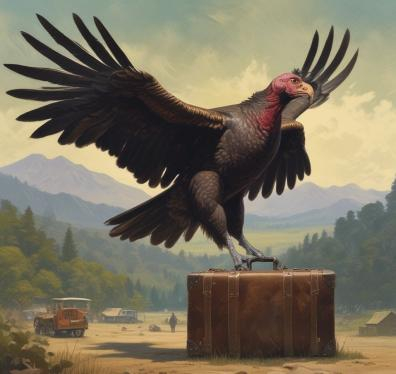
Native to the Americas, the turkey vulture (Cathartes aura) travels widely in search of sustenance. While usually foraging alone, it relies on other individuals of its species for companionship and mutual protection. Sometimes misunderstood, sometimes feared, sometimes shunned, it nevertheless performs an important role in the ecosystem.
This scavenger bird is a marvel of efficiency. Rather than expend energy flapping its wings, it instead locates uplifting columns of air, and spirals within them in order to glide to greater heights. This behavior has been mistaken for opportunism, interpreted as if it is circling doomed terrestrial animals destined to be its next meal. In truth, the vulture takes advantage of these thermals to gain the altitude needed glide longer distances, flying not out of necessity, but for the joy of it.
It also avoids the exertion necessary to capture live prey, preferring instead to feast upon that which is already dead. In this behavior, it resembles many humans.
It is not what most of us would consider to be a pretty bird. While its habits are often off-putting, or even disgusting, to members of more fastidious species, the turkey vulture helps to keep the environment from being clogged with detritus. Hence its Latin binomial, which translates to English as "golden purifier."
I rarely know where the winds will take me next, or what I might find there. The journey is the destination.
December 13, 2025 at 9:18am December 13, 2025 at 9:18am
| |
More support for my "science fiction is the most important genre of literature" hypothesis, from a not-so-happy Medium:
Because those are references to Nineteen Eighty-Four and Brave New World, respectively, and, despite being Very Serious Literature studied by Very Serious Literature Students, both are indisputably science fiction.
Everyone’s worried about 1984, right?
Well, no. 1984 was, as the article footnotes, a damn good year. They mention Ghostbusters from that year, but it's also the year Born in the USA came out, and we were still near the beginning of our long downward slide. Michael Jackson amused us all by lighting himself on fire, This is Spinal Tap turned everyone up to eleven, and the first American chick to do a spacewalk did a spacewalk. The greatness of the year was only marred by the re-election of Reagan, which was the direct proximate cause of most of our current problems.
Horrible authoritarian government that monitors its citizens every second of the day and controls them with a tight fist. You know the drill.
Yes, and I wish more people would actually read it instead of pretending to have read it.
And sure, the authoritarian world of 1984 is something we want to avoid. I think we call agree on that.
For various definitions of "we," sure. I can think of several people right off the top of my head that would love it.
Dictatorships are a wonderful form of government. For the dictator.
But there’s another style of dystopia that we’re heading towards instead. One that we should be more worried about.
The Fallout universe? No, that would at least provide some level of amusement for the survivors.
It’s a track the internet started us down, and generative AI is accelerating us down.
Oh no. No no no no. Don't blame the internet.
For those who haven’t read “Brave New World” by Aldous Huxley, it paints the picture of society where every country is united in a giant World State.
Okay, full disclosure, I last read both of those novels sometime before the year 1984. But I did read them.
Society has strictly defined and enforced social classes, where the upper classes live luxurious lives, while the lower classes do all the hard work for less reward.
As I'm sure you know, we're already in that part of the book. The internet didn't cause that. Reagan did. (Don't give me shit about that. That's the actual predictable outcome of Reaganomics.)
What makes the World State interesting is how they keep the lower classes in check. In 1984, the people are controlled through fear.
I mean, it's effective.
In “Brave New World”, the government encourages everyone to take a drug called “Soma”, a drug that is “euphoric, narcotic, pleasantly hallucinant.” Taking Soma makes people happy and content with no ill side effects.
If you're happy and you don't know any better, that can feel like true freedom.
It's one reason I've ragged on the idea that happiness is a worthwhile goal, by itself, to pursue.
Soma, the fictional drug, creates a sense of comfortable complacency. It doesn’t make people happy, but it distracts them from being bored or sad, and keeps them just satisfied enough to keep doing their jobs.
If that book were written today, the drug would also have to boost productivity.
It’s hard to see Soma now without comparing it to the modern internet. The explicit goal of TikTok, YouTube, Instagram, Reddit, and basically every other part of the internet is to give you enough of a dopamine spike to keep you addicted to them.
Ehhhhh... I'm skeptical. While I avoid all of those (except the occasional hit of YouTube), other articles have ranted about how those platforms, and others, exist to keep people out- and en- raged. But definitely also engaged. (There's no such thing as outgaged, is there?) Engagement doesn't require pleasure spikes. And rage is, like, the opposite of a dopamine effect.
Video games, now, I could see the dopamine thing. But nothing's going to get me to say a bad thing about video games, unless they're the free kind that come with commercials, or the other kind where you have to keep paying to play or get cool in-game stuff.
The article goes on to do a fairly run-of-the-mill rant against generative AI and its companies, and you can read it if you want, but I'm fairly certain that my intelligent, perspicacious, well-informed and remarkably good-looking readers have already heard something similar.
Here’s the thing about dystopias. They’re only bleak for the people on the bottom. There’s always a group on top who wins out.
I just said that, up there.
But then people ask me “Okay, but what do I do about it? How do we prevent this dystopian future?”
One of the most insidious aspects of mass media is that it almost always gives us the hope that there are things that we, personally, can do to prevent [whatever catastrophe]. Sometimes, they might be right. But not always. And it just leads to people stressing out more. What can we do about that? I don't know, and if I did, I wouldn't want to add to your stress by stating it.
It's like "The missiles are coming. But there's still hope! Get to a bomb shelter in the next 10 minutes!"
Or, "An asteroid is on collision course with Earth. What can you do to save yourself? You can try to leave Earth now if you can."
To summarize, their "prevention" is: don't use AI. And I can understand that. But the problem is, it's not going to happen, just like the solution to the problems of social media is "don't use social media" and people do it anyway. Or how the solution to terrible working conditions in the preparation for the World Cup was "don't watch the World Cup," but people did anyway, and advertisers got the message: doesn't matter how authoritarian the regime is, doesn't matter how many enslaved or conscripted workers they had, people will put eyes on our ads because it's a sportsball championship.
At this point, not using AI is like "you can help fight global warming by not having a car." It works for some people (hell, it worked for me for over a year), but you're fighting an uphill battle suggesting it. Your individual contribution is like a bucket of piss in the ocean. Nothing more. And you can't do anything at all about the billions of other buckets of piss, or the several thousand Colorado-sized swimming pools full of piss which, in this disgusting metaphor, represents the big companies.
Don't get me wrong; I'm not a fan of most AI (I have to admit I'm amused by the image-creating ones) or the tech companies that are shoving it down our throats. But I do think the article is dead wrong about one thing: it assumes that it's either 1984 OR BNW, when the reality is... we're heading for both at the same time. |
© Copyright 2026 Robert Waltz (UN: cathartes02 at Writing.Com). All rights reserved.
Robert Waltz has granted InkSpot.Com, its affiliates and its syndicates non-exclusive rights to display this work.
|


 Comment • View 4 comments