|
About This Author
Come closer.
|
Carrion Luggage
Carrion Luggage
 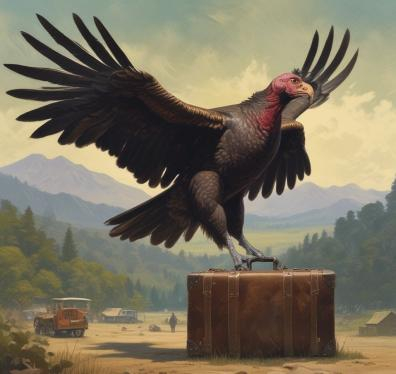
Native to the Americas, the turkey vulture (Cathartes aura) travels widely in search of sustenance. While usually foraging alone, it relies on other individuals of its species for companionship and mutual protection. Sometimes misunderstood, sometimes feared, sometimes shunned, it nevertheless performs an important role in the ecosystem.
This scavenger bird is a marvel of efficiency. Rather than expend energy flapping its wings, it instead locates uplifting columns of air, and spirals within them in order to glide to greater heights. This behavior has been mistaken for opportunism, interpreted as if it is circling doomed terrestrial animals destined to be its next meal. In truth, the vulture takes advantage of these thermals to gain the altitude needed glide longer distances, flying not out of necessity, but for the joy of it.
It also avoids the exertion necessary to capture live prey, preferring instead to feast upon that which is already dead. In this behavior, it resembles many humans.
It is not what most of us would consider to be a pretty bird. While its habits are often off-putting, or even disgusting, to members of more fastidious species, the turkey vulture helps to keep the environment from being clogged with detritus. Hence its Latin binomial, which translates to English as "golden purifier."
I rarely know where the winds will take me next, or what I might find there. The journey is the destination.
December 18, 2025 at 9:34am December 18, 2025 at 9:34am
| |
I always like knowing the origins of words, at least as far back as we can trace them. Here's one I knew from being raised around agriculture, but NPR explains it better than I could have:
Broadcasters keep popping up in the news.
Really? Because it seems to me actual "broadcasting" is dying.
Commercial TV networks have made headlines: CBS announced the cancellation of The Late Show with Stephen Colbert this summer. ABC drew ire in September when it yanked Jimmy Kimmel off the air...
Those sources are, of course, two of the three "classical" commercial TV networks, the other being NBC.
Broadcasting — distributing radio and television content for public audiences — has been around for a century, but is facing a uniquely challenging landscape today.
And I can kinda see the word being used for cable TV, but I'm not sure about streaming. Would you call Netflix a "broadcaster?" I wouldn't. That sort of thing is a "streamer," a word which has an almost opposite implication: broadcasting is wide; streaming is narrow.
It's kind of like "podcast," itself a portmanteau of iPod and broadcast. Though they stopped making iPods, so that word is an anachronym.
[Broadcast] originally described a method of planting seeds, particularly for small grains like wheat, oats and barley.
Oh, and here I thought it referred to hiring the female lead in an old movie. (Broad? Cast? I'll be here all week, folks; try the veal.)
Various dictionaries have traced the verb's first written use — to sow seed over a broad area — to 1733 and 1744.
Modern farming techniques broadcast seeds mechanically, but the basic technique is the same: just scatter the little suckers.
The use of the term "broadcasting" to describe radio first hit the mainstream in the early 1920s. Radio signals (formerly called "wireless telegraphy") and amateur broadcasts existed before that, Socolow says.
What I think the article glides past is the "wireless telegraphy" part. A telegraph, like the later telephone, had a sender and a recipient. Broadcasting has a sender and a large number of potential recipients.
It was a piece of legislation that officially cemented broadcasting's new definition: The Communications Act of 1934 defined it as "the dissemination of radio communications intended to be received by the public, directly or by the intermediary of relay stations."
Technically, broadcast TV uses radio waves, just in a different segment of the EM spectrum.
These days, people tend to use the word to describe any sort of dissemination of information — even if it comes from cable news networks, social media platforms and streaming services, which are not technically broadcasters under the government's definition, Socolow says.
Well, okay, then. Obviously, words change over time. I just hadn't heard of Netflix or Prime Video ever referred to as "broadcasters."
The article tries to explain why it matters, but to me, it's just another quirk of language. And a source of really bad, sexist puns. After all, dames don't like to be called broads. |
© Copyright 2026 Robert Waltz (UN: cathartes02 at Writing.Com). All rights reserved.
Robert Waltz has granted InkSpot.Com, its affiliates and its syndicates non-exclusive rights to display this work.
|


 Comment • View 5 comments