|
About This Author
Come closer.
|
Carrion Luggage
Carrion Luggage
 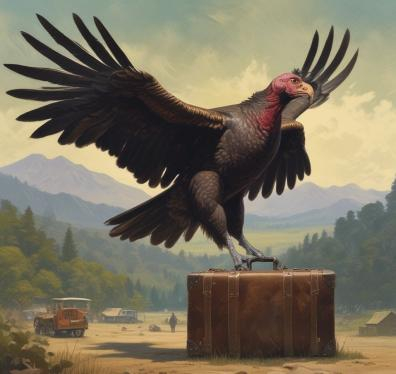
Native to the Americas, the turkey vulture (Cathartes aura) travels widely in search of sustenance. While usually foraging alone, it relies on other individuals of its species for companionship and mutual protection. Sometimes misunderstood, sometimes feared, sometimes shunned, it nevertheless performs an important role in the ecosystem.
This scavenger bird is a marvel of efficiency. Rather than expend energy flapping its wings, it instead locates uplifting columns of air, and spirals within them in order to glide to greater heights. This behavior has been mistaken for opportunism, interpreted as if it is circling doomed terrestrial animals destined to be its next meal. In truth, the vulture takes advantage of these thermals to gain the altitude needed glide longer distances, flying not out of necessity, but for the joy of it.
It also avoids the exertion necessary to capture live prey, preferring instead to feast upon that which is already dead. In this behavior, it resembles many humans.
It is not what most of us would consider to be a pretty bird. While its habits are often off-putting, or even disgusting, to members of more fastidious species, the turkey vulture helps to keep the environment from being clogged with detritus. Hence its Latin binomial, which translates to English as "golden purifier."
I rarely know where the winds will take me next, or what I might find there. The journey is the destination.
December 20, 2025 at 8:22am December 20, 2025 at 8:22am
| |
A bit more serious rant today, thanks to this article from The Conversation:
Well, obviously, They're pushing conspiracy theories on us to detract from the real problems going on. Study it out, sheeple!
(I said "a bit more" serious, not "completely" serious.)
Everyone has looked up at the clouds and seen faces, animals, objects.
One time, I saw a giant Middle Finger. I felt that was appropriate.
But some people – perhaps a surprising number – look to the sky and see government plots and wicked deeds written there.
Not to mention aliens.
Conspiracy theorists say that contrails – long streaks of condensation left by aircraft – are actually chemtrails, clouds of chemical or biological agents dumped on the unsuspecting public for nefarious purposes. Different motives are ascribed, from weather control to mass poisoning.
Here in reality, meanwhile, weather patterns are shifting due to climate change, and mass poisoning is absolutely occurring due to pollution. There are people who refuse to accept that those things are happening, so there must be a grand, evil design behind it all.
I’m a communications researcher who studies conspiracy theories. The thoroughly debunked chemtrails theory provides a textbook example of how conspiracy theories work.
Translation (for conspiracy theorists): "I'm part of the cover-up."
More seriously, while this article focuses on the chemtrail nonsense, it provides insight into conspiracy "theories" (I really hate calling them that) in general.
But even without a deep dive into the science, the chemtrail theory has glaring logical problems. Two of them are falsifiability and parsimony.
This can, of course, be said of most conspiracy accusations. The Apollo one, for example. What does it really take for someone to believe that thousands, maybe millions, of people from all over the world, including our biggest rivals at the time, faked the moon landing and managed to keep a lid on it? That the USSR wouldn't have been the first to claim it was a hoax? That the US government, which these same people insist is utterly incompetent at anything, could manage to orchestrate such a grand conspiracy without a single actual piece of evidence?
According to psychologist Rob Brotherton, conspiracy theories have a classic “heads I win, tails you lose” structure. Conspiracy theorists say that chemtrails are part of a nefarious government plot, but its existence has been covered up by the same villains.
Any new data, to them, is either part of the cover-up, or supports their belief.
Therefore, no amount of information could even hypothetically disprove it for true believers. This denial makes the theory nonfalsifiable, meaning it’s impossible to disprove. By contrast, good theories are not false, but they must also be constructed in such a way that if they were false, evidence could show that.
Bit of a quibble here: it's absolutely possible to have a good hypothesis that is later falsified. In science, this happens all the time, and it's just part of the process. Right now, there's evidence calling into question some of cosmologists' most cherished previous conclusions about the age and structure of the universe, and you know what? That's a good thing.
Nonfalsifiable theories are inherently suspect because they exist in a closed loop of self-confirmation. In practice, theories are not usually declared “false” based on a single test but are taken more or less seriously based on the preponderance of good evidence and scientific consensus.
Again, I'm not thrilled with the casual use of "theories" here, but I know the author means it in the colloquial, not the scientific sense. In that spirit, take one of my own pet theories: that sentient, technology-using life is vanishingly rare in the universe. I could change my mind about that in a heartbeat, if, for example, a flying saucer containing bug-eyed aliens landed in my front yard when I knew I hadn't been tripping.
Like most conspiracy theories, the chemtrail story tends not to meet the criteria of parsimony, also known as Occam’s razor, which suggests that the more suppositions a theory requires to be true, the less likely it actually is. While not perfect, this concept can be an important way to think about probability when it comes to conspiracy theories.
In fairness, Occam's Razor isn't a law carved in stone; it's a guide for choosing between hypotheses. Sometimes, things really are complicated. And sometimes, cover-ups happen. I was just reading about a possible link  between Parkinson's and certain kinds of water contamination. In that case, though, the cover-up seems to have failed. between Parkinson's and certain kinds of water contamination. In that case, though, the cover-up seems to have failed.
Of course, calling something a “conspiracy theory” does not automatically invalidate it. After all, real conspiracies do exist. But it’s important to remember scientist and science communicator Carl Sagan’s adage that “extraordinary claims require extraordinary evidence.”
This is why I get all ragey when I see yet another unsubstantiated claim about Comet 3I/Atlas, which I vaguely remember mentioning in here recently.
If the evidence against it is so powerful and the logic is so weak, why do people believe the chemtrail conspiracy theory? As I have argued in my new book...
Oh hey, a stealth ad for a book! It's a conspiracy!
...conspiracy theorists create bonds with each other through shared practices of interpreting the world, seeing every detail and scrap of evidence as unshakable signs of a larger, hidden meaning.
Really, that sounds a lot like religion. And, in a way, it is: in that worldview, we're all at the whim of higher powers.
Conspiracies are dramatic and exciting, with clear lines of good and evil, whereas real life is boring and sometimes scary. The chemtrail theory is ultimately prideful. It’s a way for theorists to feel powerful and smart when they face things beyond their comprehension and control.
That's one reason why I can't completely dismiss all conspiracy "theorists" as absolute nutters. They're victims, too—victims of a world grown beyond any one person's comprehension. Also, it makes me realize that we all have the potential to fall for misinformation. Articles like this (I'm not going to buy the book, sorry) help me remember how to combat that tendency in myself. |
© Copyright 2026 Robert Waltz (UN: cathartes02 at Writing.Com). All rights reserved.
Robert Waltz has granted InkSpot.Com, its affiliates and its syndicates non-exclusive rights to display this work.
|


 Comment • View 4 comments