|
About This Author
Come closer.
|
Carrion Luggage
Carrion Luggage
 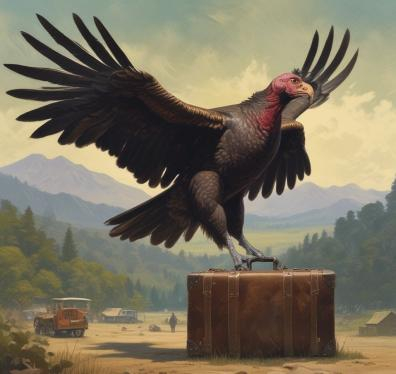
Native to the Americas, the turkey vulture (Cathartes aura) travels widely in search of sustenance. While usually foraging alone, it relies on other individuals of its species for companionship and mutual protection. Sometimes misunderstood, sometimes feared, sometimes shunned, it nevertheless performs an important role in the ecosystem.
This scavenger bird is a marvel of efficiency. Rather than expend energy flapping its wings, it instead locates uplifting columns of air, and spirals within them in order to glide to greater heights. This behavior has been mistaken for opportunism, interpreted as if it is circling doomed terrestrial animals destined to be its next meal. In truth, the vulture takes advantage of these thermals to gain the altitude needed glide longer distances, flying not out of necessity, but for the joy of it.
It also avoids the exertion necessary to capture live prey, preferring instead to feast upon that which is already dead. In this behavior, it resembles many humans.
It is not what most of us would consider to be a pretty bird. While its habits are often off-putting, or even disgusting, to members of more fastidious species, the turkey vulture helps to keep the environment from being clogged with detritus. Hence its Latin binomial, which translates to English as "golden purifier."
I rarely know where the winds will take me next, or what I might find there. The journey is the destination.
December 23, 2025 at 8:48am December 23, 2025 at 8:48am
| |
Here's an interesting article from the BBC which, despite having a few reservations, I thought I'd share.
The very first humans millions of years ago may have been inventors, according to a discovery in northwest Kenya.
Like I said, reservations.
Let's start with the definition of "human." The Latin binomial homo sapiens translates to "wise person" or "knowledgeable person," but that's just a matter of labeling, and besides, there's a big difference between "wise" and "knowledgeable."
To the extent of my understanding, evolution is generally a gradual process. Each generation broadly resembles the one before, but distant generations do not necessarily resemble each other. It's like... if you look in the mirror today, you will see the same face as you did yesterday, when you saw the same face as the day before. (Barring injury or hangover or the like, of course). Take any two consecutive days from your life, and neither you nor facial recognition software would be able to distinguish them. And yet, you look markedly different from 10-year-old you, who looked markedly different from 20-year-old you, etc.
Point is, I think it's really, really hard to point to one particular generation, especially millions of years in the past where the fossil record is sparse, and say, "These were the first humans."
But if pressed, I'd say there's one philosophical hump our ancestors had to go through. It wasn't tool use; lots of animals, as we now know, use tools. Some other animals even crudely make tools. But what probably distinguishes "sapiens" from other animals is: using tools to make other tools. That's a huge leap, in my opinion.
My point is: "the very first humans were inventors" is, philosophically at least, a tautology.
Second quibble: humans and other animals display a wide range of what we call "intelligence" within a species. In other words, there are geniuses, average specimens, and dummies. But what the vast majority of us have in common is that we're very, very good at mimicry. There's a reason "to ape" is a verb: the actual distinguishing mental characteristic of an ape is its ability to copy what others do (though other animals have this ability as well; parrots, e.g.)
So, no, I don't believe that "the very first humans were inventors." Just as we had luminaries like Nikola Tesla and whatever genius figured out how to make beer, all it takes is one human to make a mental leap, invent something truly new and useful, and next thing you know, the other humans have followed that lead. Some certainly improve on the invention, like how once someone created an incandescent bulb (I don't believe for a moment that it was Edison himself, but it could have been), almost anyone with the right equipment could create it, and someone else standardized the sockets, and another added frosted glass, etc.
And my point there is that, millions of years ago, the very first inventor invented inventing, and the rest of our ancestors just kept the momentum going: slowly at first, but eventually building on previous work until we could send robots to Mars and argue on the internet.
And, finally: like I said, the fossil/archaeological record is sparse. I don't see how they can definitively claim that they found the first invention. Plus, early humans seem to have been scattered in tribal or clan groups, just as we are today, but didn't have the internet—so it's entirely possible that inventing was invented in more than one place, separately, much as Newton and Liebniz both invented (or discovered, depending on your point of view) calculus.
Researchers have found that the primitive humans who lived 2.75 million years ago at an archaeological site called Namorotukunan used stone tools continuously for 300,000 years.
Quibbles aside, though, I'm not saying the article isn't worth reading. For instance: 2.75 million years? I can't remember hearing about any evidence of tool use that's that old. It also predates the generally accepted advent of what they call "anatomically modern" humans by, like, a shitload.
I've droned on enough; the article is there if you're interested. I'll just quote one more passage, from the end:
"We have probably vastly underestimated these early humans and human ancestors. We can actually trace the roots of our ability to adapt to change by using technology much earlier than we thought, all the way to 2.75 million years ago, and probably much earlier."
"And probably much earlier." That just supports my points above. |
© Copyright 2026 Robert Waltz (UN: cathartes02 at Writing.Com). All rights reserved.
Robert Waltz has granted InkSpot.Com, its affiliates and its syndicates non-exclusive rights to display this work.
|


 Comment • View 1 comment