|
About This Author
Come closer.
|
Carrion Luggage
Carrion Luggage
 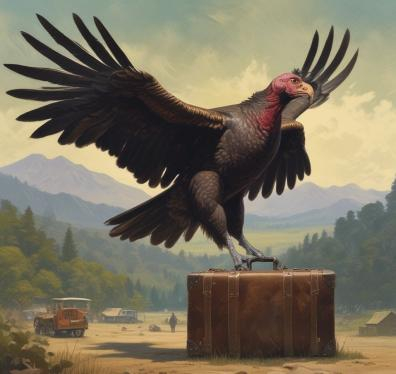
Native to the Americas, the turkey vulture (Cathartes aura) travels widely in search of sustenance. While usually foraging alone, it relies on other individuals of its species for companionship and mutual protection. Sometimes misunderstood, sometimes feared, sometimes shunned, it nevertheless performs an important role in the ecosystem.
This scavenger bird is a marvel of efficiency. Rather than expend energy flapping its wings, it instead locates uplifting columns of air, and spirals within them in order to glide to greater heights. This behavior has been mistaken for opportunism, interpreted as if it is circling doomed terrestrial animals destined to be its next meal. In truth, the vulture takes advantage of these thermals to gain the altitude needed glide longer distances, flying not out of necessity, but for the joy of it.
It also avoids the exertion necessary to capture live prey, preferring instead to feast upon that which is already dead. In this behavior, it resembles many humans.
It is not what most of us would consider to be a pretty bird. While its habits are often off-putting, or even disgusting, to members of more fastidious species, the turkey vulture helps to keep the environment from being clogged with detritus. Hence its Latin binomial, which translates to English as "golden purifier."
I rarely know where the winds will take me next, or what I might find there. The journey is the destination.
December 30, 2025 at 7:25am December 30, 2025 at 7:25am
| |
Looks like I get to balance out yesterdays "man" entry with a "woman" one, this being from Women'sHealth (don't ask me why it's all one word like that):
Maybe, if they can get through reading the study without getting distracted.
But new research suggests that having ADHD comes with some upsides too.
This shouldn't be surprising. Though as usual, "research suggests" is a far cry from the headline's promised "Just Revealed Exactly Why."
For the study, researchers asked 200 adults with ADHD and 200 adults without ADHD to examine how strongly they identify with 25 positive characteristics, like humor, creativity, and spontaneity.
I just want to know if the control group finished faster.
Yes, I am going to continue to make "distraction" jokes.
People with ADHD were more likely to strongly endorse 10 strengths they had over those without the condition. Those included:
(a list of five completely unsurprising traits)
One of the traits listed is "spontaneity." I'd argue that's not a strength. It's an annoyance to others, like chewing with your mouth open.
But the findings suggest that adults with ADHD who are aware of their strengths and actually use them have higher confidence and quality of life as a result, Ammon says.
This seems like more than just "looking on the bright side." It's like Rudolph the Red-Nosed Reindeer, who taught us all an important life lesson: that deviation from the norm will be punished and shunned unless it can be exploited, and that the exploited should be happy about it. By labeling ADHD as such, you're slapping on a "diagnosis," one with the words "deficit" and "disorder," which all have negative connotations. If you can see things from a different point of view, and recognize that you actually have a superpower, well, then Santa finally has a use for you.
In case it's not clear, what I mean is that those who deviate from the norm should be accepted for who they are, even if they're not useful.
Hoogman says she hopes the findings will help people understand the strengths associated with ADHD. “My other studies show that adults with ADHD frequently, in addition to their deficits, also experience benefits from their ADHD characteristics,” she says.
Just don't put them where they can see squirrels. |
© Copyright 2026 Robert Waltz (UN: cathartes02 at Writing.Com). All rights reserved.
Robert Waltz has granted InkSpot.Com, its affiliates and its syndicates non-exclusive rights to display this work.
|


 Comment • View 2 comments