|
About This Author
Come closer.
|
Carrion Luggage
Carrion Luggage
 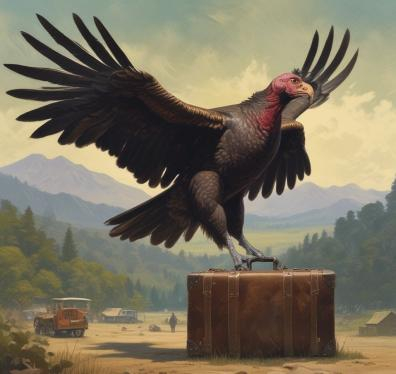
Native to the Americas, the turkey vulture (Cathartes aura) travels widely in search of sustenance. While usually foraging alone, it relies on other individuals of its species for companionship and mutual protection. Sometimes misunderstood, sometimes feared, sometimes shunned, it nevertheless performs an important role in the ecosystem.
This scavenger bird is a marvel of efficiency. Rather than expend energy flapping its wings, it instead locates uplifting columns of air, and spirals within them in order to glide to greater heights. This behavior has been mistaken for opportunism, interpreted as if it is circling doomed terrestrial animals destined to be its next meal. In truth, the vulture takes advantage of these thermals to gain the altitude needed glide longer distances, flying not out of necessity, but for the joy of it.
It also avoids the exertion necessary to capture live prey, preferring instead to feast upon that which is already dead. In this behavior, it resembles many humans.
It is not what most of us would consider to be a pretty bird. While its habits are often off-putting, or even disgusting, to members of more fastidious species, the turkey vulture helps to keep the environment from being clogged with detritus. Hence its Latin binomial, which translates to English as "golden purifier."
I rarely know where the winds will take me next, or what I might find there. The journey is the destination.
December 4, 2025 at 10:31am December 4, 2025 at 10:31am
| |
Been a while since I had an astronomy thing to share. This one's from Smithsonian.
I could quibble about their use of "history" there (it's more of a history of humans' lore and science about the cluster than the history of the stars themselves), or the almost-clickbaity "amazing." But that's all I'm going to say about those things.
The Nebra sky disc, as their find is now known, is circular, about 12 inches across and decorated with intriguing gold symbols. Some we can recognize instantly, and others are more ambiguous. But they all appear to be celestial: A crescent shape represents either the moon or an eclipsed sun, and a bright circle depicts the sun or the full moon.
The article includes a sketch of the disc in question, and I can see why the sun and moon might be ambiguous. I also found a photo of the thing from Wikipedia. 
Thirty-two stars cover the disc, but seven particularly draw the eye. They stand out, because they form a tight cluster. Given the cost of materials and craft needed to create this rare object, this must have been a deliberate attempt to portray a cluster of seven stars in the night sky. As such, it can represent only one astronomical formation.
The cluster doesn't really look much like the actual Pleiades, but then again, neither does the current Subaru logo.
(As the article notes, "Subaru" is what the Pleiades are called in Japanese. And there's no truth to the rumor that I drive a Subaru because I'm a huge fan of astronomy. That's only, like, 75% of the reason. They're solid vehicles.)
Nowhere else can a tight group of about seven stars be found easily with the naked eye. And this visibility is why we can find references to the Pleiades from almost all civilizations that left records, under many different names.
I met someone once with an interest in astronomy but very little actual knowledge. I'm not ragging on him, mind you; we all start out with very little actual knowledge, and he was eager to learn more, which is always to be encouraged. So, he knew the Big Dipper and the Little Dipper and maybe Orion. But then he pointed off to Orion's right and asked, "So is that the Micro Dipper?"
I mean, why not, right? Look at the thing.
Why is it said to have “about seven stars”? While the cluster is easy to spot, the precise number of stars we see will depend on the conditions: A veil of high clouds, light pollution and light from the moon can all have an impact. So can the time of night and our eyesight.
I never was able to count them, even back when I had near-perfect vision, so I just went with the "seven" thing.
In 1961, the late astronomer Patrick Moore put this question to the audience of the popular BBC weekly television program he hosted, “The Sky at Night,” and viewers wrote in with their answers. The numbers varied: Some saw fewer than 7, others saw 8 stars, 9 or even, in one case, 11. But the average number was seven.
I have to wonder how much of that was priming, like I experienced. You're told seven, so you see seven. I don't know.
But the number seven will persist. It’s a sticky number, popular in ancient times and considered lucky by many to this day.
Oh, no, it's not just popular or lucky. Come on. Seven is indelibly associated with astrology, the precursor to astronomy. Early sky-watchers noticed that, against what for all practical pre-industrial Earthbound purposes is a fixed background of stars, a number of bodies persisted (unlike, say, comets) but moved around. And that number was seven: Sun, Moon, Mars, Mercury, Jupiter, Venus, Saturn; all visible to the naked eye. Or whatever different cultures called those wanderers. The concept of a seven-day week was built around that, though the English version is mostly named in the Germanic, not Roman, style (Saturday is an exception).
When Newton, who was a mystic as well as a scientist, studied the spectrum of sunlight, he identified seven colors, our familiar ROYGBIV rainbow. As the spectrum is, well, a spectrum, a continuum, the mostly-arbitrary number seven was undoubtedly influenced by this ancient astrological tradition. (Can you tell indigo from violet on a rainbow? I certainly can't.)
Point is, yes, it's a sticky number, but it's a sticky number for sound historical (if not scientific) reasons.
In autumn, the Pleiades can be seen climbing above the eastern horizon soon after dusk. In spring, they catch up with the sun, and we soon lose them again.
Those sentences are, obviously, written from a Northern Hemisphere perspective. As the article notes, native Australians and other upside-downers also had a thing for what we call the Pleiades.
The Pleiades rise and set close to northeast and northwest from temperate latitudes. Like all stars that rise over the eastern horizon, they climb until they reach their highest point when they are due south—a moment known to astronomers as “culmination”—before descending toward the western horizon.
Given astronomers' penchant for solitude and isolation, I'm surprised they don't call it "climax."
There is a belief in some circles that the Druids marked Samhain, the precursor of Halloween, using the culmination of the Pleiades at midnight, which is plausible.
Meh. Plausible, I'll grant. But we know little more than jack and shit about the actual Druids, and there's already too much speculation and reinterpretation going on about them.
The Pleiades are not a constellation in themselves, but they’re part of a much larger pattern: the constellation of Taurus, the bull.
Here's where I really break with the article, but not in a "makes the whole article bogus" way. What we call constellations are based, primarily, on the lore of ancient Europe, with maybe some Mesopotamia thrown in. Their boundaries are arbitrary, and the Northern Hemisphere ones in particular borrow from that mythology. Other cultures put different interpretations on the shapes they saw in the stars, with different lore and different arrangements.
In other words, we can say "star A is in constellation X," but that's just a categorization thing, helpful in communicating to the general public and other astronomers, but having no real basis in science. It's kind of like saying "Paris is in France," but, apart from the coastline, the borders of France are a matter of custom, law, wars, culture, and human decision-making, not any fixed and objective measure. (Even when they follow natural boundaries like mountain ridges.) Those boundaries have changed with time, and, before a certain point in time, France didn't exist at all. Neither did Paris. Nor the Pleiades.
Still, yes, we don't consider the Pleiades a constellation in itself. Neither are either of the Dippers. That kind of recognizable shape that's not an official constellation is called an asterism. In an alternate universe where the sky is the same but human culture unfolded differently, our names and boundaries for the constellations would be different.
There's another bit of lore about the Pleiades that I especially like: the story of Bear Lodge, which the North American colonizers called Devil's Tower. "Bear Lodge" is a rough translation of the Lakota name of that prominent landmark. And the Lakota story about it is intimately tied with what we call the Pleiades.
There's more here, and in the references on that page, and elsewhere on the internet, but I'll paste the most relevant section of the Wiki page:
According to the traditional beliefs of Native American peoples, the Kiowa and Lakota, a group of girls went out to play and were spotted by several giant bears, who began to chase them. In an effort to escape the bears, the girls climbed atop a rock, fell to their knees, and prayed to the Great Spirit to save them. Hearing their prayers, the Great Spirit made the rock rise from the ground towards the heavens so that the bears could not reach the girls. The bears, in an effort to climb the rock, left deep claw marks in the sides, which had become too steep to climb. Those are the marks which appear today on the sides of Devils Tower. When the girls reached the sky, they were turned into the stars of the Pleiades.
That story bears (I'd apologize for that pun, but I don't do that) all of the hallmarks of classic mythology: an origin story, interpreted through the lens of the culture that spawned the myth. And I don't mean "myth" in the sense of "falsehood" here; I mean those powerful cultural stories that both arise from and shape the worldviews of the cultures that spawn them.
I couldn't tell you why that particular story resonates with me. As far as I know, I have no Native American ancestry. I guess I just love a good myth, while at the same time acknowledging that Bear Lodge was as much a natural formation as the Pleiades themselves.
The difference being that the Pleiades asterism belongs to everyone.
And no one. |
© Copyright 2026 Robert Waltz (UN: cathartes02 at Writing.Com). All rights reserved.
Robert Waltz has granted InkSpot.Com, its affiliates and its syndicates non-exclusive rights to display this work.
|


 Comment • View 4 comments