|
About This Author
Come closer.
|
Carrion Luggage
Carrion Luggage
 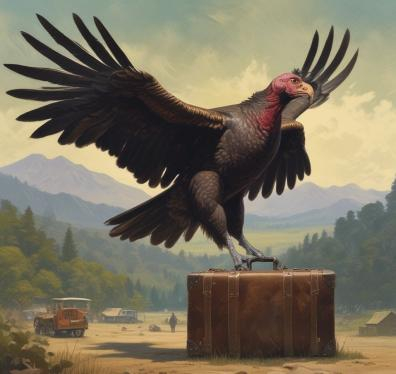
Native to the Americas, the turkey vulture (Cathartes aura) travels widely in search of sustenance. While usually foraging alone, it relies on other individuals of its species for companionship and mutual protection. Sometimes misunderstood, sometimes feared, sometimes shunned, it nevertheless performs an important role in the ecosystem.
This scavenger bird is a marvel of efficiency. Rather than expend energy flapping its wings, it instead locates uplifting columns of air, and spirals within them in order to glide to greater heights. This behavior has been mistaken for opportunism, interpreted as if it is circling doomed terrestrial animals destined to be its next meal. In truth, the vulture takes advantage of these thermals to gain the altitude needed glide longer distances, flying not out of necessity, but for the joy of it.
It also avoids the exertion necessary to capture live prey, preferring instead to feast upon that which is already dead. In this behavior, it resembles many humans.
It is not what most of us would consider to be a pretty bird. While its habits are often off-putting, or even disgusting, to members of more fastidious species, the turkey vulture helps to keep the environment from being clogged with detritus. Hence its Latin binomial, which translates to English as "golden purifier."
I rarely know where the winds will take me next, or what I might find there. The journey is the destination.
December 5, 2025 at 10:04am December 5, 2025 at 10:04am
| |
Wading back in to what we writers work with, here's a listicle about words from Mental Floss:
You know, sometimes, the perfect word doesn't exist, so we have to create it. It worked for Shakespeare. It worked for Charles Dodgson. Fantasy and science fiction are especially prone to the creation of new words, because they deal with new (to us) worlds. Though, admittedly, sometimes they go overboard with it.
Anyway, the article.
Language is ever-evolving, with new words springing up from a variety of places. Some are borrowed from other languages (“karaoke”), others are two words blended together (“doomscrolling”), and some are simply shortened (“decaf”).
And sometimes, we just make them up because we feel like it.
As I've said numerous times, all words are made-up. It's only a matter of how long ago.
Science fiction is a particularly bountiful genre for the introduction of new words, in large part because authors come up with unique and otherworldly terms to describe their sci-fi worlds.
Like, where would we be without "frack" from the original Battlestar:Galactica?
As usual, I'm only going to comment on a few of them here.
Robot and Robotics
The word “robot” can be traced back to Czech writer Karel Čapek and his sci-fi play R.U.R. (1920).
I did a whole entry on that last month: "No Ifs, Androids, or Bots" 
Grok
Robert A. Heinlein’s Stranger in a Strange Land (1961) follows Valentine Michael Smith, a human born and raised on Mars, as he experiences Earth for the first time.
No word is sufficient enough to express my white-hot anger at having this word appropriated for nefarious purposes. Stranger was a life-changing novel for me, and I've read all of Heinlein's published works. Yes, even the weird, self-indulgent, freaky ones. (I'm not saying I loved all of them.) If there's one writer I can credit for instilling in me a lifelong love of science fiction, and reading and writing in general, it's Heinlein. Well, also Niven. But mostly Heinlein.
So Muskmelon comes along and, first, ruins the good name of Nikola Tesla. That was bad enough. Then he goes and appropriates grok?
My anger burns with the fiery power of a million supernovas.
Metaverse
In 1992, Neal Stephenson’s Snow Crash introduced the word metaverse to the world. Set in a dystopian future, characters use VR headsets to connect to a universally used virtual world called the “metaverse.”
I don't have nearly the same level of seething rage over this appropriation.
For me, the most memorable thing about Snow Crash was the name of the main character: Hiro Protagonist. You'll never come up with a better name. Neither will I. It is, in practice, absolutely impossible to invent a better name for a novel's main character. Simply can't be done, like accelerating past lightspeed, counting to infinity, or finding an honest politician.
Newspeak
George Orwell’s dystopian sci-fi novel Nineteen Eighty-Four (1949) introduced many new words and phrases to the world.
And make no mistake, 1984 was absolutely science fiction. Most lit-snobs refuse to acknowledge this (or many of Vonnegut's works, as well) because they've been programmed to believe that science fiction is all escapist pulp brainrot and can't possibly be Serious Literature Being All Serious.
There are, as I said, more at the link. I like SF and I like word origins, so how could I resist? |
© Copyright 2026 Robert Waltz (UN: cathartes02 at Writing.Com). All rights reserved.
Robert Waltz has granted InkSpot.Com, its affiliates and its syndicates non-exclusive rights to display this work.
|


 Comment • View 4 comments