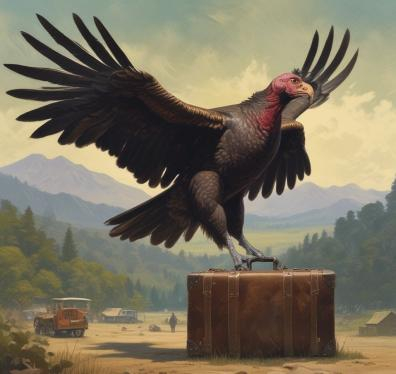
Native to the Americas, the turkey vulture (Cathartes aura) travels widely in search of sustenance. While usually foraging alone, it relies on other individuals of its species for companionship and mutual protection. Sometimes misunderstood, sometimes feared, sometimes shunned, it nevertheless performs an important role in the ecosystem.
This scavenger bird is a marvel of efficiency. Rather than expend energy flapping its wings, it instead locates uplifting columns of air, and spirals within them in order to glide to greater heights. This behavior has been mistaken for opportunism, interpreted as if it is circling doomed terrestrial animals destined to be its next meal. In truth, the vulture takes advantage of these thermals to gain the altitude needed glide longer distances, flying not out of necessity, but for the joy of it.
It also avoids the exertion necessary to capture live prey, preferring instead to feast upon that which is already dead. In this behavior, it resembles many humans.
It is not what most of us would consider to be a pretty bird. While its habits are often off-putting, or even disgusting, to members of more fastidious species, the turkey vulture helps to keep the environment from being clogged with detritus. Hence its Latin binomial, which translates to English as "golden purifier."
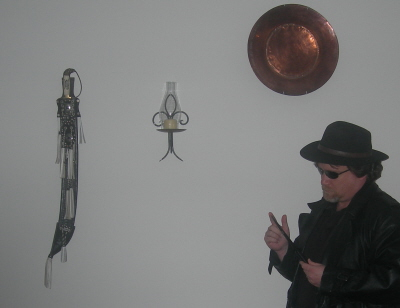
I rarely know where the winds will take me next, or what I might find there. The journey is the destination.
Even with proven facts, there's always some knucklehead who will insist the science is wrong, and there's always a whole slew of doofuses who will follow the knucklehead. Ex: Flat-Earthers.
Of all the science deniers, the Anti-Vaxxers Cult is the one that bothers me the most. Thinking the Earth is flat hurts no one but yourself. Creating doubt and confusion over vaccines is actually killing people.
I also heard about that study with getting zapped rather than sit still. Your point that it leads to a new experience and knowledge is more profound to me than the idea that sitting still is impossible.
I sit a lot but i'm rarely doing nothing. I watch tv..read..play on my phone..etc. My favorite is reading. If i sit and do absolutely nothing..the brain kicks in with its fantastic list of things I do wrong or mistakes ive made or things thst could happen. When I read im inside another whole world..that's my escape.
Research has shown that people often underestimate the extent to which they will enjoy inactivity.
Having been put in both voluntary and involuntary positions of inactivity, I have to say this is definitely a "your mileage may vary" scenario. That's before we even touch the weasel wording of this line. If you are forced into inactivity (such as by injury), it becomes very easy to become hyperaware of your situation (including physical pain). Doing absolutely nothing can be excruciating. You do need to do something, even if it's just a breathing exercise. For voluntary inactivity, it's a little different. In my experience, it's okay. I wouldn't say it's enjoyable, but it can help my brain slow down.
Also, I'd like to be super loud and say that some people (like me) legitimately enjoy being productive because our brains are always churning through things. For us, being productive is an antidote to overthinking/letting destructive thoughts overtake us.
Now, this might be a paid ad for the museum running the exhibition. But even if it is, the article is informative by itself.
More than 500 years ago, after dedicating hours to the meticulous transcription of a crucial manuscript, a Flemish scribe set the parchment out to dry—only to later return and discover the page smeared, filled with inky paw prints.
I hope the scribe didn't punish the poor kitty.
“Objects like [the manuscript] have a way of bridging across time, as it’s just so relatable for anyone who has ever had a cat,” Lynley Anne Herbert, the museum’s curator of rare books and manuscripts, tells Artnet’s Margaret Carrigan. “Many medieval people loved their cats just as much as we do.”
The common perception is that Europeans, back then, hated and/or feared cats, believing them to be agents of the devil (which, to be honest, I can kind of understand). And I've heard they were blamed for the Plague, or at least one of the Plagues, therefore killed en masse, thus eliminating a check on the rodent population, in turn enabling the spread of the flea with the plague germs.
I can hear someone from that time right now if I tried to explain that to them: "But still, it's cats."
Anyway, point is, I'm sure that then, as now, there were people who liked and appreciated cats. Though maybe liked them a little less when they left paw prints on your manuscript.
This affection is evidenced by the myriad illustrations of cats across cultures. After finding the Flemish manuscript, Herbert searched the museum archives and found no shortage of other feline mentions or depictions in Islamic, Asian and other European texts and images.
Also, apparently, they're not limiting it to Europe.
And a 15th-century painting called Madonna and Child With a Cat features a small kitten beside the newborn baby Jesus. The depiction is likely a reference to the lesser-told Christian legend that a cat gave birth to a litter of kittens inside the manger at the same time that Mary gave birth to Jesus, according to the museum.
And yet, to the best of my knowledge, no one worships those kittens or their mother. It's just not fair.
“Paws on Parchment” is the first of three exhibitions over the next two years dedicated to animals in art. Its displays have already made an impression on viewers, human and feline alike. Shortly after its grand opening, in partnership with the Baltimore Animal Rescue and Care Shelter, of four 6-week-old foster kittens were given a private tour. Herbert adopted two of them.
Hopefully they won't do that with the elephant exhibit.
Anyway, not much to the article which, as I say, may very well be an ad. But it has pictures. Including pictures of the 6-week-old foster kittens from that last quote.
I'll just end with this: a while back, I had to get part of my basement slab redone. They poured new concrete and, as the concrete was curing, my cat at the time decided to walk in it.
He did not like having his paws washed afterward, but I never did anything about the prints in the concrete. So the next owner of this house is going to get a nice surprise.


 Comment • View 1 comment