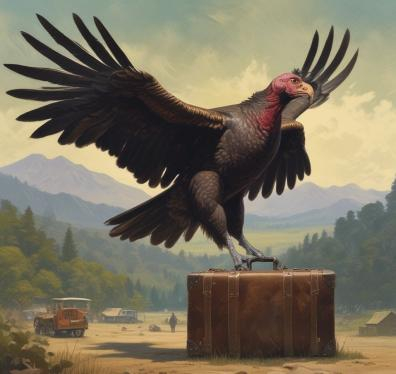
Native to the Americas, the turkey vulture (Cathartes aura) travels widely in search of sustenance. While usually foraging alone, it relies on other individuals of its species for companionship and mutual protection. Sometimes misunderstood, sometimes feared, sometimes shunned, it nevertheless performs an important role in the ecosystem.
This scavenger bird is a marvel of efficiency. Rather than expend energy flapping its wings, it instead locates uplifting columns of air, and spirals within them in order to glide to greater heights. This behavior has been mistaken for opportunism, interpreted as if it is circling doomed terrestrial animals destined to be its next meal. In truth, the vulture takes advantage of these thermals to gain the altitude needed glide longer distances, flying not out of necessity, but for the joy of it.
It also avoids the exertion necessary to capture live prey, preferring instead to feast upon that which is already dead. In this behavior, it resembles many humans.
It is not what most of us would consider to be a pretty bird. While its habits are often off-putting, or even disgusting, to members of more fastidious species, the turkey vulture helps to keep the environment from being clogged with detritus. Hence its Latin binomial, which translates to English as "golden purifier."
I rarely know where the winds will take me next, or what I might find there. The journey is the destination.
I think the concepts behind the depolarization challenge can also be applied to science and science communication. There was a (non-research) piece published in Nature a few months ago that provides a great example of this, but only part of it is publicly available (that I've been able to find so far). It acknowledges that an educated iteration of tribalism has contributed to mistrust in the scientific community globally and that things will need to change in their part.
Some people want to change but i think the majority are set in their ways or on their comfort zone. As far as our government goes..they refuse to work together..they have forgotten why they are there. It will be like this and worse until Christ returns!
I pride myself on the fact that, as a supervisor, I was always happy to let my subordinates fully and completely present their ideas and positions before I told them NO.
"I'd also add this: Be humble enough to know that you can be wrong. Be brave enough to admit when you're wrong. And allow space for the idea that sometimes, your ideological opponents are right."
We all need to print that on a wallet-sized card and read it at least once a day.
But unless you have an extremely hot flame it wouldn't even work underwater! Thats why they use magnesium torches for underwater welding. Maybe if they had atomic fire breath like Godzilla?
Wait, they're mythological creatures. Does it matter? Ah heck maybe I gotta write another story about Kaiju... or a sea monster capable of producing fusion induced plasma that they then use for hunting or an alien.
Here's one for your inner 12-year-old, from Live Science:
How many holes does the human body have? You might think that the human body has many holes, but that number shrinks when you stop to consider what counts as a hole.
Because I know your inner 12-year-old immediately said "which sex?"
The human body is extraordinarily complex, with several openings and a few exits.
Cue Beavis and Butt-Head.
But exactly how many holes does each person have?
I imagine it not only depends on your definition of "holes," but how recently someone's been shot. Maybe that only applies in war or the US.
But it's not quite that easy once you start considering questions like: "What exactly is a hole?" "Does any opening count?" And "why don't mathematicians know the difference between a straw and a doughnut?"
I've noted before that a "hole" isn't a thing. However you conceive of the concept, a hole can only be defined by what's around it. You can't just point to a random location in space and say "that's a hole." Or, well, you can, but people would look at you funny.
"Black holes" may be the only exception to this, but their name is more metaphorical.
Oh, and the branch of mathematics that doesn't know the difference between a straw and a donut (and a coffee mug, for that matter) is called topology, where all of those shapes are considered toroids: one hole going all the way through.
Topologically, we're all toroids (assuming we haven't been shot through recently). Most animal life on Earth is.
Katie Steckles, a lecturer in mathematics at Manchester Metropolitan University in the U.K. and a freelance mathematics communicator, told Live Science that mathematicians "use the term 'hole' to mean one like the hole in a donut: one that goes all the way through a shape and out the other side."
Look, I don't care if you call it doughnut or donut. The former is more British; the latter is more US. Just do try to keep it consistent, and if you're quoting a Brit, use the former. Or do what I do, and say "bagel" instead.
But if you dig a "hole" at the beach, your aim is probably not to dig right through to the other side of the world.
Totally tried to do that when I was a kid. It's good to have goals.
Similarly, mathematical communicator James Arthur, who is based in the U.K., told Live Science that "in topology, a 'hole' is a through hole, that is you can put your finger through the object."
Um.
Phrasing?
And if you ask people how many holes a straw has you will get a range of different answers: one, two and even zero. This is a result of our colloquial understanding of what constitutes a hole.
Are... are you telling me language can be ambiguous? Say it ain't so!
In topology, objects can be grouped together by the number of holes they possess. For example, a topologist sees no difference between a golf ball, a baseball or even a Frisbee.
And I knew that, obviously, but it's also another excuse for people to grumble about "common sense," as if that were a thing that existed.
Armed with the topologists' definition of a hole, we can tackle the original question: How many holes does the human body have? Let's first try to list all the openings we have. The obvious ones are probably our mouths, our urethras (the ones we pee out of) and our anuses, as well as the openings in our nostrils and our ears. For some of us, there are also milk ducts in nipples and vaginas.
At least they addressed the 12-year-old directly and shut down its gigglesnorts with all kinds of formal medical words. Unfortunately, that sentence needs another comma near the end.
In total there are potentially millions of these openings in our bodies, but do they all count as holes?
This is a bit like asking if a tomato is a fruit or a vegetable, in that a scientist will give you a different answer than a sous-chef.
"They're not actually holes in the topological sense, as they don't go all the way through," Steckles said. "They're just blind pits."
Again. Phrasing.
A pair of underwear, for example, has three openings (one for the waist and one for each of the two legs), but it's not immediately clear how many holes a topologist would say it has.
And again, it probably depends on the sex and/or gender of the person wearing it. And here comes the 12-year-old, giggling again.
So the mathematician's answer is that humans have either seven or eight holes.
And my answer? None.
Think about it: how many holes does your house have? You can ignore the drafty cracks for my purposes; I'm talking about, like, windows and doors. Open one window: no holes in the topological sense. Open a window and a door: suddenly you have a topological hole. Open three windows, and you get the situation the article refers to with underpants. Might be complicated if you also consider water and sewer systems.
And your digestive tract is, also, usually closed at at least one end, like a door or a window in your house. So while you could, technically and topologically, thread a string from mouth to asshole (preferably not the other way around), in practice, we're usually pretty closed off, apart from respiratory functions.
So, again: it's all about how you look at it. And if you're 12, this shit is funny as hell.


 Comment • View 2 comments