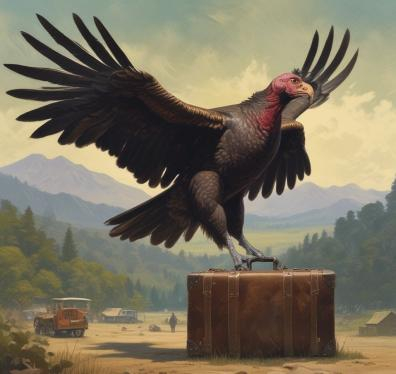
Native to the Americas, the turkey vulture (Cathartes aura) travels widely in search of sustenance. While usually foraging alone, it relies on other individuals of its species for companionship and mutual protection. Sometimes misunderstood, sometimes feared, sometimes shunned, it nevertheless performs an important role in the ecosystem.
This scavenger bird is a marvel of efficiency. Rather than expend energy flapping its wings, it instead locates uplifting columns of air, and spirals within them in order to glide to greater heights. This behavior has been mistaken for opportunism, interpreted as if it is circling doomed terrestrial animals destined to be its next meal. In truth, the vulture takes advantage of these thermals to gain the altitude needed glide longer distances, flying not out of necessity, but for the joy of it.
It also avoids the exertion necessary to capture live prey, preferring instead to feast upon that which is already dead. In this behavior, it resembles many humans.
It is not what most of us would consider to be a pretty bird. While its habits are often off-putting, or even disgusting, to members of more fastidious species, the turkey vulture helps to keep the environment from being clogged with detritus. Hence its Latin binomial, which translates to English as "golden purifier."
I rarely know where the winds will take me next, or what I might find there. The journey is the destination.
Personally, I've never touched the genealogy genre because it honestly feels like too confining of a genre. It strikes me as something that would be dominated by non-fiction and essays. Even though I've become more of an essayist in middle age, this genre isn't exactly in the same mold as the media analysis pieces I tend to write.
Side note: I'm glad I'm not the only one who remembers the Bad Idea Jeans SNL skit. I think about that one perhaps more than I should be publicly admitting.
I think the concepts behind the depolarization challenge can also be applied to science and science communication. There was a (non-research) piece published in Nature a few months ago that provides a great example of this, but only part of it is publicly available (that I've been able to find so far). It acknowledges that an educated iteration of tribalism has contributed to mistrust in the scientific community globally and that things will need to change in their part.
Some people want to change but i think the majority are set in their ways or on their comfort zone. As far as our government goes..they refuse to work together..they have forgotten why they are there. It will be like this and worse until Christ returns!
I pride myself on the fact that, as a supervisor, I was always happy to let my subordinates fully and completely present their ideas and positions before I told them NO.
"I'd also add this: Be humble enough to know that you can be wrong. Be brave enough to admit when you're wrong. And allow space for the idea that sometimes, your ideological opponents are right."
We all need to print that on a wallet-sized card and read it at least once a day.
Well, no, I haven't started suddenly following Wine Spectator. Though I might. Still, I'd rather drink it than read about it, except maybe in this case:
Okay, well, if it's truly an indispensable tool, then the answer is "stop being 'organic'" or "move out of France."
The irony (another heavy metal) here is that copper is considered "organic" for agricultural purposes. Which is distinct from the chemical meaning of "organic" (carbon, not copper, compounds), and the original meaning of "organic" (from organs).
My amusement at this is tempered only by knowing that, in French, what we call organic in the agricultural sense is called biologique.
It leaves organic winemakers confronting an existential question: How do you protect vines from downy mildew when your primary defense has been eliminated?
Because no one in France has ever confronted an existential question before.
“Copper is a natural element, naturally occurring in nature,” said Gérard Bertrand, a leading vigneron in southern France and advocate of organic farming.
Uh huh. Okay. I'm letting the repetition of "natural" slide there because it's either a translation or someone's second or third language. But I'm not going to let the natural fallacy slide, oh hell no, not me.
Once more for the back row: "natural" doesn't mean "good." Poison ivy is natural. Tobacco is natural. Arsenic is a naturally occurring element much like copper.
Copper is a naturally occurring element and is approved worldwide for organic agriculture. Critically, there is no equivalent for organic farming. The other options are forbidden synthetic fungicides.
Not, mind you, that I'm coming down on one side or the other here. I don't know enough about copper toxicity or viticulture in general to weigh in on what France did, and even if I did know enough, they wouldn't give one single shit about my opinion. All they care about is that I enjoy the finished product and keep sending them money in exchange.
Copper, while it does protect vines from fungal disease, is a persistent metal that accumulates irreversibly in the top few inches of vineyard soils. In large quantities it disrupts essential microbial communities and earthworm populations that define healthy terroir. It can also contaminate the waterways that flow through wine regions. There are also mounting concerns about its impact on vignerons and vineyard workers themselves.
Well, there you go. Look at that: something natural isn't good for you.
Regarding a way forward, Jestin remains optimistic, hoping that scientific research can devise alternatives to copper.
Honestly, I hope so too. French wine is expensive enough with tariffs.
Trade body SudVinBio cautioned that producers may abandon organic practices altogether.
About that, I don't care.
Two copper products remain authorized, but they carry stringent restrictions, which may make them less practical. Without viable alternatives to copper, how does organic viticulture survive in regions where Bordeaux's Atlantic humidity, Burgundy's continental rainfall, Cognac’s and Champagne's persistent dampness all create conditions where mildew protection determines vineyard sustainability?
I have another article in my pile about the American chestnut, which used to dominate Blue Ridge Mountain forests until a fungus destroyed the entire native population. It'll pop up eventually, but the point for now is that things change. And right now, things, climatically speaking, change even faster. France is very strict about its wine growing policies; for instance, they don't allow irrigation apart from whatever rains fall. So either they can become less strict, or wine growing will shift to some other region.
Which would be a shame, but at least they'll still have cheese. Which I don't think has any copper in it, but I haven't tested it for that.


 Comment