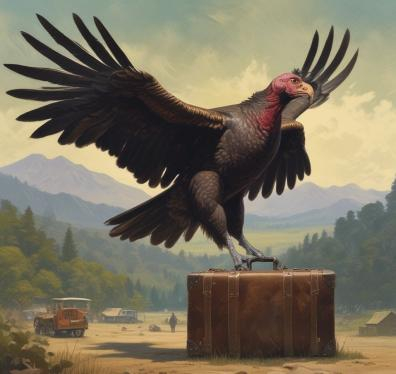
Native to the Americas, the turkey vulture (Cathartes aura) travels widely in search of sustenance. While usually foraging alone, it relies on other individuals of its species for companionship and mutual protection. Sometimes misunderstood, sometimes feared, sometimes shunned, it nevertheless performs an important role in the ecosystem.
This scavenger bird is a marvel of efficiency. Rather than expend energy flapping its wings, it instead locates uplifting columns of air, and spirals within them in order to glide to greater heights. This behavior has been mistaken for opportunism, interpreted as if it is circling doomed terrestrial animals destined to be its next meal. In truth, the vulture takes advantage of these thermals to gain the altitude needed glide longer distances, flying not out of necessity, but for the joy of it.
It also avoids the exertion necessary to capture live prey, preferring instead to feast upon that which is already dead. In this behavior, it resembles many humans.
It is not what most of us would consider to be a pretty bird. While its habits are often off-putting, or even disgusting, to members of more fastidious species, the turkey vulture helps to keep the environment from being clogged with detritus. Hence its Latin binomial, which translates to English as "golden purifier."
I rarely know where the winds will take me next, or what I might find there. The journey is the destination.
It's been years since I grew tomatoes and never knew any of this. Now that I know, I'm with Brandiwyn🎶 I'm not eating any tomatoes with chemicals in them.
Hm. Where I live right now, we've had days over 85F in January. Summers get up into triple digits. I guess my tomatoes will have white, shriveled rings?
Tomatoes need a very balanced diet to grow well. In addition to the potassium, which prevents white rings, they need calcium to prevent blossom end rot.
When your hobby becomes your job, it loses a lot of what makes it interesting.
I'm not sure if I'm the right gauge, since I have a disorder that makes my hobby-turned-career more difficult and in some cases, impossible, but I still play piano for fun occasionally. Not nearly as often as I used to.
Doing nothing feels differently depending on location.
When I do nothing at home, I have dishes and dusty floors silently judging me.
Second Son got stung on the cheek by a bee in Rome and his face swelled up like that of a cartoon character. We spent half the day resting in the hotel room. It was the most glorious doing nothing ever. We were in one of the oldest cities in Europe in a modern hotel doing nothing.
The best doing nothing in many years. Except for the bee sting.
I have a lit of leisure time..most of the time. I used to feel guilty thinking I needed to be doing something constructive. I'm getting passed that..I worked my entire life..now it's time to relax and do what I want..if it's nothing..so be it.
All I really know about it, was that there was a police department that had an issue with cops that liked to abuse their power. They tried yellow bands (or whatever), but other officers thought they had looked cool, and intentionally got into trouble to get them. So, they decided to punish the officers with Hello Kitty stickers - hard to look intimidating, or cool, with one of those stuck to your breast pocket.
Post-Luxury Status Symbol #2: Wasteful Time We’ve spent two decades optimising ourselves into exhaustion, and now the flex is declaring you were never stressed in the first place.
I suppose that's preferable to all the bragging about how busy one is.
In Eat, Pray, Love, an Italian man tells our hapless protagonist her problem is that she’s American - Americans don’t understand pleasure because they believe it must be earned through exhaustion.
Far be it from me to agree with anything from the genre I call divorce porn (chick gets divorced, goes to a foreign land to "find" herself, doinks a hunky local guy, leaves satisfied), but that one feels right, like when a Belgian tour guide told me Americans eat like we have free health care.
Italians, he explains, have mastered il dolce far niente: the sweetness of doing nothing.
Fifteen years later, that sweetness has become the ultimate luxury.
Some might recall that I had an entry about doing nothing back on Groundhog Day: "Nothing Matters"
Thorstein Veblen argued that people signal wealth through conspicuous consumption, conspicuous waste, and conspicuous leisure. Had he lived into the 21st century, he might have added a fourth: conspicuous grinding. The performance of perpetual productivity. Capitalism convinced us this is what rich people actually do. It isn’t.
The biggest advantage to being rich is that you have the ability, and the resources, to do nothing. Or almost nothing. But grinding doesn't get you there. Your hustle mostly enriches someone else. Someone who is doing almost nothing. And yeah, you're surviving, maybe even thriving, but you're not going to become a billionaire that way.
(Look, if the article can use the second-person pronoun with impunity, so can I.)
Leisure makes you feel guilty because you’re not working. Working constantly feels virtuous because that’s what success demands. We optimised our work, then ourselves, then wondered why we felt empty.
(And also the first-person plural pronoun.)
What’s emerging now is a pendulum swing towards a new aspirational leisure class: people whose value isn’t tied to what they do, but to how effortlessly they exist.
Insofar as people have "value," I balk at the notion that some are more valuable than others.
Time itself has become precious, so the ultimate status is to be wasteful with it. Complete autonomy over your schedule. The ability to meet anyone, whenever, and always know the right spot. To decline opportunities based on values or vibes. To partake in long, leisurely meals with no rushed ending.
I also balk at—nay, outright reject—the idea that such things are in any way "wasteful."
Although many activities today would have been considered leisure by previous generations - skincare rituals, vinyl listening bars, elaborate dining experiences - the question remains: is it still leisure if an algorithm told you to do it?
People can answer that question for themselves, I think.
If nobody could see you, if you couldn’t post about it, would you still do it?
That one, too. In my case, I do plenty of stuff that I don't post about. Some of it's not even embarrassing to admit; I just keep it private.
If so, that’s neo-leisure. If not, it’s unpaid labour, the performance of joy for an invisible audience.
Personally, I'm under the impression that a lot of that sort of thing isn't someone spontaneously deciding to, say, go to Tuscany and doink a local, but someone getting paid to promote Tuscany.
This is the contradiction at the heart of Neo-Leisure: the moment you perform it, you’re optimising again. The ability to waste time becomes another metric to track, another behaviour to perfect. We’ve simply replaced productivity optimisation with leisure optimisation. One exhausting performance becomes another.
When your hobby becomes your job, it loses a lot of what makes it interesting. Like, can porn stars ever have normal sex again? I'll never know the answer to that one.
For marginalised communities, for precarious workers, for anyone without generational security, the luxury of wasting time remains inaccessible. They’re still grinding because they have to. The status symbol isn’t in wasting time. It’s in having enough capital that you don’t need to justify how you spend it.
I don't think it's an epiphany to realize that leisure is tied to privilege. I know there's a bit going around about how feudal serfs had more free time than we do in our post-industrial dystopia, or about how hunter-gatherers work less than agriculturalists. I don't know how true any of that is.
The article then goes into "leisure" products that I've never even heard of. Remember what I said about getting paid for seeming to perform leisure, up there? I suspect that this is product placement.
True leisure, in my view, doesn't need a "product."
Odell wrote that “nothing is harder to do than nothing”. In an era where attention and consumption are currency, wasting time becomes an act of resistance.
Okay, but again, I must reiterate that I don't believe that these things are wastes of time. You know what is a waste of time? Doing work for a project that ultimately gets canceled. Even that isn't a complete waste of time if you learn something along the way.
The greatest luxury might be doing nothing and feeling no need to signal it at all.
Maybe. Or maybe the greatest luxury is to get paid to write blog entries. (To be clear, at the risk of repeating myself, I do not get paid to write blog entries.)


 Comment • View 3 comments