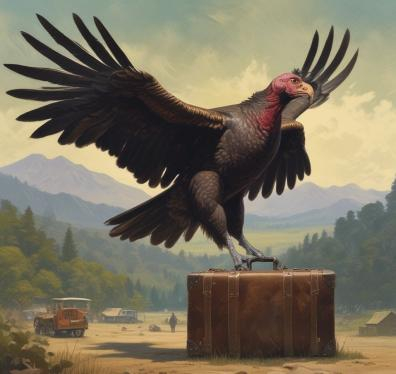
Native to the Americas, the turkey vulture (Cathartes aura) travels widely in search of sustenance. While usually foraging alone, it relies on other individuals of its species for companionship and mutual protection. Sometimes misunderstood, sometimes feared, sometimes shunned, it nevertheless performs an important role in the ecosystem.
This scavenger bird is a marvel of efficiency. Rather than expend energy flapping its wings, it instead locates uplifting columns of air, and spirals within them in order to glide to greater heights. This behavior has been mistaken for opportunism, interpreted as if it is circling doomed terrestrial animals destined to be its next meal. In truth, the vulture takes advantage of these thermals to gain the altitude needed glide longer distances, flying not out of necessity, but for the joy of it.
It also avoids the exertion necessary to capture live prey, preferring instead to feast upon that which is already dead. In this behavior, it resembles many humans.
It is not what most of us would consider to be a pretty bird. While its habits are often off-putting, or even disgusting, to members of more fastidious species, the turkey vulture helps to keep the environment from being clogged with detritus. Hence its Latin binomial, which translates to English as "golden purifier."
I rarely know where the winds will take me next, or what I might find there. The journey is the destination.
It's been years since I grew tomatoes and never knew any of this. Now that I know, I'm with Brandiwyn🎶 I'm not eating any tomatoes with chemicals in them.
Hm. Where I live right now, we've had days over 85F in January. Summers get up into triple digits. I guess my tomatoes will have white, shriveled rings?
Tomatoes need a very balanced diet to grow well. In addition to the potassium, which prevents white rings, they need calcium to prevent blossom end rot.
When your hobby becomes your job, it loses a lot of what makes it interesting.
I'm not sure if I'm the right gauge, since I have a disorder that makes my hobby-turned-career more difficult and in some cases, impossible, but I still play piano for fun occasionally. Not nearly as often as I used to.
Doing nothing feels differently depending on location.
When I do nothing at home, I have dishes and dusty floors silently judging me.
Second Son got stung on the cheek by a bee in Rome and his face swelled up like that of a cartoon character. We spent half the day resting in the hotel room. It was the most glorious doing nothing ever. We were in one of the oldest cities in Europe in a modern hotel doing nothing.
The best doing nothing in many years. Except for the bee sting.
I have a lit of leisure time..most of the time. I used to feel guilty thinking I needed to be doing something constructive. I'm getting passed that..I worked my entire life..now it's time to relax and do what I want..if it's nothing..so be it.
All I really know about it, was that there was a police department that had an issue with cops that liked to abuse their power. They tried yellow bands (or whatever), but other officers thought they had looked cool, and intentionally got into trouble to get them. So, they decided to punish the officers with Hello Kitty stickers - hard to look intimidating, or cool, with one of those stuck to your breast pocket.
As a reminder, all words were invented. Some were invented more recently than others.
“Words are events, they do things, change things. They transform both speaker and hearer; they feed energy back and forth and amplify it. They feed understanding or emotion back and forth and amplify it,” Ursula K. Le Guin wrote in her exquisite manifesto for the magic of real human conversation.
All due respect to Ms. Le Guin, but "real human conversation" can also be incredibly annoying.
In the roots of words we find a portal to the mycelial web of invisible connections undergirding our emotional lives — the way “sadness” shares a Latin root with “sated” and originally meant a fulness of experience, the way “holy” shares a Latin root with “whole” and has its Indo-European origins in the notion of the interleaving of all things.
Well, yeah, hence "holistic." I do appreciate etymology.
Because we know their power, we ask of words to hold what we cannot hold — the complexity of experience, the polyphony of voices inside us narrating that experience, the longing for clarity amid the confusion. There is, therefore, singular disorientation to those moments when they fail us — when these prefabricated containers of language turn out too small to contain emotions at once overwhelmingly expansive and acutely specific.
One thing I try to avoid is the phrase "words cannot describe." I call myself a writer. I need to find words that describe.
I don't always succeed in my avoidance, mind you; some things are simply indescribable.
John Koenig offers a remedy for this lack in The Dictionary of Obscure Sorrows...
Yes, the article promotes a book.
The title, though beautiful, is misleading — the emotional states Koenig defines are not obscure but, despite their specificity, profoundly relatable and universal; they are not sorrows but emissaries of the bittersweet, with all its capacity for affirming the joy of being alive: maru mori (“the heartbreaking simplicity of ordinary things”), apolytus (“the moment you realize you are changing as a person, finally outgrowing your old problems like a reptile shedding its skin”), the wends (“the frustration that you’re not enjoying an experience as much as you should… as if your heart had been inadvertently demagnetized by a surge of expectations”), anoscetia (“the anxiety of not knowing ‘the real you'”), dès vu (“the awareness that this moment will become a memory”).
Well. All of that is nice. So are the other examples given, which I won't get into but are right there at the link. There's a problem, though.
The purpose of language, in my view, is not for us, as writers, to demonstrate our superior intelligence, insight, vocabulary, and sexual attractiveness (though we certainly possess these qualities). It's not to smugly show how clever and erudite we are. No, the purpose is to communicate. If we're going to go by what Le Guin said in the quote above, words can certainly "do things, change things," but only if both the speaker and listener (or writer and reader) can agree, at least to some extent, on the meanings of those words.
So if I'm going to a rock concert that I've been looking forward to for some time, and I feel like I should be enjoying it more, my friend might ask, "Hey, what's wrong?" And if I go, "I got the wends," unless they saw this article, they'd have no idea what the hell I'm talking about, and might even drag me to the first-aid station. Or, I could explain what "the wends" are, per the last paragraph I quoted, but at that point I wouldn't feel much like explaining anything.
Or I could just say "I'm not enjoying this as much as I'd hoped," and leave it at that.
And I say this as someone who's made up words in the past and have had to explain what they mean. Consider how much harder it must be if you're using someone else's recently-made-up words.
But hey, maybe some of these will catch on and become part of the lexicon. Language may reflect what's important to a culture, which is why we have dozens of words for death and less than a half-dozen for love. I'm sure there are linguists who disagree, but maybe, by changing the language, we can change minds. That power, however, can also be used for evil.
So, I don't know. I guess when it comes to this stuff, I'm feeling agnosthesia.


 Comment • View 1 comment