|
About This Author
Come closer.
|
Carrion Luggage
Carrion Luggage
 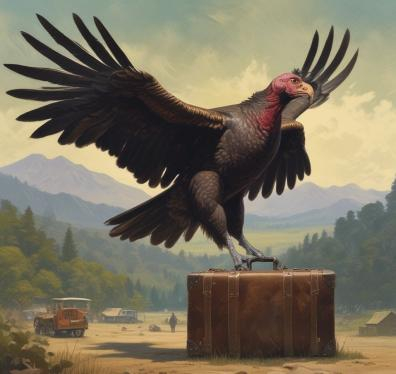
Native to the Americas, the turkey vulture (Cathartes aura) travels widely in search of sustenance. While usually foraging alone, it relies on other individuals of its species for companionship and mutual protection. Sometimes misunderstood, sometimes feared, sometimes shunned, it nevertheless performs an important role in the ecosystem.
This scavenger bird is a marvel of efficiency. Rather than expend energy flapping its wings, it instead locates uplifting columns of air, and spirals within them in order to glide to greater heights. This behavior has been mistaken for opportunism, interpreted as if it is circling doomed terrestrial animals destined to be its next meal. In truth, the vulture takes advantage of these thermals to gain the altitude needed glide longer distances, flying not out of necessity, but for the joy of it.
It also avoids the exertion necessary to capture live prey, preferring instead to feast upon that which is already dead. In this behavior, it resembles many humans.
It is not what most of us would consider to be a pretty bird. While its habits are often off-putting, or even disgusting, to members of more fastidious species, the turkey vulture helps to keep the environment from being clogged with detritus. Hence its Latin binomial, which translates to English as "golden purifier."
I rarely know where the winds will take me next, or what I might find there. The journey is the destination.
February 6, 2026 at 8:37am February 6, 2026 at 8:37am
| |
Regular readers know I'm a fan of etymology and other language studies. Here's one from NPR:
For many in the business world, a return to work after the winter break will mean once again donning the dreaded suit and tie.
Pretty sure that's falling out of fashion, except for, like, lawyers.
The corporate neckwear is the everyday counterpart to the traditionally more luxurious cravat – a voluminous neckscarf that conjures up images of opulent dinners aboard a yacht sailing through the Mediterranean.
It does no such thing for me. But I do know that what we call "a tie" is called "une cravate" in French, and France has a Mediterranean coast, so... whatever; I don't really have a point here, unlike my ties.
Yes, I do own some.
President Abraham Lincoln wore cravats, as did Hollywood actor Cary Grant and the extravagant entertainer Liberace.
At least one, possibly all three, of those men were gay. Nothing wrong with that, of course, at least not from today's perspective; I'm just pointing out that it might be a factor.
In more recent times, the garment has been popularized in the American mainstream by the likes of Madonna and the late Diane Keaton.
Fashion has been moving toward more unisex styles, from what little I know of it. Nothing wrong with that, either.
In this installment of NPR's "Word of the Week" series we trace the origins of the "cravat" (borrowed from the French "cravate") back to the battlefields of 17th century Europe and explore its links to the modern day necktie, patented in New York more than 100 years ago.
That is, honestly, more recent than I thought modern neckties were.
"Scarves worn around the neck existed long before, but the story of the cravat truly begins in the Thirty Years' War when it first gained wider European recognition," explains Filip Hren...
As someone who has studied fighting skills, albeit briefly and without much enthusiasm, I've often wondered about that. Something worn tied around one's neck is a liability in a fight. Unless it's a fake, designed to throw the opponent off-guard when they grab it to strangle you, and it instead comes off in your hand, giving you at least a temporary advantage.
Hren is referring to the 1618-48 conflict fought between Catholics and Protestants and known as Europe's last religious war.
Heh. That's funny.
The word "cravate" first appeared in the French language to describe military attire worn by Croatian mercenaries who were renowned among their enemies for their brutal fighting prowess.
Looking like a fighter is at least half the battle. Not sure if Sun Tzu wrote that, but I believe it to be true.
Made of silk or cotton, the cloth is said to have been used to protect their faces against cold weather and smoke in battle, and to treat injuries.
For a while, neckwear existed with a practical purpose (for non-warriors): shirts didn't have top buttons, or had really bad top buttons, so they used ties (of various styles) to hold the collar closed for a cleaner, more formal look.
For fighters, I can only imagine that they could turn its inherent disadvantage into an advantage: "I can kick your ass even with this liability looped around my most vital body connection."
"The scarves took their names from Croats. It was tied in a Croatian manner, or in French – a la Croate," explains Filip Hren.
And that, I didn't know until I read this article.
As an aside, Croats should not be confused with the Croatoan, a native American tribe largely in what is now North Carolina.
King Louis XIV introduced the cravat into French fashion and from Paris it soon spread across Europe.
And who, in the history of the world, has had more impact on clothing fashion than the French? No one, I say.
They also kick military ass. Coincidence? I think not.
Over the years, the necktie has come to symbolize success, sophistication and status, but has also been criticized by some as a symbol of power, control and oppression.
I don't really understand fashion, but I am rather attuned to symbolism (pretty much have to be, as a writer).
Remaining unexplained, however, is the continued popularity of its cousin, the bowtie. |
© Copyright 2026 Robert Waltz (UN: cathartes02 at Writing.Com). All rights reserved.
Robert Waltz has granted InkSpot.Com, its affiliates and its syndicates non-exclusive rights to display this work.
|


 Comment • View 1 comment