|
About This Author
Come closer.
|
Carrion Luggage
Carrion Luggage
 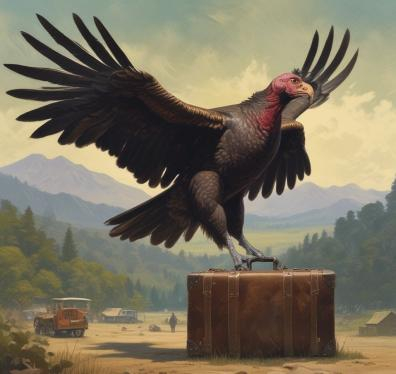
Native to the Americas, the turkey vulture (Cathartes aura) travels widely in search of sustenance. While usually foraging alone, it relies on other individuals of its species for companionship and mutual protection. Sometimes misunderstood, sometimes feared, sometimes shunned, it nevertheless performs an important role in the ecosystem.
This scavenger bird is a marvel of efficiency. Rather than expend energy flapping its wings, it instead locates uplifting columns of air, and spirals within them in order to glide to greater heights. This behavior has been mistaken for opportunism, interpreted as if it is circling doomed terrestrial animals destined to be its next meal. In truth, the vulture takes advantage of these thermals to gain the altitude needed glide longer distances, flying not out of necessity, but for the joy of it.
It also avoids the exertion necessary to capture live prey, preferring instead to feast upon that which is already dead. In this behavior, it resembles many humans.
It is not what most of us would consider to be a pretty bird. While its habits are often off-putting, or even disgusting, to members of more fastidious species, the turkey vulture helps to keep the environment from being clogged with detritus. Hence its Latin binomial, which translates to English as "golden purifier."
I rarely know where the winds will take me next, or what I might find there. The journey is the destination.
February 9, 2026 at 9:03am February 9, 2026 at 9:03am
| |
Speaking of time, there's this article from aeon:
The shape of time 
In the 19th century, the linear idea of time became dominant, forever changing how those in the West experience the world
It would be horribly remiss of me if I didn't include this famous quote:
"People assume that time is a strict progression of cause to effect, but actually from a non-linear, non-subjective viewpoint - it's more like a big ball of wibbly-wobbly... timey-wimey... stuff."
— The Doctor
‘It’s natural,’ says the Stanford Encyclopedia of Philosophy, ‘to think that time can be represented by a line.’ We imagine the past stretching in a line behind us, the future stretching in an unseen line ahead.
I have heard that there is a culture, perhaps in Australia, or maybe Papua New Guinea or South America (I don't recall), where they think of the future as behind them and the past as in front of them. This is, if I remember right, because you can "see" the past but you cannot "see" the future.
So, no, it's no more "natural" to "think that time can be represented by a line" than it is to think of time moving from left to right on a page, the way Westerners read language. Perhaps those who write from right to left see time progressing from right to left. Even writing is arguably not "natural."
However, this picture of time is not natural. Its roots stretch only to the 18th century, yet this notion has now entrenched itself so deeply in Western thought that it’s difficult to imagine time as anything else.
Except, perhaps, as a big ball of wibbly-wobbly, timey-wimey stuff.
Let’s journey back to ancient Greece. Amid rolls of papyrus and purplish figs, philosophers like Plato looked up into the night. His creation myth, Timaeus, connected time with the movements of celestial bodies. The god ‘brought into being’ the sun, moon and other stars, for the ‘begetting of time’. They trace circles in the sky, creating days, months, years.
While it seems to be true that Western culture borrows a lot from ancient Greece, there really were other cultures in the world. I'd think the whole "this started with ancient Greece" thing would have fallen out of favor by now. Guess not.
Such views of time are cyclical: time comprises a repeating cycle, as events occur, pass, and occur again.
I can kind of understand why people would think time is a cycle. As the article notes, things do seem to have cycles: day/night, moon, year, planet alignments, etc. But the idea that "events occur, pass, and occur again" just seems wrong to me. Even though there's, e.g., Groundhog Day every year, not every Groundhog Day is the same.
It’s even hinted at in the Bible. For example, Ecclesiastes proclaims: ‘What has been will be again … there is nothing new under the sun.’
Of all the laughably wrong things in the Bible, "there is nothing new under the sun" might well be the most laughably wrong. Well, right up there with "we live on a flat Earth between two waters," anyway. Maybe also with "there was a global flood in human history."
And yet, like Greek ideas, it's part of culture. To quote the Battlestar:Galactica remake: "All of this has happened before. All of this will happen again."
Importantly, medievals and early moderns didn’t literally see cyclical time as a circle, or linear time as a line. Yet in the 19th-century world of frock coats, petticoats and suet puddings, change was afoot. Gradually, the linear model of time gained ground, and thinkers literally began drawing time as a line.
I believe it's important to note that, whether we conceive of time as cyclical, linear, wibbly-wobbly, or anything else we can come up with, this is a matter of perception, not reality. No one knows what time really is. People have guesses, and they'll tell you their guesses with great confidence, such as "time is like a river," but as we saw yesterday, some rivers are more rivery than others.
But no. Time is time. The only thing I can say with great confidence is what it's not: an illusion. It may well be an emergent property of something deeper, but then, so is the chair you're sitting in right now.
A crucial innovation lay in the invention of ‘timelines’. As Daniel Rosenberg and Anthony Grafton detail in their coffee-table gorgeous Cartographies of Time (2010), the ‘modern form’ of the timeline, ‘with a single axis and a regular, measured distribution of dates’, came into existence around the mid-18th century. In 1765, the scientist-philosopher Joseph Priestley, best known for co-discovering oxygen, invented what was arguably the world’s first modern timeline.
What this brought to mind for me was the Periodic Table. Elements, like oxygen, exist with or without the Periodic Table, but Mendeleev's invention helped us visualize their relationships with each other, much like a timeline helps us visualize past events in relation to one another.
Rosenberg and Grafton describe A Chart of Biography as ‘path-breaking’, a ‘watershed’. ‘Within very few years, variations on Priestley’s charts began to appear just about everywhere … and, over the course of the 19th century, envisioning history in the form of a timeline became second nature.’ Priestley’s influence was widespread. For example, William Playfair, the inventor of line graphs and bar charts, singled out Priestley’s timeline as a predecessor of his own work.
I say this gives short shrift to Descartes, who basically invented graphs in the early 17th century. See, already I'm putting events on a timeline.
The second key development concerns evolution. During the early 19th century, scientists created linear and cyclical models of evolutionary processes. For example, the geologist Charles Lyell hypothesised that the evolution of species might track repeatable patterns upon Earth. This led to his memorable claim that, following a ‘cycle of climate’, the ‘pterodactyle might flit again through the air.’ However, with the work of Charles Darwin, cyclical models faded. His On the Origin of Species (1859) conceives of evolution in linear terms. It literally includes diagrams depicting species’ evolution over time using splaying, branching lines.
I think that once we realized that entropy only goes in one time direction, the old idea of cycles of time had to go right out the window.
Entropy and time are intertwined, and physics's best guess as to the nature of time right now is that it is entropy.
Now, I know some people mistakenly believe that evolution goes against entropy, but that discussion is outside the scope of this entry.
The last development stemmed from mathematics: theories of the fourth dimension. Humans perceive three spatial dimensions: length, width, and depth. But mathematicians have long theorised there were more. In the 1880s, the mathematician Charles Hinton popularised these ideas, and went further. He didn’t just argue that space has a fourth dimension, he identified time with that dimension.
Now that was something I wasn't aware of. I knew the idea of "spacetime" preceded Einstein, but I don't think I'd ever heard of Hinton.
Nowadays, of course, mathematicians like to play with way more than four dimensions, and apparently, something like 16 are required for string theory (which, if anything in science can be said to be "only a theory," it's string theory).
Within history, conceiving of time as a line helped to fuel the notion that humanity is making progress. Joseph Priestley, our timeline inventor, is partly responsible for this. The man once listed inventions that have made people happier, including flour mills, linen, clocks, and window glass.
Sadly, Priestly lived before sliced bread and the "Skip Intro" button.
Within philosophy, conceiving of time as a line led to thinkers debating the reality of the past and future.
Whereas I assert that only the past is real; the present is an illusion created by the very recent past, and the future doesn't even rise to the level of illusion, as it does not exist at all and won't until the past catches up.
But I acknowledge that this, too, is a matter of perception and point of view.
I've gone on long enough for today (see, I made a time reference there). The article also goes on for a while, but it's an interesting read. And an appropriate one for an outlet named aeon. |
© Copyright 2026 Robert Waltz (UN: cathartes02 at Writing.Com). All rights reserved.
Robert Waltz has granted InkSpot.Com, its affiliates and its syndicates non-exclusive rights to display this work.
|


 Comment • View 3 comments