|
About This Author
Come closer.
|
Carrion Luggage
Carrion Luggage
 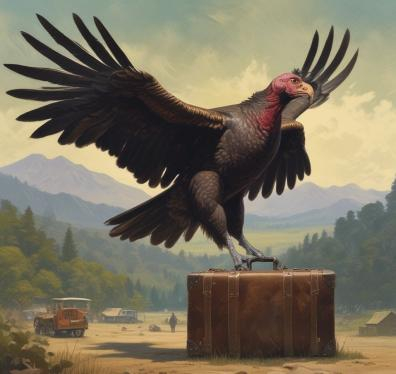
Native to the Americas, the turkey vulture (Cathartes aura) travels widely in search of sustenance. While usually foraging alone, it relies on other individuals of its species for companionship and mutual protection. Sometimes misunderstood, sometimes feared, sometimes shunned, it nevertheless performs an important role in the ecosystem.
This scavenger bird is a marvel of efficiency. Rather than expend energy flapping its wings, it instead locates uplifting columns of air, and spirals within them in order to glide to greater heights. This behavior has been mistaken for opportunism, interpreted as if it is circling doomed terrestrial animals destined to be its next meal. In truth, the vulture takes advantage of these thermals to gain the altitude needed glide longer distances, flying not out of necessity, but for the joy of it.
It also avoids the exertion necessary to capture live prey, preferring instead to feast upon that which is already dead. In this behavior, it resembles many humans.
It is not what most of us would consider to be a pretty bird. While its habits are often off-putting, or even disgusting, to members of more fastidious species, the turkey vulture helps to keep the environment from being clogged with detritus. Hence its Latin binomial, which translates to English as "golden purifier."
I rarely know where the winds will take me next, or what I might find there. The journey is the destination.
| |
This Smithsonian article was probably timed for Presidents' Day, but for some reason it seems appropriate enough that it came up at random for me today. Maybe it has something to do with reminding us what US presidents used to be like.
From Abraham Lincoln’s patent to James A. Garfield’s geometry proof, learn how these 19th- and 20th-century commanders in chief shaped their legacies beyond politics
It would also have been impossible for me not to save a link with "teenage diplomat" in the headline, thanks to Bruce Springsteen's Blinded By The Light: "Madman drummers bummers and Indians in the summer with a teenage diplomat..."
I gave up on trying to understand those lyrics years ago, but it remains one of my favorite songs. Not the Manfred Mann version. The original Springsteen. But I doubt he was speaking of the president in question.
But I digress. We were talking about former presidents.
In 1876, when James A. Garfield was serving his seventh term in Congress, he devised an original proof for the Pythagorean theorem. A classics scholar who’d taught math, history, philosophy, Greek, Latin and rhetoric at an Ohio college, the 20th president was also a preacher, a Union major general during the Civil War and a lawyer.
Elitist! Out of touch with the common citizen!
John Quincy Adams was a teenage diplomat and polyglot.
Well, that settles the headline, if not the song.
As president in the 1820s, Adams was an early, vocal proponent of astronomy, mocked when he advocated for America to build “lighthouses of the skies” that would rival European observatories.
I can appreciate that. I'd be remiss if I didn't point out that Jefferson (for all his well-known faults) was also a fan of astronomy. Lore at UVA is that he'd originally designed the Rotunda for use as an early version of a planetarium.
William Henry Harrison was the only U.S. president to attend medical school.
And yet...
William Henry Harrison had the shortest tenure of any American president, dying just 31 days after he delivered a two-hour long inaugural address in the rain, without wearing a coat or a hat.
In fairness, as the article points out, Harrison didn't actually finish medical school.
Abraham Lincoln is the only president to hold a patent.
It's unfortunate that he couldn't patent his beard.
Between 1858 and 1860, Abraham Lincoln delivered multiple lectures across Illinois on the vital importance of “discoveries and inventions” to the progress of mankind. Yet he never told audiences that he was responsible for one such innovation: U.S. Patent No. 6,469, a device for “buoying vessels over shoals.” Lincoln is the only American president to hold a patent.
Fun fact: my father held a patent. It was also ocean-related. It also had to do with the ocean. My father's excuse was that he was a sailor, not a lawyer.
James A. Garfield devised a proof for the Pythagorean theorem.
This bit just expands on what they said in the lede. I'm including it again because I like math.
Garfield’s Pythagorean proof offers just a glimpse into the brilliance of America’s 20th president, who was shot by a disgruntled lawyer in July 1881, just four months into his term.
I'm beginning to see a pattern here: the smart ones dying too early.
Herbert Hoover and his wife were giants of mining engineering.
Yeah, and he's the one with a dam named after him. But the big deal here is the "wife" bit. As the article notes, his wife "was the first woman to graduate from Stanford with a geology degree," though sexism kept her from finding a job in the field.
In the early 1900s, the Hoovers, who were then living in London, learned that no one had yet published an English translation of De Re Metallica, a seminal 16th-century mining text.
...and nothing else matters.
Yes, I can quote Springsteen and Metallica in one blog post.
Jimmy Carter was a pioneering nuclear engineer and Renaissance man.
I think most people knew that, regardless of their opinion of him as President. And this one almost makes up for the other smart ones dying too early.
For me, though, his greatest accomplishment was signing legislation that permitted homebrewing of beer, which led to an explosion of craft breweries, which brought us real alternatives to mass-produced, rice-adjunct swill. It also brought us an unfortunate deluge of IPAs, but there's nothing so good that there isn't some bad in it.
Anyway, there's a few I skipped, and there's a lot more detail at the link. |
© Copyright 2026 Robert Waltz (UN: cathartes02 at Writing.Com). All rights reserved.
Robert Waltz has granted InkSpot.Com, its affiliates and its syndicates non-exclusive rights to display this work.
|


 Comment • View 3 comments