|
About This Author
Come closer.
|
Carrion Luggage
Carrion Luggage
 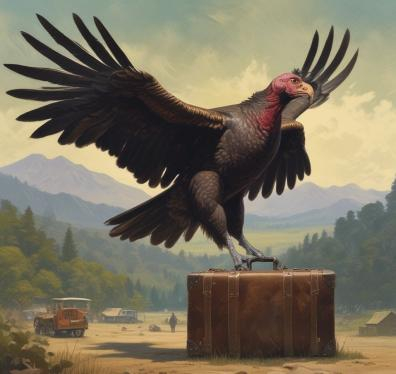
Native to the Americas, the turkey vulture (Cathartes aura) travels widely in search of sustenance. While usually foraging alone, it relies on other individuals of its species for companionship and mutual protection. Sometimes misunderstood, sometimes feared, sometimes shunned, it nevertheless performs an important role in the ecosystem.
This scavenger bird is a marvel of efficiency. Rather than expend energy flapping its wings, it instead locates uplifting columns of air, and spirals within them in order to glide to greater heights. This behavior has been mistaken for opportunism, interpreted as if it is circling doomed terrestrial animals destined to be its next meal. In truth, the vulture takes advantage of these thermals to gain the altitude needed glide longer distances, flying not out of necessity, but for the joy of it.
It also avoids the exertion necessary to capture live prey, preferring instead to feast upon that which is already dead. In this behavior, it resembles many humans.
It is not what most of us would consider to be a pretty bird. While its habits are often off-putting, or even disgusting, to members of more fastidious species, the turkey vulture helps to keep the environment from being clogged with detritus. Hence its Latin binomial, which translates to English as "golden purifier."
I rarely know where the winds will take me next, or what I might find there. The journey is the destination.
| |
Been a while since I've talked about cheese. Here's a cheesy article from Good Housekeeping.
With a clickbait headline like that, I was almost hoping it was an ad for Cheez Wiz. Alas, it seems to be a serious article (though it might still be an ad).
I used to be a cheesemonger and sold artisan cheese to chefs in Chicago for almost ten years, and when I think of pasta, (and I often do), I dream of cacio e pepe.
I'm not sure how I feel about that lede. It's a sentence that makes sense grammatically, sure (though I'm not sure it needs the comma after "pasta"). It also works if one already knows what the author is about to talk about, or in hindsight, once the connection between artisan cheese and cacio e pepe is more clear. But as a lede? It's functionally equivalent to "I used to be a plumber, and when I think of cars, I dream of Toyotas."
The sharp, salty flavor of a hunk of Pecorino Romano cheese, plus freshly ground black pepper, is crucial to the rustic flavor of this simple dish.
At least it's explained there in the first paragraph.
I buy it in small wedges, preferably cut fresh from the 55-pound wheel, and whiz it in the food processor for a rough, toothy texture that is fine enough to melt instantly.
Look at Ms. Fancy Chef over here with her fancy-cheese-pulverizing Food Processor.
Don’t get me wrong, I love Parmigiano-Reggiano, the so-called King of Cheeses, for its savory, caramelly, nutty flavor that brings umami to every plate.
Just so everyone's aware: there are other countries besides Italy that make cheese. Just saying.
Dishes with olives, roasted peppers, anything grilled with a bit of a char pair beautifully with the slightly pungent, briny, rustic taste of a true Pecorino Romano.
We're edging dangerously close to the No True Pecorino Romano fallacy.
Pecorino Romano and Parmesan are both aged Italian (or Italian-style) cheeses made in large wheels. Pecorino Romano, however, is made from sheep milk (”sheep” is “pecora” in Italian) while Parmigiano-Reggiano is made from cow’s milk and is a protected designation of origin (PDO) cheese produced in specific regions of Italy.
You know one thing I've never fully understood, though it's something I probably should: how protected labels are enforced outside of the country they're from. Perhaps the most famous is champagne, which, as everyone knows, can only be called champagne if it's from the Champagne region. Tequila can only be called tequila if it comes from a small region in Mexico.
But the US, for example, isn't France or Mexico, so what's stopping someone in, say, Oregon, from importing a bunch of agave and making a fine distilled beverage and calling it tequila? I mean, sure, Mexico could declare war on us over the violation (and right now, might just win), but other than war, what? Treaties? The UN? Pinky promises? Trade embargo? Strongly worded letter?
I'll have to look into that. Anyway...
Pecorino Romano cheese possesses a PDO (protected designation of origin) and thus can only be made in particular regions of Italy—primarily Sardinia, Lazio, and the province of Grosseto in Tuscany...
I'm embarrassed that I had to look up Lazio. It's the region containing Rome. For some reason, I'd never been aware of that name. In my defense, I've never been to Italy. Still... four years of Latin in high school and a love of Italian cuisine here. Just saying.
Cheese just called “Romano,” on the other hand, generally refers to an American-made version of a hard, salty cheese that can be made from cow’s milk, sheep’s milk, goat’s milk (or a blend) without the nuances in flavor and texture that a heritage Pecorino Romano from Italy might possess.
Now, just because it's made in the US doesn't make it automatically bad. Sure, the mass-produced, pre-grated Kraft version is basically sawdust, but we do make some decent cheese here. Just mostly smaller-batch stuff, like the difference between a delicious craft (not to ever be confused with Kraft) beer and the mass-produced swill that gets heavily advertised.
I can accept, however, that Romano from the US is, at the very least, different from Pecorino Romano from Italy.
Speaking of advertising, the article ends by mentioning a couple of brand names. Sneaky, sneaky ads. Oh, well, at least it doesn't come with a cheesy jingle. |
© Copyright 2026 Robert Waltz (UN: cathartes02 at Writing.Com). All rights reserved.
Robert Waltz has granted InkSpot.Com, its affiliates and its syndicates non-exclusive rights to display this work.
|


 Comment • View 4 comments