|
About This Author
Come closer.
|
Carrion Luggage
Carrion Luggage
 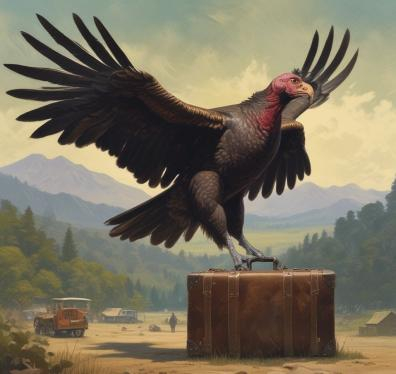
Native to the Americas, the turkey vulture (Cathartes aura) travels widely in search of sustenance. While usually foraging alone, it relies on other individuals of its species for companionship and mutual protection. Sometimes misunderstood, sometimes feared, sometimes shunned, it nevertheless performs an important role in the ecosystem.
This scavenger bird is a marvel of efficiency. Rather than expend energy flapping its wings, it instead locates uplifting columns of air, and spirals within them in order to glide to greater heights. This behavior has been mistaken for opportunism, interpreted as if it is circling doomed terrestrial animals destined to be its next meal. In truth, the vulture takes advantage of these thermals to gain the altitude needed glide longer distances, flying not out of necessity, but for the joy of it.
It also avoids the exertion necessary to capture live prey, preferring instead to feast upon that which is already dead. In this behavior, it resembles many humans.
It is not what most of us would consider to be a pretty bird. While its habits are often off-putting, or even disgusting, to members of more fastidious species, the turkey vulture helps to keep the environment from being clogged with detritus. Hence its Latin binomial, which translates to English as "golden purifier."
I rarely know where the winds will take me next, or what I might find there. The journey is the destination.
March 19, 2026 at 10:40am March 19, 2026 at 10:40am
| |
Here's an animalistic one from Mental Floss.
Well, no, I knew those things (though I wonder if mice simply don't like what we laughingly call "cheese" in the US). But they're iconic. Perhaps even clichéd. So, a joke like "The early bird may catch the worm, but the second mouse gets the cheese" is instantly understandable, even if both the teller and listener know that cheese isn't actually mouse Kryptonite.
Even my use of "Kryptonite" there is wrong. Superman never, as far as I know (he's been around a long time), deliberately sought out Kryptonite to eat. It would be more accurate for me to say that cheese isn't actually mouse Lois Lane.
When we’re babies, many of our parents teach us what sounds animals make, then give us plush animal toys, then show us cartoons starring animals who talk.
For some reason, they never told me what the fox says.
Many of us, therefore, grow up convinced we know all about animals, even if our knowledge consists entirely of nonsensical stereotypes.
It is, for example, required for city people, while driving through the country and seeing cattle, to go "MOOO!" in the car.
Apologies for the all-caps headers. I copy/paste these things, and I can't be arsed to convert to Upper Lower Case.
MICE DON'T LOVE CHEESE
We all picture mice nibbling at cheese, and if you buy a mousetrap, it might feature a little drawing of a wedge of cheese on it.
Yes, and it's always, always Swiss cheese. I've covered this in here before.
In fact, mice will choose most foods in your kitchen over cheese.
Especially the plastic crap that marketing has convinced us is cheese.
The idea may have also spread because artists began to commonly draw mice next to big wedges of Swiss cheese full of holes, perhaps since mice are so associated with holes.
I've also covered the concept of "holes" in here.
CATS CAN’T DIGEST MILK
As for the mouse’s enemy, the cat, we all think we know what food to give it: a saucer of milk. Or, in practice, we know enough to give cats actual cat food, but we still have the image in our minds of kindly giving a cat a saucer of milk. Don’t ever do that.
As a nearly lifelong cat person, of course I knew that.
I am, however, way more concerned about people who think their cats can survive on a vegan diet. They're obligate carnivores with the occasional craving for whatever houseplant you love the most.
PEANUTS AREN'T GOOD FOR ELEPHANTS
If you've ever imagined yourself feeding an elephant a handful of peanuts, consider that this is one snack they are not terribly likely to encounter in the scrublands and savannas.
Peanuts originated in South America. Ever seen an elephant roaming wild in South America? I haven't, but perhaps that's because I've never actually been to South America.
Which, of course, doesn't explain the popularity of cat food made from beef. I haven't seen a housecat take down a cow, either. Try, yes. Succeed, no.
RABBITS AREN’T MADE FOR CARROTS
Rabbits are one more animal that would be better off eating leafy greens than eating anything else humans eat, but people still associate them with one specific food. Rabbits are commonly linked to carrots, but this is only because Bugs Bunny nibbles on carrots in cartoons.
They also don't say "What's up, doc?" I know, I know: your entire worldview has just been shattered. Sorry.
I've kept rabbits. You know what they do like? Carrot tops. Not the terrible comedian, but the actual green stuff that sticks out of the ground above carrots.
This worked out for me because I love carrots (they are, in fact, the only vegetable I would associate with the word "love" rather than "like," "tolerate," or "despise"), and we could get whole carrots with the tops on and not waste the green parts.
I did see some article recently that was something about "why you should be eating carrot tops," but I didn't even bother to save that one to rag on.
Incidentally, carrots are in the same family as parsley. You know, in case you were wondering why carrot leaves so closely resemble parsley in morphology, if not in taste.
DON’T FEED DUCKS BREAD
It’s unclear where the idea that you should feed bread to ducks originated. Maybe it came from the fact that people often picnicked next to water, had bread with them for sandwiches, and found bread to be the most convenient food to tear apart and throw to the ducks.
Again: ever seen a wild duck foraging for wild bread? No, because bread doesn't exist in the wild.
The article says "don't feed ducks anything," but I wouldn't go that far, personally. I have it on good authority that mealworms are preferred if you're going to feed ducks. Since you'd have to go out of your way to get mealworms, then yeah, don't feed the ducks.
PIRANHAS DON’T EAT HUMANS
Dangit. Now I have to find something else to populate the moat around my lair. |
© Copyright 2026 Robert Waltz (UN: cathartes02 at Writing.Com). All rights reserved.
Robert Waltz has granted InkSpot.Com, its affiliates and its syndicates non-exclusive rights to display this work.
|


 Comment • View 4 comments