|
About This Author
Come closer.
|
Carrion Luggage
Carrion Luggage
 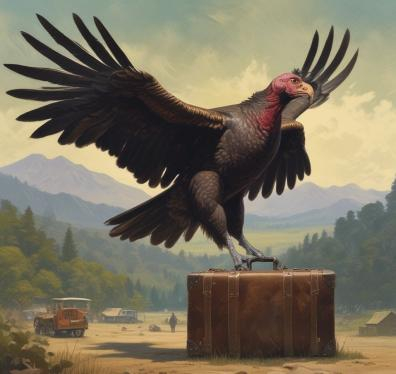
Native to the Americas, the turkey vulture (Cathartes aura) travels widely in search of sustenance. While usually foraging alone, it relies on other individuals of its species for companionship and mutual protection. Sometimes misunderstood, sometimes feared, sometimes shunned, it nevertheless performs an important role in the ecosystem.
This scavenger bird is a marvel of efficiency. Rather than expend energy flapping its wings, it instead locates uplifting columns of air, and spirals within them in order to glide to greater heights. This behavior has been mistaken for opportunism, interpreted as if it is circling doomed terrestrial animals destined to be its next meal. In truth, the vulture takes advantage of these thermals to gain the altitude needed glide longer distances, flying not out of necessity, but for the joy of it.
It also avoids the exertion necessary to capture live prey, preferring instead to feast upon that which is already dead. In this behavior, it resembles many humans.
It is not what most of us would consider to be a pretty bird. While its habits are often off-putting, or even disgusting, to members of more fastidious species, the turkey vulture helps to keep the environment from being clogged with detritus. Hence its Latin binomial, which translates to English as "golden purifier."
I rarely know where the winds will take me next, or what I might find there. The journey is the destination.
| |
Here's one of those reports that seems like it should be fake, but in this case, probably isn't. From ScienceNews:
Though, apart from the whole "never-before-seen" thing, I'm not sure why a predator catching prey is such a big deal. Cats catch birds in flight. Frogs catch flies in flight. I guess there's some poetry because "rat" and "bat" rhyme in English.
The observation happened by chance, says Florian Gloza-Rausch, a biologist at the Museum of Natural History in Berlin. He and colleagues had been studying a colony of 30,000 bats overwintering in a cave about 60 kilometers north of Hamburg.
I suppose if the bats in question were endangered, there'd be an issue, but that does not appear to be the case.
Brown rats (Rattus norvegicus) figured out how to get inside the kiosk and climb up to the bats’ landing platform at the entrance, using a curtain the researchers placed inside the kiosk for filming purposes.
Rats are scary smart. More importantly, they adapt to what we do.
Out of 30 filmed predation attempts, 13 were successful. The attacks happened in complete darkness, so the researchers suspect that the rats sensed the bats with their whiskers.
"Rat-sense. Tingling." Seriously, though, I'd love to see a follow-up study to determine if the rats get better at it over time. And also a follow-up to see if it is their whiskers, or if rats have a heretofore unknown echolocation sense like the bats have. Unlikely, as rats are probably the most-studied animals in the world. Still, nature surprises us all the time, as this article demonstrates.
Look, I have nothing against bats (or rats); predation is just part of nature. However, a lot of the rat population is the result of human activity, so maybe this happens because of us, collectively? I don't know. It's kind of like how some people insist cats should be kept indoors to protect birds. As if cats were the invasive species, and not us.
A colony of just 15 brown rats could reduce the cave’s population of 30,000 bats by 7 percent each winter, Gloza-Rausch and colleagues estimate.
I imagine you never have a colony of "just" 15 rats. At least not for very long. And, okay, the researchers would know better than I do what the conservation issues might be.
Bats are, of course, just as important to the ecosystem as rats, however maligned both critters may be. Perhaps not as majestic as the turkey vulture, but they are cuter. |
© Copyright 2026 Robert Waltz (UN: cathartes02 at Writing.Com). All rights reserved.
Robert Waltz has granted InkSpot.Com, its affiliates and its syndicates non-exclusive rights to display this work.
|


 Comment • View 10 comments