|
About This Author
Come closer.
|
Carrion Luggage
Carrion Luggage
 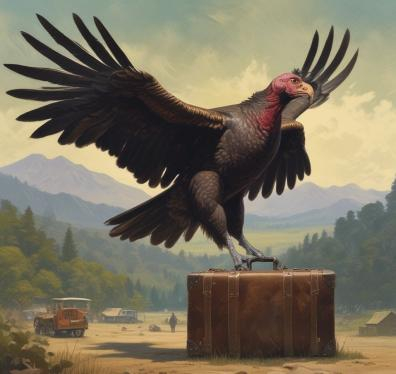
Native to the Americas, the turkey vulture (Cathartes aura) travels widely in search of sustenance. While usually foraging alone, it relies on other individuals of its species for companionship and mutual protection. Sometimes misunderstood, sometimes feared, sometimes shunned, it nevertheless performs an important role in the ecosystem.
This scavenger bird is a marvel of efficiency. Rather than expend energy flapping its wings, it instead locates uplifting columns of air, and spirals within them in order to glide to greater heights. This behavior has been mistaken for opportunism, interpreted as if it is circling doomed terrestrial animals destined to be its next meal. In truth, the vulture takes advantage of these thermals to gain the altitude needed glide longer distances, flying not out of necessity, but for the joy of it.
It also avoids the exertion necessary to capture live prey, preferring instead to feast upon that which is already dead. In this behavior, it resembles many humans.
It is not what most of us would consider to be a pretty bird. While its habits are often off-putting, or even disgusting, to members of more fastidious species, the turkey vulture helps to keep the environment from being clogged with detritus. Hence its Latin binomial, which translates to English as "golden purifier."
I rarely know where the winds will take me next, or what I might find there. The journey is the destination.
| |
We haven't had one of these for a little while: a language-related listicle from Mental Floss.
Well, now next time someone invites me somewhere, I can say I have extenuating errands.
The English language is certainly bizarre in the best way.
For instance, there are values of "best" I wasn't aware of until just now.
Some of it is totally run-of-the-mill, and some of it is full of words that only seem to appear in one extremely specific situation.
There's another listicle somewhere that explains "run-of-the-mill." Maybe I already featured it. Maybe it's coming. Maybe I forgot to save it. I don't recall. It's really not hard to guess at, but I think it's good for writers to think about these things.
So let’s take a little stroll through eight words that only show up in one weirdly specific context.
Including the word "weird" in the headline (and to a lesser extent, here) is way too close to clickbait. But have you ever wondered why "weird" is so weird? I mean, it doesn't even follow the well-known "I before E except after C" spelling rule.
Anyway, I'm not going to cover all of them.
Inclement (Weather)
If you’ve ever heard the word “inclement” outside of local news broadcasts, please step forward, because we know you’re lying.
This is, of course, our clue to use it to describe something other than weather. The situation at the office, maybe, or a police raid.
What the article doesn't note, but I will, is that this is one of those Latin-root words whose cousins appear every now and then. The obvious example is the name "Clementine," or the citrus fruit that has that name. But my dictionary source says "clement" can describe someone's demeanor (synonym: merciful), so why can't "inclement?"
Diametrically (Opposed)
Diametrically has one job: heighten drama. No one is ever diametrically aligned, and no one is diametrically friends.
That's because the meaning is something like "directly and completely," and it doesn't hurt that the word contains many of the same sounds. This isn't a case like "literally," which is often used to mean "figuratively or metaphorically" and also to heighten drama. "Figuratively" and "metaphorically" have definitions that should be diametrically opposed to that of "literally."
Bode (Well/Ill)
Bode is a free agent in theory, but let’s be honest: you’ve only ever seen it next to “well” or “ill.”
Again, an opportunity to get this one to stretch a bit.
Hermetically (Sealed)
Now, this word is a little “underground,” if you will. Hermetically sealed sounds like something out of a sci-fi lab, but it mostly refers to food packaging and those little foil seals you peel off with your teeth, even though you’re not supposed to.
This one's a little trickier. It doesn't mean what I thought it meant for most of my life. I thought it was related to mercury (the element, not the planet or the god), by extension from Mercury to Hermes. I thought it had to do with how liquid mercury could form seals. In my defense, I wasn't too far off, but it referred to an entirely different god: Thoth, the Egyptian god of knowledge who, when the Greeks took over Egypt, became identified with Hermes. How that led to things being described as hermetically sealed is interesting, but beyond today's scope.
If that's a little confusing, don't worry. I was confused, too. The link in the article only goes to something that explains what "hermetically sealed" does, without going into the word origin.
Pyrrhic (Victory)
Of all the words here, I think this one makes the most sense to be paired with only one other word. Again, it's of ancient origin, but it's derived from a person's name: a Roman general named Pyrrhus. And to one particular battle, which his forces won, but only at great cost. It became the Platonic ideal (Platonic, of course, being another word derived from a name, but which can pair with several other words besides "ideal") of a victory that only comes with tremendous losses.
Contiguous (United States)
Contiguous technically means “touching,” but 99% of its appearances involve either a map or the phrase “excluding Alaska and Hawaii.”
Yeah, but that other 1% exists (though I think the percentages here are pulled from thin air)—though they're mostly technical jargon.
English is full of these little linguistic oddities. Some may be outdated, sure, but one thing remains true: We sound incredibly smart when we use them the right way!
I think we can sound even smarter if we come up with new ways to use them, perhaps even all of them in one contiguous sentence. Which I'm entirely too lazy to do right now, so I'll settle for just the one. |
| |
Here's one of those reports that seems like it should be fake, but in this case, probably isn't. From ScienceNews:
Though, apart from the whole "never-before-seen" thing, I'm not sure why a predator catching prey is such a big deal. Cats catch birds in flight. Frogs catch flies in flight. I guess there's some poetry because "rat" and "bat" rhyme in English.
The observation happened by chance, says Florian Gloza-Rausch, a biologist at the Museum of Natural History in Berlin. He and colleagues had been studying a colony of 30,000 bats overwintering in a cave about 60 kilometers north of Hamburg.
I suppose if the bats in question were endangered, there'd be an issue, but that does not appear to be the case.
Brown rats (Rattus norvegicus) figured out how to get inside the kiosk and climb up to the bats’ landing platform at the entrance, using a curtain the researchers placed inside the kiosk for filming purposes.
Rats are scary smart. More importantly, they adapt to what we do.
Out of 30 filmed predation attempts, 13 were successful. The attacks happened in complete darkness, so the researchers suspect that the rats sensed the bats with their whiskers.
"Rat-sense. Tingling." Seriously, though, I'd love to see a follow-up study to determine if the rats get better at it over time. And also a follow-up to see if it is their whiskers, or if rats have a heretofore unknown echolocation sense like the bats have. Unlikely, as rats are probably the most-studied animals in the world. Still, nature surprises us all the time, as this article demonstrates.
Look, I have nothing against bats (or rats); predation is just part of nature. However, a lot of the rat population is the result of human activity, so maybe this happens because of us, collectively? I don't know. It's kind of like how some people insist cats should be kept indoors to protect birds. As if cats were the invasive species, and not us.
A colony of just 15 brown rats could reduce the cave’s population of 30,000 bats by 7 percent each winter, Gloza-Rausch and colleagues estimate.
I imagine you never have a colony of "just" 15 rats. At least not for very long. And, okay, the researchers would know better than I do what the conservation issues might be.
Bats are, of course, just as important to the ecosystem as rats, however maligned both critters may be. Perhaps not as majestic as the turkey vulture, but they are cuter. |
| |
This one, from Atlas Obscura, has been languishing in my pile for a very long time. Probably not since last July, when it was published, but it's been a while. So whatever reason I had for saving it, I don't remember what it was, other than my general appreciation for Brutalism, a much-maligned architectural style.
Now, a couple more disclaimer-type things: First, the article is a podcast transcript. I don't listen to podcasts. I'd rather read text. But if you're the other way around, I think there are links at the article. And second, my appreciation for Brutalism is a direct result of me being a function-over-form engineer who has worked in the concrete industry, not because I have a developed sense of aesthetics. Still, my favorite architecture is both functional and pretty—though of course, "pretty" is subjective.
Diana Hubbell: Whether or not you saw the movie The Brutalist, you’ve probably heard a lot about it.
This is literally the only place I've seen, or heard, anything about that movie.
In the film, Brutalist architecture serves as a metaphor for resilience and transformation.
I also appreciate metaphor.
Viewers of Brutalist architecture over the years have accused it of being drab and utilitarian. They’ve said these hulking concrete buildings looked more like fortresses. More than a few have accused them of being ugly. And while I can kind of see their point, there’s something powerful about these buildings when you consider them in the context they were made.
As I said, it's subjective. Thing is, there are a lot of ugly buildings around (there's one close to me which actually got the nickname "Big Ugly," and it's your classical colonial Virginia brick-with-white-trim, not Brutalist. We have a Brutalist building downtown, though. Used to house a spy agency. The blacked-out windows were uglier than the concrete framing them.
A couple years ago, I visited the Rothko Chapel in Houston, Texas, and it challenged my idea of what a church could be.
It's a building. It can be lots of things. We used to have a Catholic church around here with a very interesting design, including a rounded triangular shape (apparently representing the Trinity) and a reverse steeple. Yep, the ceiling dipped down in the middle, I guess to emphasize that God is coming "down" to Earth instead of people reaching "up" to God. Or something. I'm better at metaphor when it's written.
What was I doing in a Catholic church? I've been in lots of churches. Occupational hazard of having been a wedding photographer.
In true Brutalist fashion, it bears more resemblance to a bunker than a Gothic cathedral. The stark exterior is an irregular octagon done up in rose stucco.
I'm sure there was a religious reason for all of that, too. I just can't figure what it might have been.
It seems appropriate to me that the Rothko Chapel isn’t really a church in the traditional sense. Although the de Menils who commissioned it were devout Catholics, this place is non-denominational. Great art has the power to move anyone, regardless of their faith.
I think this may have been the bit that made me save this article. I find that last sentence to be true, at least for me. Once I see a great work of architecture or art, or hear music, it doesn't matter whether it had a religious, or spiritual, purpose to it; I just appreciate the artistry.
A handful of years after the Rothko Chapel was completed in the ’70s, another Brutalist structure was being built, this time on the other side of the world. Roxanne Hoorn brings us that story.
I mean, sure, another continent, but hardly the other side of the world.
Roxanne Hoorn: Shrouded by the forest and perched on a sloping hillside in northwest Bosnia and Herzegovina sits a massive marble structure. Split down the middle, its two towering concave walls reaching as high as a basketball court is long. They curve inward, reaching for one another, shadowing the two-story atrium between them.
One of my failings as a writer is that it's hard for me to do descriptions like this. So I appreciate them when I see them.
Still, I'm a little unclear on how marble fits into the Brutalist category.
There's more at the link, including the history behind this second structure. It makes me want to see the things, which I suppose is the whole point of AO (I used that site to help guide my European visit a couple years back). But mostly, I just wanted to cast (pun intended) another vote in favor of Brutalism. |
| |
This Smithsonian article was probably timed for Presidents' Day, but for some reason it seems appropriate enough that it came up at random for me today. Maybe it has something to do with reminding us what US presidents used to be like.
From Abraham Lincoln’s patent to James A. Garfield’s geometry proof, learn how these 19th- and 20th-century commanders in chief shaped their legacies beyond politics
It would also have been impossible for me not to save a link with "teenage diplomat" in the headline, thanks to Bruce Springsteen's Blinded By The Light: "Madman drummers bummers and Indians in the summer with a teenage diplomat..."
I gave up on trying to understand those lyrics years ago, but it remains one of my favorite songs. Not the Manfred Mann version. The original Springsteen. But I doubt he was speaking of the president in question.
But I digress. We were talking about former presidents.
In 1876, when James A. Garfield was serving his seventh term in Congress, he devised an original proof for the Pythagorean theorem. A classics scholar who’d taught math, history, philosophy, Greek, Latin and rhetoric at an Ohio college, the 20th president was also a preacher, a Union major general during the Civil War and a lawyer.
Elitist! Out of touch with the common citizen!
John Quincy Adams was a teenage diplomat and polyglot.
Well, that settles the headline, if not the song.
As president in the 1820s, Adams was an early, vocal proponent of astronomy, mocked when he advocated for America to build “lighthouses of the skies” that would rival European observatories.
I can appreciate that. I'd be remiss if I didn't point out that Jefferson (for all his well-known faults) was also a fan of astronomy. Lore at UVA is that he'd originally designed the Rotunda for use as an early version of a planetarium.
William Henry Harrison was the only U.S. president to attend medical school.
And yet...
William Henry Harrison had the shortest tenure of any American president, dying just 31 days after he delivered a two-hour long inaugural address in the rain, without wearing a coat or a hat.
In fairness, as the article points out, Harrison didn't actually finish medical school.
Abraham Lincoln is the only president to hold a patent.
It's unfortunate that he couldn't patent his beard.
Between 1858 and 1860, Abraham Lincoln delivered multiple lectures across Illinois on the vital importance of “discoveries and inventions” to the progress of mankind. Yet he never told audiences that he was responsible for one such innovation: U.S. Patent No. 6,469, a device for “buoying vessels over shoals.” Lincoln is the only American president to hold a patent.
Fun fact: my father held a patent. It was also ocean-related. It also had to do with the ocean. My father's excuse was that he was a sailor, not a lawyer.
James A. Garfield devised a proof for the Pythagorean theorem.
This bit just expands on what they said in the lede. I'm including it again because I like math.
Garfield’s Pythagorean proof offers just a glimpse into the brilliance of America’s 20th president, who was shot by a disgruntled lawyer in July 1881, just four months into his term.
I'm beginning to see a pattern here: the smart ones dying too early.
Herbert Hoover and his wife were giants of mining engineering.
Yeah, and he's the one with a dam named after him. But the big deal here is the "wife" bit. As the article notes, his wife "was the first woman to graduate from Stanford with a geology degree," though sexism kept her from finding a job in the field.
In the early 1900s, the Hoovers, who were then living in London, learned that no one had yet published an English translation of De Re Metallica, a seminal 16th-century mining text.
...and nothing else matters.
Yes, I can quote Springsteen and Metallica in one blog post.
Jimmy Carter was a pioneering nuclear engineer and Renaissance man.
I think most people knew that, regardless of their opinion of him as President. And this one almost makes up for the other smart ones dying too early.
For me, though, his greatest accomplishment was signing legislation that permitted homebrewing of beer, which led to an explosion of craft breweries, which brought us real alternatives to mass-produced, rice-adjunct swill. It also brought us an unfortunate deluge of IPAs, but there's nothing so good that there isn't some bad in it.
Anyway, there's a few I skipped, and there's a lot more detail at the link. |
© Copyright 2026 Robert Waltz (UN: cathartes02 at Writing.Com). All rights reserved.
Robert Waltz has granted InkSpot.Com, its affiliates and its syndicates non-exclusive rights to display this work.
|


 Comment • View 7 comments